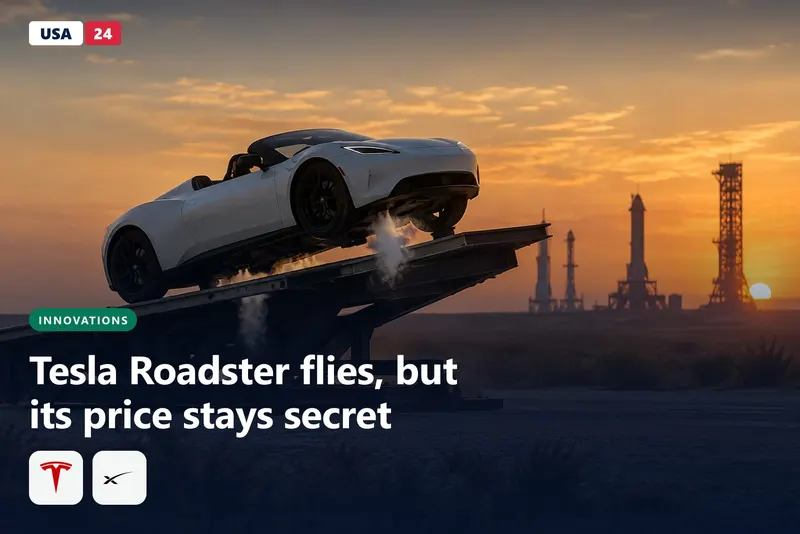
Tesla's second-generation Roadster finally had its production reveal on October 15, and the moment people keep repeating is a car leaving the ground. At SpaceX's rocket test site in McGregor, Texas, a Roadster drove up an inverted ramp, fired thrusters and jumped over five other Tesla vehicles, according to Fox News. The Tesla Roadster price is still unannounced, though, and four days later most of the car's basic facts remain provisional.
The event was a second attempt. Tesla had planned an outdoor reveal for October 1 but postponed it because of weather at the site, according to InsiderFinance. Musk said production would begin in 2028 and did not give a price, CNBC reported.
What Tesla showed at the McGregor event
The demonstration took place on a Texas test pad, with a Texas-built car running on thruster hardware developed with SpaceX. Musk summed up the stage message in one line: “Turns out the future does have flying cars.” Lars Moravy, Tesla’s vice president of vehicle engineering, went further: “Flying cars are real,” according to Fox Business.
The show was built for spectacle, not for a product walkthrough. Tesla has not published a final 2026 battery capacity, charging rate or homologated range, according to Smart Motoring. The demo proved that the thrusters can lift and move the car in a controlled run. Almost everything else about the production car is still a set of claims.
How the thrusters work and what the demo does not prove
The Roadster does not burn fuel for its airborne tricks. According to Bless This Stuff, two high-pressure carbon-composite air tanks feed ten thrusters. Four rear-facing nozzles add acceleration, and six downward-facing units handle the airborne maneuvers. The EV Report puts the compressed air supply at about 600 liters.
Tesla says the car reached 0 to 60 mph in about 0.81 seconds during the demonstration, as Aviation Week reported. Aviation World cited more than 80 kilonewtons of thrust from the rear units, also according to Tesla. Coverage of the event reported a top speed above 230 mph, based on Tesla's claims.
Those figures come from demo runs, and the sources do not agree on how the car was controlled. Aviation World described the demo car as flown autonomously with no one on board, while other outlets describe a remotely operated prototype. Until Tesla publishes a checkable spec sheet, read the 0 to 60 time and thrust numbers as company claims, not measured production specs.
The thruster run is a demonstration, not a production feature. It shows the hardware can work in a set-piece event. It does not show how a production Roadster would behave on a public road in ordinary traffic.
Tesla Roadster price, reservations and the 2028 production target
Tesla is collecting deposits without publishing a price. Reservations for the Performance trim cost $50,000, and the Thrust trim requires $250,000, according to GetTesla and The EV Report. The Rocket trim is invite-only, so most buyers cannot reserve it directly.
One report cited a New York Times figure of at least $200,000 for the final price, but the sources reviewed did not confirm it. Until Tesla posts an official number, treat any price as unknown.
The 2028 date is also a target rather than a schedule. Some coverage does not confirm it, so read it as the company's stated goal.
If you are considering a reservation
- Read the refund terms before you pay, and confirm whether the deposit is refundable and under what conditions.
- Remember that a deposit is not a purchase price, because Tesla has not said what the finished car will cost.
- Treat the 0 to 60 time, the 230 mph top speed and the 300-mile range as claims until Tesla publishes them on its own spec page.
- Do not assume a reservation secures a delivery date, since Tesla has missed every Roadster delivery target it has set.
Street legality and the FAA question
Whether the Roadster can drive on public roads is the first question most buyers will ask, and the answer is still open. Speaking on stage about whether the car is street legal, Musk said it is “not necessarily a safety-optimized car,” according to CNBC. That is not a yes, and it is not a clear no.
The flight raises a separate regulatory question. Aviation World framed thruster-assisted flight as an unresolved FAA puzzle, and the sources reviewed do not show that the agency has ruled on it. A car that leaves the ground does not fit neatly into the rules for road vehicles, and the sources do not say how regulators will sort it out.
Regulators are already watching Tesla's autonomy claims. The National Highway Traffic Safety Administration is reviewing claims that Tesla robotaxis speed through active school zones, as USA 24 reported. Any public-road approval for the Roadster would likely draw similar questions. Before you assume any road use, check your state's rules for registration and equipment.
A Roadster timeline that keeps slipping
Musk first previewed the next-generation Roadster in 2017 and targeted deliveries for 2020. CNBC reports that Tesla has since missed every targeted delivery date. Tesery counts the October 15 reveal as at least the fifth Roadster reveal date set this year.
The specs have moved too. Electrek compared Tesla's original promises with the figures quoted at the reveal:
| Spec | Original promise | Quoted at the reveal |
|---|---|---|
| Range | 620 miles | Over 300 miles |
| Top speed | Above 250 mph | Over 230 mph on the Rocket trim |
| Seating | Four, in a 2+2 layout | Two seats at most |
The seating change matters most to buyers. A two-seat car drops the family-car case that the original four-seat plan supported, which makes the Roadster look more like a niche performance product than a daily road car.
Tesla SpaceX merger talk and what to watch next
The reveal also revived speculation that Tesla and SpaceX could combine. CNBC cited valuations of about $2 trillion for SpaceX and about $1.4 trillion for Tesla. It also reported that Barclays analyst Dan Levy predicted a transaction could happen before the end of 2026, but neither company has announced one.
The engineering ties are real. CBC reported that Tesla and SpaceX worked together on the car, which fits a pattern of cross-company work. Shared engineering and a shared test site signal close ties, but they are not evidence of a deal.
Three things will show whether the Roadster moves from stage show to product: a Tesla price and spec page, an FAA position on thruster-assisted flight, and any update on the 2028 date. Each one would give buyers something to check. Until then, the reservation deposits carry most of the risk, and that risk sits with the people who pay them.