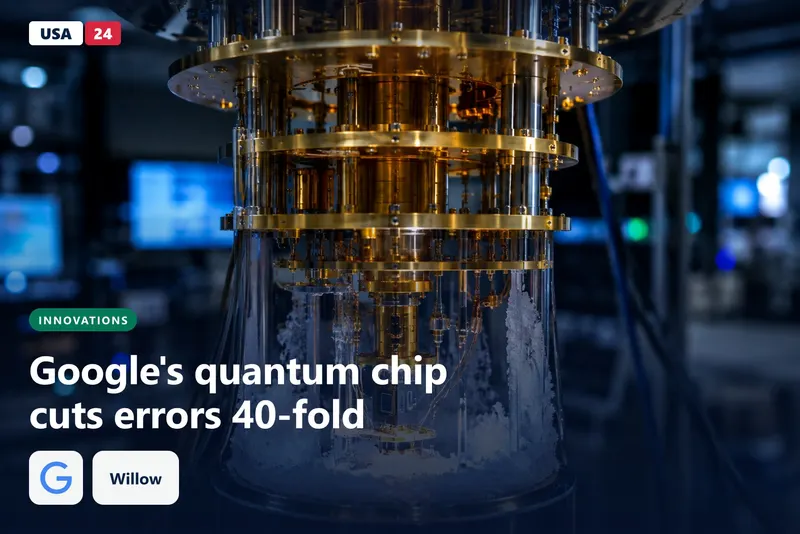
Google Quantum AI cut quantum errors about 40-fold on its Willow processor, according to a study published in Science on Thursday, October 15, as Quantum Computing Report described it. The paper reports the first physical hardware demonstration of a technique called magic state cultivation. It has also revived an old fear: that future quantum machines could crack Bitcoin and the encryption that guards much of the internet.
Google’s announcement, as quoted by Yahoo Tech, called the result “an extraordinary 40-fold reduction in errors relative to un-cultivated states.” The team reports logical fidelity for T-states of at least 99.99%, which the paper writes as 0.9999(1). Engineers care about numbers like this because error rates determine whether a quantum computer can run long calculations at all.
What Google’s magic state cultivation result showed
The experiment ran on Willow, a superconducting processor that Google debuted in December 2024. Willow has 105 qubits, and the cultivation experiment used at most 54 of them. The 99.99% figure describes logical operations built from those physical qubits, not the raw qubits themselves.
The study matters because it moves an idea from theory into hardware. Google’s researchers first proposed the approach in 2024. Until this experiment, it had been tested only in theory and simulation.
How the filter works and why 8% of attempts survive
Magic states are special quantum states that let a fault-tolerant machine perform operations its error correction cannot carry out on its own. They are also expensive to make. Some estimates cited by Google say producing them can consume up to 95% of a quantum computer’s capacity, as The Block reported.
Google describes its method as a filter rather than a factory. A rough magic state is placed in a small patch of the chip, a chain of checks runs on it, and flawed attempts are discarded while the surviving states are grown. ScienceAlert reported that only about 8% of attempts passed every check. The chip therefore throws away more than nine of every ten tries to keep one clean state.
That trade-off is the main engineering cost. Google’s team projects that halving Willow’s underlying hardware noise would push magic-state errors down to about two in 100,000. In other words, better hardware would make the filter far less wasteful.
Why the encryption debate restarted
Factoring an RSA-2048 key would require magic states with error near one in 10 billion. That is roughly a million times cleaner than the result Google reported. The gap is still large, but it has been narrowing. Gidney’s 2025 estimate put the number of noisy qubits needed to break RSA-2048 at under a million, down from 20 million in 2019, according to Yahoo Tech.
For now, the immediate picture has not changed. Reporting consistently says no current machine can break Bitcoin or standard encryption today. The experiment addresses one bottleneck, not the scale or sustained operation a codebreaking machine would need. Nic Carter, co-founder of Castle Island Ventures, said AI-assisted advances are speeding up quantum progress, though he does not see a threat as imminent.
Industry commentators read the result as confirming earlier threat estimates rather than pulling practical machines closer, according to TradersUnion. Crypto industry groups, including Coinbase, are speeding up post-quantum preparations. One report cites a Google target for a transition by 2029, and some analysts project “Q-day,” the point when quantum machines could break current encryption, as early as 2028.
Some claims circulating online need caution. One secondary article, from Pomegra, puts the amount of Bitcoin in quantum-exposed addresses at about 6.04 million BTC. That figure has not been independently confirmed. Social posts describing Q-day as suddenly closer are also unverified. An explainer from CellCog states that the result gives no timeline for a machine capable of breaking encryption.
Pentagon money and the wider quantum race
The result arrives during a busy week for government quantum policy. On October 8, the Pentagon announced a package of about $350 million. It includes roughly $200 million in new DARPA funding and a conditional loan of up to $150 million for PsiQuantum, according to PostQuantum.com.
The package connects to DARPA’s Quantum Benchmarking Initiative. On October 7, Atom Computing, Diraq, IBM and IonQ moved to Stage C of that program. Readers following the broader chip race can compare this with IBM’s early design kits for a 0.7nm nanostack chip architecture.
IonQ announced a different kind of advance on October 9. It reported an entanglement rate above 1,000 per second between a trapped-ion qubit and solid-state memory, according to IonQ. That is a networking milestone, not a computing one, so it does not compare directly with Google’s error reduction. Export policy is also moving. China has proposed export curbs on 40 AI, chip and solar technologies, as USA 24 reported.
What to do now if you hold crypto or run IT systems
For most people, this announcement does not require action this week. No action is needed for ordinary consumer devices based on this announcement alone. The following steps are general guidance, not findings from the research:
- Crypto holders should ask their wallet provider, exchange or custodian whether it has a published post-quantum migration plan, and what that plan would require of them.
- IT managers should inventory where RSA and elliptic-curve keys protect data that must stay confidential for many years, since long-lived data is the first priority in post-quantum planning.
- Teams should follow standards updates and vendor advisories rather than social media posts about Q-day.
What to watch next as cultivation scales
Google says the next step is running cultivation at a larger scale. The paper notes that the larger error-correcting code introduced additional errors, so whether the method holds up as it grows is the central open question. Until larger runs are reported, the result stays a lab demonstration on a single chip family.
Independent replication has not been reported in the sources reviewed. Watch for outside groups to reproduce the 40-fold figure on other hardware, and for Google to publish the results of larger runs. The sources also give no date for a machine capable of breaking encryption, so any timeline remains an estimate rather than a forecast.
The signal to watch is whether a larger Willow run keeps most of the error reduction while using more of the chip. If it does, the 8% retention rate becomes the next problem to solve.