A draft set of China export controls would restrict or ban 40 technologies, reaching AI chip design work, solar factories and biomedical research that American companies rely on. The Ministry of Commerce and the Ministry of Science and Technology published the package on Friday, October 16, 2026, as a draft revision to China's catalog of technologies prohibited or restricted from export, according to Global Times. It is the broadest list yet. USA 24 has already reported on China's proposed controls on AI model weights and source code, but this draft widens the frame to chips, solar manufacturing and biomedicine.
AP's coverage, published under the headline China moves to curb tech exports, including AI, citing national security risks, places the move alongside national security concerns and competition with countries including the United States. In a written statement quoted by Fortune, the commerce ministry called the measures "necessary" and said the government is taking steps to ensure that AI "remains under human control." The statement came from an unnamed spokesperson, not an on-record interview.
How China export controls affect AI chip design
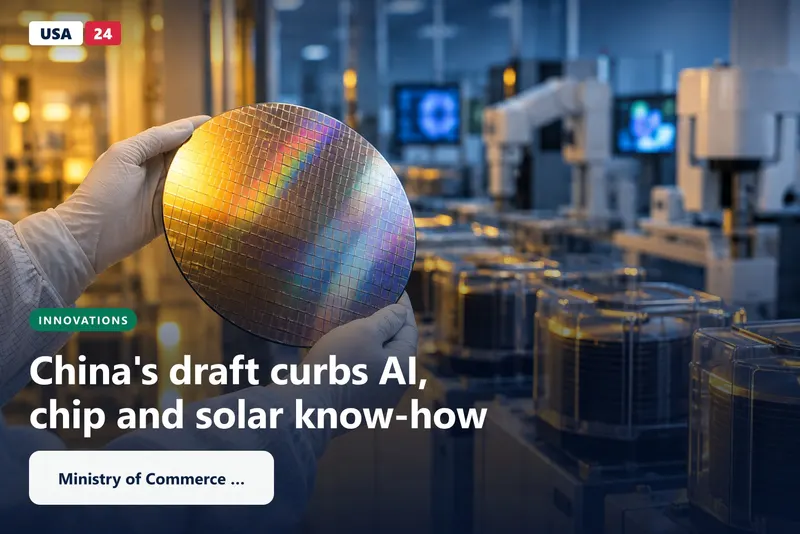
The chip provisions target design know-how, not finished processors. Global Times reports that design technology for certain 2.5D and 3D AI chips and for 3D flash memory would be restricted. Fortune adds that several chip design technologies for some AI processing and memory chips are included. That distinction matters, because the blueprints, layout methods and process knowledge behind a chip can be as valuable to a partner as the chip itself.
For US chipmakers and equipment suppliers, the concern is collaboration. A restriction on design know-how could slow joint development, licensing deals or technical exchanges with Chinese partners, even when the finished product remains legal to sell. USA 24 recently covered IBM's early design kits for its 0.7nm nanostack chip architecture, a reminder of how much value now sits in design work.
On AI, the draft would bar exports of core technology for large models trained on nationally sensitive data. It would also bar agents that serve key national infrastructure, defense and core government functions. Fortune reports that AI models with parameter counts of 2 trillion or more, or with certain world-leading capabilities, could be restricted, though the proposal did not name specific models.
Those thresholds leave room for interpretation. The reporting I reviewed offers no clear definition of "world-leading capabilities," and the draft does not spell out what counts as "core" technology. Those definitions will determine how far the rule reaches.
The debate also raises the question of domestic capacity. USA 24 has reported on GlobalFoundries' plan to build two Malta chip fabs with $21 billion from Japan, a sign that US supply is being expanded inside the country.
Solar manufacturing and the perovskite question
The solar list covers manufacturing technique and core equipment for polysilicon, silicon wafers and photovoltaic cells, according to Global Times. It also places perovskite solar cell technology on the prohibited list. Perovskites are a newer cell chemistry than silicon, so their inclusion suggests Beijing wants to protect technology beyond the panels in use today.
For US solar developers and installers, the near-term effect depends on what they buy. The draft does not ban sales of Chinese solar panels abroad, according to Tech Insider. Developers that buy finished modules may see no direct change. The longer-term risk runs through the supply and pricing of components, if restrictions slow the transfer of polysilicon, wafer and cell know-how.
Biomedicine and the open-source exemption
The draft lists five biomedicine items, including cell and gene therapy, per Tech Insider. For US biotech firms with China-linked research, the exposure is more likely to come from sharing manufacturing methods, licensing and joint research than from selling a finished therapy.
The open-source carve-out matters most to AI developers. Global Times reports that open-source and publicly published material is excluded from the scope of control. Tech Insider reporting goes further, saying published, openly licensed models appear to fall outside the regime. Developers who release models should confirm that wording in the final text, since an exemption is only as clear as the definitions around it.
Which tier applies: prohibition or license
The draft splits the 40 items into two tiers: 14 proposed outright prohibitions and 26 that would require an export license. By sector, 23 items concern AI, 12 concern solar and photovoltaic manufacturing and 5 concern biomedicine. The reporting I reviewed does not say which specific items fall into each tier, so do not treat any individual item as banned until you see the official text.
The draft is aimed at technology transfer, not finished goods. Under its terms, covered know-how, designs or manufacturing techniques would need government approval before moving abroad through licensing, joint ventures, overseas plants or sales. That approval step is what would turn a list of technologies into a practical constraint on partnerships.
Is the list already in force?
Reports disagree on timing. Tech Insider has published a piece saying a registration requirement takes effect today, before public comment ends, with interim rules running through November 15. Other coverage, including the Global Times report, describes a draft that is not yet law. We could not confirm the effective date against an official Ministry of Commerce text, so treat any date as unsettled until the ministry publishes final wording.
Because the draft is open for comment, the list may change. Enforcement is also unclear: how the license process works, who reviews applications and what counts as core technology.
Washington's response is not yet clear, and no US official reaction appears in the sources reviewed. The structure of the draft is familiar, though. Tech Insider commentators note that it mirrors US restrictions, including entity lists and chip-equipment rules. The Biden administration tightened its own rules in 2023, and Commerce Secretary Gina Raimondo said the goal was to limit China's access to advanced semiconductors that could fuel AI breakthroughs, according to Axios.
What US companies should do now
- Read the official draft from the Ministry of Commerce and compare the 14 prohibited items and 26 license items against your products and research list.
- Map any China-linked R&D, licensing deals, joint ventures or overseas plants, since those are where the approval rules would apply.
- Ask outside counsel to review exposure, especially for AI design work, 3D memory, polysilicon and cell know-how, and cell or gene therapy programs.
- Procurement teams should identify components whose supply depends on Chinese polysilicon, wafer or cell manufacturing.
- Investors should watch the comment period and any formal effective date before reassessing exposure.
Ordinary consumers see no immediate change, based on the reporting.
What to watch next
The next checkpoints are the close of the public comment period, the final text and any formal effective date. Watch whether Beijing defines "world-leading capabilities" or names specific models, and whether Washington responds with its own steps. For US firms, the bigger question is how the license process works once the draft hardens into rules, because that will decide whether the list stays on paper or reshapes partnerships.