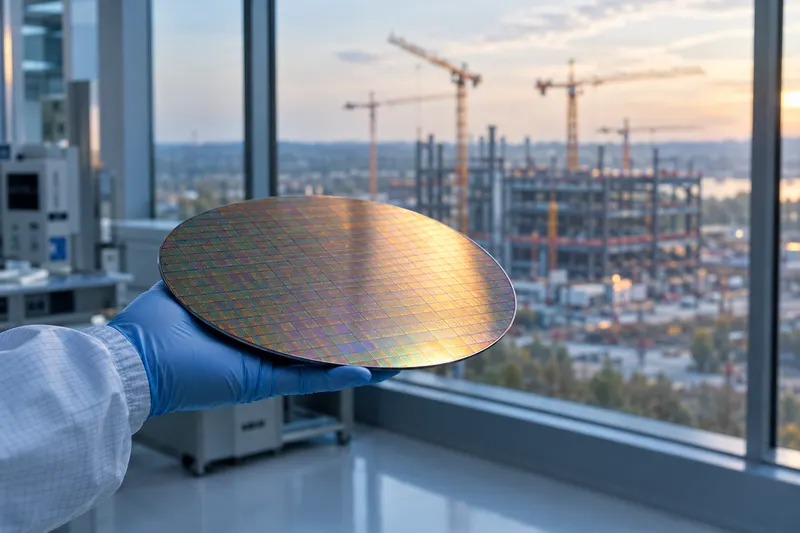
Japan will pay to build two new chip fabs in Malta, New York, and GlobalFoundries will run them. The GlobalFoundries Malta fab plan could total up to $21 billion, and the company announced it Wednesday, October 14, under a U.S.-Japan trade and investment deal that the White House promoted the same day. It is the first semiconductor investment under the bilateral Strategic Investment Initiative, according to the Semiconductor Industry Association as reported by Converge Digest.
The short version is this: a trade pledge is turning into physical chip capacity on U.S. soil. GlobalFoundries (Nasdaq: GFS) was selected as technology provider and operator for the two fabs, which sit at its Malta, New York site. The deal also gives the U.S. government an equity stake in a chipmaker, and it arrives while chip stocks sell off this week.
What the GlobalFoundries Malta fab will build
In a press release filed on Form 6-K, GlobalFoundries said it was selected to operate two new semiconductor fabs in New York under a U.S.-Japan initiative providing up to $21 billion in funding. The initiative rests on President Trump’s trade and investment agreement with Japan. Its stated aim is to speed trusted chip manufacturing in the United States and to support automotive, industrial and connected-infrastructure demand.
The division of labor is straightforward. Japan provides the capital, while GlobalFoundries contributes technology, manufacturing expertise and operations.
The first investment is about $10 billion to fund a 300mm fab that the company expects to bring online in 2029. A second investment of about $10 billion would fund a second fab. Separately, GlobalFoundries and the Commerce Department agreed to shift $955 million from the company’s existing CHIPS and Science Act award toward silicon photonics, silicon-germanium and advanced packaging at Malta and at Burlington, Vermont, according to Converge Digest.
Who owns the Malta fabs and who collects the returns
The reports do not agree on who owns what. Converge Digest says the United States and Japan will jointly own the facilities, with Japan financing construction. AP and Quartz describe the U.S. stake as an equity position in GlobalFoundries itself. Under a separate agreement, the Commerce Department will receive roughly 4% equity in the company, according to Quartz.
Returns follow a different formula. According to Reuters, as reported by Quartz, returns on the investments will be divided equally between Washington and Tokyo up to a defined ceiling. After that point, the U.S. share rises to 90%. The reports reviewed do not state what that ceiling is.
Trump has been direct about the money. In a Truth Social post, he wrote, “Under my direction, JAPAN WILL PROVIDE THE CAPITAL.” AP reports that he also said the government will receive shares in GlobalFoundries, just as it did for Intel Corp. That extends the administration’s practice of taking ownership stakes in private companies.
The structure is unusual. A foreign government pays for construction, a U.S. company runs the plant, and the U.S. government takes equity. For taxpayers, that means a roughly 4% stake and a share of whatever returns the investments produce.
How Japan’s $550 billion pledge pays for the fabs
Bloomberg reports that the initiative is enabled by a trade and investment agreement in which Japan pledged to invest $550 billion in the United States, in exchange for lower U.S. tariffs on Japanese imports. The Malta project is the first semiconductor investment under the Strategic Investment Initiative, so it will be an early test of how that mechanism works in practice.
The tariff link matters. Japan’s money comes in return for trade concessions, which ties the chip project to the health of that trade arrangement. Any change to the tariff terms could reshape how the funding flows.
The money is also “up to” $21 billion. The company has not published a final definitive agreement or a disbursement schedule in the sources reviewed. Until those documents appear, readers should treat $21 billion as a ceiling rather than a payment plan.
Jobs, wafer capacity and the 2029 timeline
Reports cite about 27,000 construction and supply-chain jobs, plus more than 1,000 skilled manufacturing jobs. One outlet reported 28,000 construction-related jobs, but the other reports use 27,000.
| Item | First fab | Second fab |
|---|---|---|
| Investment | About $10 billion | About $10 billion |
| Annual capacity | About 900,000 300mm wafers | Projected to add about the same |
| Timing | Break ground later in 2026, open in 2029 | Not specified in company release |
The capacity figures are the detail industry buyers will care about most. CBS6 Albany reports that the first fab is expected to add about 900,000 300mm wafers of annual U.S. manufacturing capacity, and the second is projected to add about the same.
Manufacturing Dive reports that GlobalFoundries expects to break ground on the first 300mm fab later this year. Opening in 2029 leaves roughly three years of construction.
The second fab’s schedule is less clear. The Times Union reports that construction could begin before year-end. The company’s own release says only “about $10 billion” for that fab.
Whether these plants change U.S. chip supply depends on what they produce after 2029. The sources do not answer that question yet.
Who will buy the chips and how the market is reacting
Reuters reports that GlobalFoundries will earn construction, operating and licensing fees, and will initially serve customers including Renesas Electronics and Apple, according to Converge Digest. The company’s release does not name those customers, so treat them as reported rather than confirmed. Yomiuri Shimbun, as summarized by Seoul Economic Daily, cites Renesas and Japanese automakers as potential users of logic chips for automotive and telecom applications.
For New York’s Capital Region, the near-term payoff is employment. Construction crews, skilled manufacturing workers and local suppliers would see demand well before the fab opens.
The timing is awkward. CNN reports that the global chipmaker sell-off deepened as enthusiasm for AI stocks wobbled. The Kospi, heavily weighted toward Samsung and SK Hynix, closed at a six-month low, erasing all of its gains since April. Chinese chipmaker CXMT announced progress on advanced memory chips, which added to market jitters.
The longer backdrop still points up. The Semiconductor Industry Association reports global semiconductor sales of $159.7 billion in August 2026, up 8% from July. A fab that opens in 2029 is a bet that demand holds up through the next cycle, and this week’s selloff shows how quickly sentiment can turn.
Political framing and what to watch next
Commerce Secretary Howard Lutnick called the deal “another massive manufacturing investment into America,” and GlobalFoundries CEO Tim Breen described it as “a bold new initiative for semiconductor manufacturing,” according to OANN.
The political framing is contested. Trump’s posts emphasize job numbers. Seoul Economic Daily notes that his approval rating hit a record low even in Fox News polling, and that he is promoting investment figures ahead of formal commitments. BigGo Finance, a secondary source, says Trump has presented similar moves involving Taiwan and South Korea as converting Asian investment pledges into fabs, with roughly 20 days left before the U.S. midterm elections.
No consumer action is needed. For professionals in automotive, industrial or telecom supply chains, these are the signals to track:
- A definitive agreement and disbursement schedule, which would turn “up to $21 billion” into firm numbers.
- Clarity on ownership, since reports conflict on whether the U.S. stake sits in the fabs, in GlobalFoundries or both.
- The groundbreaking on the first 300mm fab, which the company expects later this year.
- Confirmation from Renesas and Apple, which appear so far only in press reports.
- Formal terms for the Commerce equity stake and the 90% return threshold.
The next concrete signal is the Malta groundbreaking. If it happens on schedule this year, the 2029 opening gets a firm date and the second fab gets a clearer path. If the definitive agreement stalls or the funding terms change, the project becomes a test of how durable trade-linked investment really is.