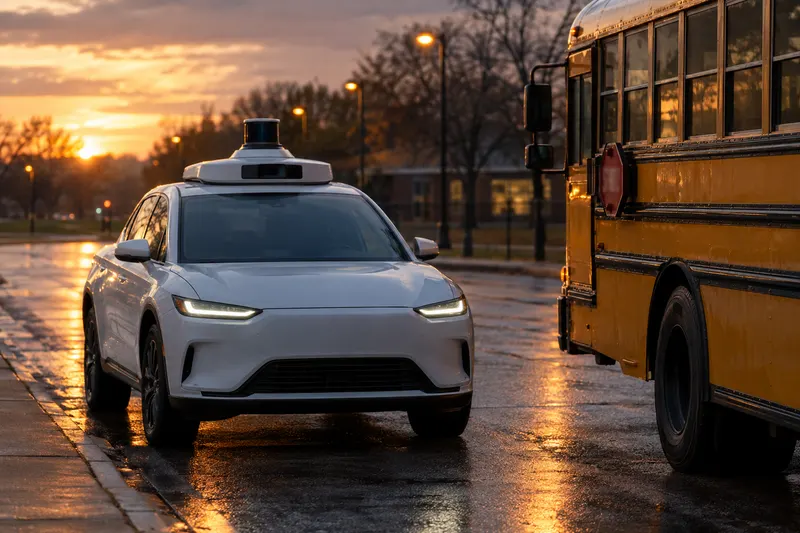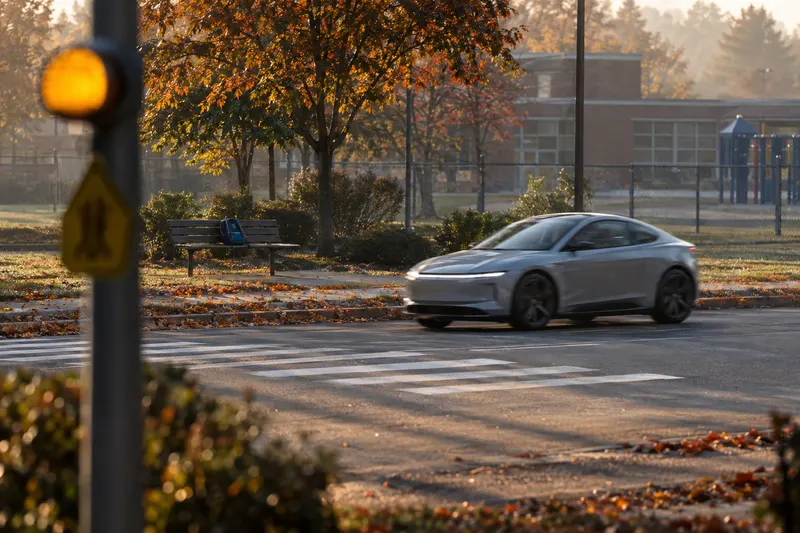
A petition that reached federal regulators on Sept. 23 makes a claim no robotaxi operator wants attached to its name: that its driverless cars speed past schools while the reduced limits are in force.
The National Highway Traffic Safety Administration is now looking into it. On Friday, Oct. 9, the agency's Office of Defects Investigation (ODI) opened a defect petition review, case number DP26010, into whether Tesla's automated driving system "exceeds posted speed limits in active school zones," as the petition alleges. The review covers model-year 2026 Tesla Robotaxis, both the Model Y and the new Cybercab, when the automated driving system is engaged, according to NHTSA's summary as reported by TeslaNorth. The documents went up on NHTSA's website on Monday, Oct. 12.
The Tesla robotaxi school zone question arrives at an awkward moment for the company. Tesla began offering public Cybercab rides in Austin on Sept. 3, says it runs more than 300 Cybercabs there alongside Model Y robotaxis, and has named Dallas as its next Cybercab market. The school year is in full swing in both cities, and this is now the second open federal review touching Tesla's driverless program.
What NHTSA's Tesla robotaxi school zone review covers
NHTSA estimates that about 1,000 vehicles fall under DP26010. The agency's summary lists four incidents: one complaint filed directly with ODI and three social media reports included in the petition. The petitioner, who is not named in the public documents, submitted three video links as evidence, Gizmodo reported.
No crashes, injuries or deaths are recorded in connection with the allegations.
The robotaxis keep running while the agency reviews the material, Not a Tesla App noted. Nothing about the review requires Tesla to pull cars off the road or change how they drive.
Two basic facts remain unclear from public coverage. The first is where the videos were filmed; reports do not say whether the clips come from Austin. The second is the fleet count. NHTSA's estimate of about 1,000 vehicles appears to span both models, while Tesla's own figure is more than 300 Cybercabs in Austin plus an unspecified number of Model Y robotaxis. Neither the agency nor the company has publicly broken down how the 1,000 figure divides between models or cities.
What the Tesla robotaxi petition alleges, and what it doesn't
The allegation is narrow. The petition does not claim Tesla's robotaxis speed in general, and it does not describe a near miss with a child. It claims the cars travel above the posted limit specifically when a school zone is active.
That word, active, is where the engineering question lives. Many US school zones lower the limit only during set hours or when yellow beacons flash, and the rules vary from city to city. A driverless system has to know a zone exists, know when the reduced limit applies, and slow down in time. A failure at any of those points could produce the behavior the petition describes.
Which of those, if any, is happening is unknown. Public reporting does not say whether Tesla's system relies on mapped school-zone data, reads signs and beacons with its cameras, or handles time-based limits at all. The answer matters for the fix: a gap in map data is a different problem from a perception system that misses a flashing light.
Tesla had not commented on the petition in any of the coverage reviewed for this story. USA 24 has asked the company for a statement.
How NHTSA's defect process works, from petition to recall
DP26010 sits at the very first rung of NHTSA's defect process. The agency's path generally runs through three stages:
- Defect petition review (DP): ODI examines the petition and evidence to decide whether to open a formal investigation. This is where the Tesla case is now.
- Preliminary Evaluation (PE): a formal investigation in which NHTSA typically requests data from the manufacturer.
- Engineering Analysis (EA): a deeper technical review that can precede a recall request.
A recall can come out of any of those stages, and manufacturers sometimes issue voluntary recalls before NHTSA finishes. For now, the agency has not decided whether a safety defect exists, and the review is not a recall.
On timing, one report puts NHTSA's decision on whether to open a formal investigation at around Jan. 21, 2027. That date has not been confirmed in NHTSA's public summary or other coverage, so treat it as a rough marker.
If the case did lead to a recall, the remedy would most likely be a software update rather than a hardware fix, since the alleged problem concerns how the driving system chooses its speed.
A second federal review of Tesla's Cybercab
The school-zone petition stacks on top of an investigation NHTSA already has open into the Cybercab itself. That probe examines the process and technical data Tesla used to self-certify that the Cybercab meets federal motor vehicle safety standards, Bloomberg reported in a story syndicated by Insurance Journal. The Cybercab is a two-seater built without a steering wheel or foot pedals, which makes many traditional safety standards awkward to apply.
The two reviews ask different questions. One concerns paperwork and design compliance, the other how the cars actually behave on public streets. Together they put Tesla's driverless program under closer federal scrutiny than at any point since public rides began.
Bloomberg describes Tesla's robotaxi service as "slow-growing." That matters beyond Austin, because the robotaxi and Cybercab story sits at the center of how many investors value Tesla. Any finding that slows expansion or forces changes to the driving software adds regulatory risk to that story.
Other companies have taken a different route. In July, NHTSA granted Zoox a safety-standards exemption allowing it to deploy up to 2,500 robotaxis a year for two years, according to Gizmodo. Tesla instead self-certified the Cybercab, the choice now under federal review.
Waymo's school-bus problems show how these cases can escalate
Tesla is not the first robotaxi company to face questions about behavior around children. Waymo, the largest US robotaxi operator, spent much of this year dealing with them.
NHTSA opened an investigation into Waymo vehicles that failed to fully slow or stop for school buses. Waymo issued a software recall covering more than 3,000 vehicles, but incidents reportedly continued. The Austin school district asked Waymo to suspend service during school pickup and drop-off times. In January 2026, the National Transportation Safety Board, which had never investigated Waymo before, opened its own probe into the school-bus behavior, TechCrunch reported.
That same month, NHTSA opened another investigation after a Waymo vehicle struck a child near an elementary school in Santa Monica, California, during drop-off, Al Jazeera reported. The child suffered minor injuries.
The Waymo cases offer a rough template. A software recall did not end the scrutiny, local school officials stepped in with their own demands, and a second federal agency joined. The Tesla petition involves no reported injuries and only four incidents, but the agencies have shown they treat driverless behavior near schools as a priority.
How to report a driverless car speeding near a school
The Tesla petition was built largely on video, and NHTSA accepts public reports. If you live, drive or walk near a school where robotaxis operate, these steps help:
- File a report at nhtsa.gov/report-a-safety-problem. Include the date, time, street location and whether the school-zone beacons were flashing or the reduced-limit hours were in effect.
- Record video safely, from the sidewalk or as a passenger, never while driving. Capture the sign or beacon and the vehicle in the same frame if you can.
- Follow the case by searching DP26010 on NHTSA's website. Any decision to open a Preliminary Evaluation will appear there.
- Check recalls if you ride in Tesla robotaxis. NHTSA's recall lookup at nhtsa.gov/recalls will list any campaign that results.
- Tell your school district. In Austin, the district's pressure on Waymo shows that local officials can push operators to change service around school hours.
What to watch as Tesla heads to Dallas
The next concrete signal is NHTSA's decision on whether to grant the petition and open a Preliminary Evaluation, which would force Tesla to hand over data on how its cars handle school zones. Watch, too, whether Tesla responds publicly or pushes a software change on its own before regulators decide, and whether Austin or Dallas school officials raise the issue as the Cybercab expands. Tesla wants Dallas to be the next proof point for a car with no steering wheel. Regulators now want to know how that car behaves when the beacons outside a school start flashing.