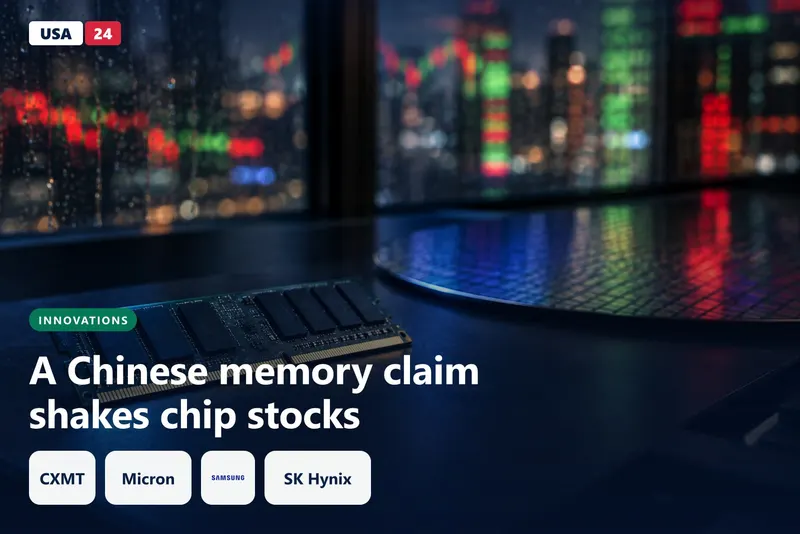
China’s CXMT says it will ship a server memory module built on a 4F2 cell design before the end of 2026. Investors did not wait for the hardware. Micron fell on the New York Stock Exchange on Monday, October 12, and Samsung and SK Hynix shares dropped sharply on October 13 as traders questioned whether US and South Korean chipmakers would keep their dominant share and pricing power.
The claim is still unproven, but the market reaction is real. Below is what CXMT said, what the numbers do and do not show, and what Washington is weighing.
What CXMT announced in Shanghai
CXMT president Cao Kanyu spoke at the 4th Integrated Circuits and Chiplet Conference in Shanghai on October 10. According to JoongAng Daily, which cited the South China Morning Post, he said the company had made “key progress” on server memory using 4F2 technology. CXMT plans to unveil next-generation DDR5 RDIMM server modules built on the design by the end of this year.
CXMT says the approach uses a Vertical Surrounding Gate transistor and that the company holds more than 300 related patents, according to BigGo Finance.
The claim has clear gaps. CXMT has not disclosed speeds, capacities or yields for the 4F2 product. Gulf News reported that the claim “remains unsubstantiated,” because CXMT has given no further details.
Why the 4F2 cell design matters for server memory
Most of the industry uses a 6F2 cell layout. A 4F2 layout shrinks each memory cell’s footprint by about a third. BigGo Finance reported that the change could raise density by roughly 30% to 50% on the same chip area.
Denser memory means more capacity from the same silicon, which is exactly what server builders and cloud operators want during a shortage. But this is a claim about a design, not a measured product. Density gains on paper can shrink once a chip has to hit target speeds, run at volume and yield well.
The timing gap is the sharper question. Startup Fortune reported that Samsung targets 4F2 production in 2028, roughly two years after CXMT’s stated 2026 timeline. An August 2026 TechInsights estimate, cited by Economy.ac, put CXMT’s DDR5 roughly three years behind the leading suppliers. The two estimates disagree on the size of the gap, and neither has been tested by a product on a shelf.
Analysts are also skeptical about near-term effects. Invezz reported that Mizuho sees no change for memory stocks in the near term, and that CXMT has yet to prove it can deliver competitive yields and pricing.
Why investors took the claim seriously
CXMT is already a major force at home. It is China’s largest DRAM maker, and its July 2026 Shanghai listing reportedly sent its shares up 466% on debut, according to Startup Fortune. Economy.ac reported that its first-quarter 2026 revenue reached 50.8 billion yuan, a rise of more than 700% from a year earlier.
Those numbers help explain why traders reacted before any product appeared. A company that is growing that fast, and that now says it can match a more advanced cell design, changes the forecast for the companies it competes with.
How much the selloff has cost memory stocks
Reports disagree on how far Korean shares fell on October 13. One set of figures has Samsung down 13.39% and SK Hynix down 12.83%. Another puts Samsung down 7.4% and SK Hynix down 10%. The reports do not say whether those are intraday or closing figures, so treat them as a range.
Micron fell about 3.88% on the New York Stock Exchange on Monday, and the Philadelphia Semiconductor Index dropped 2.67%, according to JoongAng Daily. Goldman Sachs took a wider view, measuring declines from October 1 through October 15:
| Company | Change, Oct 1 to 15 (Goldman Sachs figures) |
|---|---|
| SK Hynix | about -25% |
| Kioxia | about -26% |
| Samsung | about -20% |
| CXMT | about -15% |
| Micron | about -11% |
| SanDisk | about -11% |
Goldman argues the market reaction may be excessive. Its figures put the combined market value of six memory makers down roughly $738 billion.
One aggregator reports that the Philadelphia Semiconductor Index fell more than 11% in the week, its worst weekly move since April 2025. That figure rests on a single secondary finance source, so check it against exchange data before repeating it. The broader tech market also slid, with CNN reporting that the Nasdaq sank more than 2% on October 16 as investors questioned AI debt. That move is separate from the memory story.
Why Washington is paying attention
The Pentagon lists CXMT as a Chinese Military Company under Section 1260H, according to The Register. YMTC, the NAND maker, is already on the Commerce Department’s Entity List. CXMT, as reported, is not.
In July, House lawmakers Moolenaar and Whitesides asked Commerce to add CXMT to the Entity List and to bar US buyers from Chinese memory chips, per Tom’s Hardware. Reports date the letter to July 14 or July 16. No Commerce decision has been reported.
The current rules leave a gap. Export controls restrict US-origin chipmaking tools sold to CXMT, but reporting from Korea Invest Insights says those controls do not automatically bar US companies from buying finished CXMT chips. Closing that gap is what the lawmakers are asking for.
Beijing frames announcements like this one as workarounds to US pressure. NBC News reported a similar pattern in May 2026, when Huawei touted a chip-design breakthrough as a way to defy US sanctions. Beijing is also tightening its own rules. USA 24 recently reported on China’s proposed export curbs on 40 AI, chip and solar technologies.
Which US buyers face the most risk
PC makers, server builders, cloud providers and device brands all buy DRAM in volume. Tom’s Hardware reported that Apple has sought US approval to source memory from CXMT, amid a severe DRAM shortage driven by AI infrastructure demand.
The policy dilemma is sharp. Bloomingbit’s report on the lawmakers’ push cites analysts who say a ban on Chinese memory purchases would reduce supply during a crunch and could raise prices. Cheaper Chinese DRAM could ease costs, but blocking it could tighten an already stretched market.
US investors face exposure too. Retirement funds and index funds that hold Micron, SanDisk or semiconductor benchmarks have already felt the moves, even if they own no CXMT shares.
Building domestic capacity takes years. That is why buyers are watching projects such as the plan for two chip fabs in Malta, backed by $21 billion from Japan, as a sign of where supply may come from later.
What to check before you act
For business buyers, the most useful step is to ask memory suppliers directly where their DRAM is made and how they plan to source it. Country of origin clauses and sourcing plans are worth raising in contract renewals.
For investors, treat CXMT’s single-company claim as unverified until product data appears. Confirm any aggregator figures against exchange data before acting on them.
The items to watch are concrete:
- Whether CXMT publishes speeds, capacities and yields for its 4F2 product.
- Whether the DDR5 RDIMM modules actually ship by the end of 2026.
- Whether Samsung or SK Hynix pull their own 4F2 timelines forward from 2028.
- Whether Commerce acts on the lawmakers’ requests to add CXMT to the Entity List.
The next real test comes in the final weeks of 2026. If CXMT ships a module with published specifications, the debate moves from announcements to yields and pricing, and that will show whether the selloff was a warning or an overreaction.