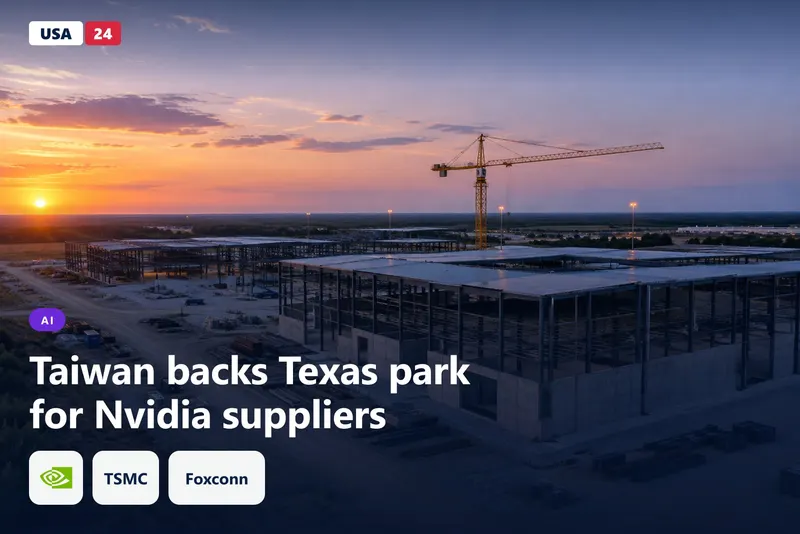
Taiwan plans to fund a Texas industrial park that could cost up to $4 billion, and the park is meant to house suppliers of Nvidia's AI hardware. The plan, outlined by Economic Affairs Minister Kung Ming-hsin, became public in a Bloomberg report published October 16. It is the first site-level detail Taipei has given on its plan to build an AI hardware supply chain in the United States.
The numbers still carry caveats. Taiwan's government has not confirmed the site, and reporting on timelines and funding is thin. Bloomberg's full article is paywalled, so the details here come from its headline and opening paragraphs as carried by syndicators and secondary outlets. Even so, the plan matters to American chip buyers, to Texas economic development and to the broader push to move AI server production onshore.
What Taiwan says it will fund
Kung's plan backs several industrial parks in the United States, each meant to serve as a base for an AI hardware supply chain with Nvidia as the anchor customer. In his October 12 interview with Bloomberg, Kung put the cost of each complex at $2 billion to $4 billion to build. The Texas complex comes first, and the government says it is planning “more than one” US site.
A statement from Kung, as reported by RSWebSols, opens with the line “We aim to forge a long-term, sustainable supply chain in the United States...” That page is a republisher, not the original, and the full sentence has not been checked against Bloomberg. Treat the wording as provisional.
The parks target a specific tier of the industry. They are aimed at smaller suppliers that feed TSMC and at AI server assemblers such as Foxconn. The largest companies are better placed to fund US expansion on their own. Many smaller component makers are not, and that gap is the problem Taipei says the parks are designed to solve.
Why Nvidia's suppliers matter to the US build-out
Nvidia's reliance on Taiwanese manufacturing is not new, but this plan turns that reliance into a construction project. Nvidia CEO Jensen Huang named dozens of Taiwanese component makers during a keynote in Taipei earlier this year. Those suppliers are part of the reason the parks matter to the US AI build-out.
US AI infrastructure buyers, including Nvidia, Microsoft and Meta, depend on these suppliers. One account argues that onshore production could reduce exposure to Asia-based supply disruptions over time. The phrase “over time” is doing real work. A park still in planning adds no output, and the reports do not give a date for when the Texas complex would begin production.
Texas would gain too. A $4 billion complex would bring manufacturing jobs and construction spending to the state and add to its AI hardware footprint. One report also says Wistron opened a $700 million plant in Texas in July 2026 that produces Nvidia AI systems. That figure comes from a single secondary source and has not been checked against a primary one, so treat it as unverified.
How the money would move
The Taiwan Electrical and Electronic Manufacturers' Association, known as TEEMA, would lead fundraising. The government plans loan guarantees and help with US visas, land and permits. The reports do not say how much of the funding would come from private fundraising versus government guarantees, or whether the TEEMA-led raise will reach $4 billion.
Bloomberg, citing people familiar with the matter, reported that Taiwan has already secured land for a Texas park. The ministry has not confirmed that and said it would provide details later. For now, the land purchase and the site location are reported facts, not official ones.
That distinction matters for anyone planning around the project. Suppliers, landowners and local officials all need a confirmed address and a clear picture of who is financing the build. Neither has been published by the government.
What the $250 billion trade-deal pledge covers
The plan is tied to the trade agreement between Taiwan and the Trump administration. That deal includes Taiwan's pledge to help back up to $250 billion in credit guarantees for US semiconductor investment. The pledge is a ceiling, not a commitment to spend $250 billion. The reports do not say whether the Texas project would draw on those guarantees. If it did, a $4 billion complex would account for about 1.6 percent of the total.
Export controls are the other half of the picture. Taiwan has aligned its AI chip export rules with US restrictions, and under its Foreign Trade Act it prohibits shipments of restricted AI hardware to China, according to GuruFocus. For buyers, that means a supply chain built with Taiwanese partners on US soil would operate inside a control regime that already restricts China-bound AI hardware. The parks do not change those rules, but they tie the two countries' AI hardware rulebooks more closely together.
What is confirmed and what is still reported
Readers should sort the claims into three buckets: what officials have stated, what is reported through people familiar with the matter, and what remains unverified. The table below separates them.
| Claim | Status |
|---|---|
| Texas complex of up to $4 billion | Reported by Bloomberg; ministry has not confirmed |
| $2 billion to $4 billion per complex | Attributed to Kung's October 12 interview |
| Taiwan has secured Texas land | Reported, citing people familiar; not confirmed |
| Up to $250 billion in credit guarantees | Part of the US-Taiwan trade deal, per reports |
| Wistron $700 million Texas plant | Single secondary source; unverified |
| Taiwan stock slipped on news day | Reported; coverage does not link it to the plan |
What US buyers and investors should do now
Consumers have no action to take. The parks concern AI server and component supply chains, and they will not change which devices sit on store shelves in the near term.
Business buyers and investors have a short list of things to track:
- The detailed plan from Taiwan's economy ministry, which has promised more details.
- Site confirmation for the Texas land, which would be the first hard signal.
- Named tenants. The value of a park depends on which suppliers sign on.
- TEEMA's fundraising size and structure, including how much comes from loan guarantees.
- The full Bloomberg article, if you have access. Secondary summaries cover only the opening paragraphs.
Investors should be careful about reading too much into market moves. Taiwan's stock market reportedly slipped on the day the news broke, but the coverage does not link the two events. For context on the wider sell-off in AI shares, see our report on why AI stocks are falling after a $1 trillion four-day selloff.
What to watch next
The first test is whether Taipei confirms the Texas site. Land that has been secured but not announced leaves room for changes in location or scope, and the ministry has said it will provide details later.
The second is access. Kung said the goal is not to be exclusively Taiwanese, but the terms for American firms are not yet public. If US suppliers and buyers can use the parks on fair terms, the project becomes a US manufacturing story. If they cannot, it is mostly a Taiwanese capacity project sited in America.
The third is financing. Large chip-related projects increasingly rely on debt. Anthropic recently offered Blackstone a double-digit yield on $9 billion in chip debt, as we reported here. Taiwan's model differs because it leans on a fundraising association and government guarantees rather than a single investor, but the core question is the same: who carries the risk if demand shifts.
The next confirmed site announcement will show whether Kung's “more than one” becomes a list of named locations, and whether the Texas complex becomes the first of several American addresses for Taiwan's AI suppliers.