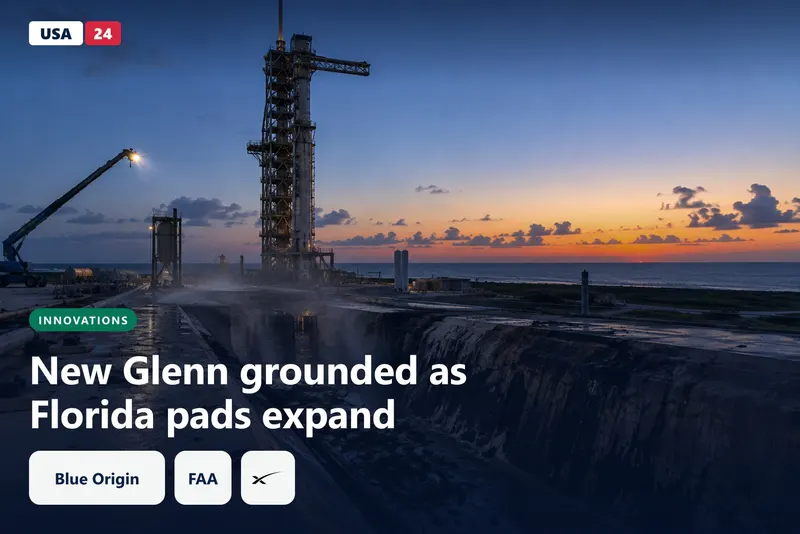
Blue Origin New Glenn has not launched since April, but the company now wants its main Florida pad to host 50 launches a year. A May explosion badly damaged that pad, and the rocket has been grounded since. Blue Origin's answer is more pads, a bigger factory campus and a request to regulators for far more flights.
On Friday, October 16, Blue Origin said it will add new launch and landing pads on Florida's Space Coast to ramp up New Glenn's flight rate, as it recovers from a catastrophic test-fire explosion in May, according to Spaceflight Now. The story is still moving. The Federal Aviation Administration has opened a 30-day public comment period on the company's request, and a follow-up report ran on October 17 in Arkansas Online.
Blue Origin New Glenn: what the Florida expansion includes
Blue Origin has outlined a $330 million expansion at its Rocket Park campus in Cape Canaveral, with completion targeted for summer 2027, according to CNBC. The work would allow production of up to 150 New Glenn upper stages a year. Blue Origin also says it has invested more than $3 billion in Florida facilities and infrastructure and employs more than 5,000 people in the state.
The company frames the plan as a capacity story. Ian Richardson, Blue Origin's senior vice president of operations, described the goal in a company blog post as "building the capacity to support more missions, more reliably, and more efficiently."
A rocket that flies from one operational pad has one place to launch from, so a damaged pad stops the whole program. New pads spread that risk and let the company run more than one campaign at a time. The catch is that new pads do not help until the existing one is repaired and the vehicle flies again.
The FAA request to raise LC-36A from 12 flights to 50
Launch Complex 36A, known as LC-36A, is permitted for 12 launches a year today. Blue Origin wants that raised to 50, according to Spaceflight Now. That would be more than four times the current permit.
The FAA has not approved the request. The 30-day public comment period is the first formal opening for outside voices, including residents, local officials, competitors and customers. The closing date of that window was not confirmed in the reporting used for this story, so readers should check the FAA's notice directly.
Regulators are scrutinizing operational claims in other fields, too. USA 24 recently reported that the National Highway Traffic Safety Administration is reviewing claims that Tesla robotaxis speed through active school zones.
Is New Glenn flying again, and when?
Not yet. New Glenn debuted in 2025 and has flown only a handful of times. The last launch from LC-36A was April 19, 2026, a New Glenn flight carrying Bluebird 7, according to Wikipedia's entry for Launch Complex 36. Florida Today's reporting, as relayed by Tech Insider, counts three New Glenn missions from that complex since January 2025.
The sequence looks like this:
- April 19, 2026: The last New Glenn launch from LC-36A, carrying Bluebird 7.
- May 2026: An explosion during a test fire, days before a planned launch of Amazon satellites, badly damages the only operational pad.
- Rest of 2026: New Glenn is grounded for the year.
- Early 2027: Blue Origin has said it expects a return to flight, according to Arkansas Online, but Tech Insider reports no firm date has been locked in.
Decoding the "150 rockets a year" headline
Several headlines have used the 150 figure as if it measured launches. It does not. The number refers to upper-stage manufacturing capacity, a distinction that Tech Insider makes directly in its coverage of the expansion.
| Figure | What it measures | Status |
|---|---|---|
| 12 flights per year | LC-36A current permitted launches | In effect |
| 50 flights per year | LC-36A launches requested from the FAA | Under public comment |
| Up to 150 upper stages per year | Rocket Park manufacturing capacity | Targeted for summer 2027 |
| Multiple flights per week | New Glenn goal by the end of the decade | Target, not current capability |
Factory capacity answers how many stages Blue Origin can build, not how many launches it can fly. Launches depend on pads, FAA permits and a vehicle that is back in service. Companies in other sectors also lead with fleet and capacity counts, as Tesla did when it said its Cybercab fleet in Austin tops 300. Readers should treat each of these numbers as a different kind of claim.
How New Glenn's pace compares with SpaceX
SpaceX dominates US launch activity, and Blue Origin wants a share of commercial and government customers. The difference in tempo is easy to see in NASA's work. According to Spaceflight Now's October launch coverage, SpaceX's October 13 cargo flight was the 35th under NASA's Commercial Resupply Services 2 contract.
That comparison has limits. A cargo resupply program is a different mission type from heavy-lift launch, so the numbers measure cadence rather than capability. Still, it shows the pace Blue Origin must eventually match. The company is building pads and factory capacity before it has demonstrated a high flight rate, which puts its schedule ambitions ahead of its track record.
Who gains, who loses and what to watch next
Satellite operators depend on rocket availability. A grounded New Glenn narrows the options for heavy payloads, which matters to commercial broadband providers and government customers alike.
Florida workers and suppliers stand to be the most directly affected by whether the expansion is built on schedule. Blue Origin says the work supports more than 5,000 employees and 500 suppliers in the state. Investors tracking space stocks and Florida economic development have two dates to watch: the FAA decision and the summer 2027 facility timeline.
General consumers have no practical steps to take here. This is a business and regulatory story, not a consumer product story. The items to track are these:
- The FAA's decision on 50 flights per year at LC-36A, after the 30-day comment period closes
- A firm return-to-flight date for New Glenn
- Repairs to the pad damaged in May
- Completion of the Rocket Park expansion, targeted for summer 2027
The next test is concrete: repair the damaged pad, return the rocket to flight and win approval for a schedule more than four times the current permit. Blue Origin has committed more than $3 billion in Florida. What it has not yet shown is a rocket flying often enough to justify the plan.