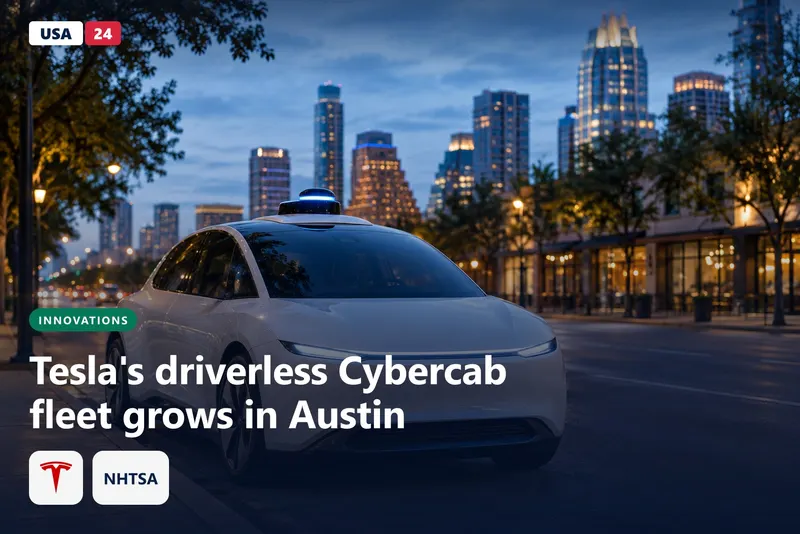
Tesla says more than 300 Cybercabs now serve riders in Austin, an eightfold jump in 30 days. The company announced the milestone on October 10 through its official Robotaxi account on X, and it pointed to Dallas as the next city. The figures come from that post, state registration data and third-party trackers, and they do not fully agree with one another.
The milestone is eight days old, but the open questions are where the reporting gets useful: how many vehicles carry paying passengers, when service reaches Dallas, and whether federal regulators will accept a car with no steering wheel or pedals.
How the Tesla Cybercab Austin fleet reached 300 vehicles
Tesla’s post claimed more than 300 Cybercabs serving Austin, up from fewer than 40 about 30 days earlier, according to Motley Fool and Teslarati. Elon Musk amplified the post, and he said in his own message, “Cybercab is scaling,” according to Benzinga.
Ashok Elluswamy, who handles Tesla’s AI software, added a quote-post on October 11: “Two years since the 10/10 Cybercab WeRobot event, the cabs are everywhere in Austin now.” Outlets disagree on his title. Teslarati calls him head of AI software, while Motley Fool calls him vice president of artificial intelligence software. Elluswamy also indicated soon after the announcement that Dallas would be the next city to receive Cybercab service.
Tesla unveiled the Cybercab in October 2024, began production in February 2026 and started paid public rides in Austin in September 2026, according to Wikipedia. That is a short timeline for a fleet that grew eightfold in a single month.
Why the fleet numbers do not add up
Three different counts are circulating, and none of them comes from a Tesla filing or an NHTSA docket. The company figure appears only in its X post, as reported by secondary outlets.
| Source | Cybercab count | Timing | What it measures |
|---|---|---|---|
| Tesla X post | More than 300 serving Austin | Oct. 10 | Company claim |
| Texas registrations | About 319 Cybercabs | As of Oct. 10 | Registered vehicles |
| Independent tracking | About 169 in Austin | Earlier in October | Estimate built from Texas registrations |
| Motley Fool | Over 100 operational | As of Oct. 14 | Operational count |
Registration is not the same as service. The same state data listed 420 Model Y robotaxis alongside the Cybercabs, so Tesla’s Austin service mixes two vehicle types. Motley Fool’s operational count is the most conservative figure, and the sources do not say whether it reflects the same date as the others.
Ride share tells a different story. Motley Fool, citing RobotaxiTracker data, reports that Cybercabs make up 39% of Tesla’s Austin robotaxi fleet but only about 11% of rides, based on 531 reported Cybercab rides. The reporting does not clarify the period those rides cover, so treat the ratio as a snapshot. Even so, it suggests the newest cars have not yet absorbed much demand.
Austin service runs until midnight, and Dallas is next
Tesla has extended Robotaxi hours in Austin again. Rides are now available until midnight, bringing service to 6 a.m. through 12 a.m., according to a Not a Tesla App report dated October 17. For riders who need a trip after dinner, that is the most immediately useful change in this news cycle.
Dallas is the bigger strategic signal. None of the sources reviewed confirms a launch date, so a Dallas launch remains a plan without a calendar. Austin is Tesla’s proving ground, which makes Dallas the first real test of whether the service model travels to a second market.
Tesla is not the only company expanding driverless rides. USA 24 recently reported that Waymo opened driverless rides to everyone in San Antonio, San Diego and Tampa, which raises the bar for Tesla to show ridership, not just fleet size.
NHTSA’s October 30 deadline is the real test
The regulatory question matters more than the fleet count. NHTSA gave Tesla a 30-day extension, so the company must answer 21 questions by October 30, 2026. The agency wants to know how Tesla certified a vehicle with no steering wheel, pedals, side mirrors or rear window, and how it plans to scale commercial operations.
The Cybercab was built as a dedicated robotaxi and uses a camera-only autonomous-driving system, according to Wikipedia. Without manual controls, regulators have to judge the autonomous system on its own, with no human driver’s controls as a backup. That design is the heart of the certification question.
This is a separate line of federal scrutiny from another issue. USA 24 has covered NHTSA’s review of a claim that Tesla robotaxis speed through active school zones, which concerns driving behavior rather than the vehicle’s certification.
The sources do not say how NHTSA will respond to Tesla’s answers or whether the agency will impose restrictions. A decision that limits the Cybercab would slow Tesla’s plan to scale a vehicle without steering wheels or pedals nationwide. A clean response would give Tesla room to expand faster.
Is the Cybercab profitable, and what does the stock say
Tesla has not disclosed how many Cybercabs run at the same time, how many rides they complete or whether the service makes money, according to Motley Fool. The company has set a stated operating-cost target of under US$0.30 per mile, per Wikipedia. Analysts say profitability remains unproven.
The market reaction is contested. Startup Fortune reported that Tesla’s stock rose 4.7% after Musk’s X post on wider Austin service. A Motley Fool page captured a TSLA quote showing -2.13% at the time of its writing. The two readings may reflect different times, and the sources do not say which is current. Neither proves that the milestone moved investors.
How to ride a Cybercab today
In these sources, Cybercab service is limited to Austin. Practical steps for riders:
- Open the Tesla Robotaxi app and enter your pickup point to confirm it falls inside the Austin service area.
- Check the hours before planning a late trip. Austin service now runs from 6 a.m. to midnight.
- Do not plan around Dallas yet, because no launch date has been confirmed.
- Know that you cannot buy a Cybercab. It is a ride-hail vehicle, and paid public rides in Austin began in September 2026.
What to watch next
Three developments will show whether this milestone holds up. The first is Tesla’s October 30 answer to NHTSA and any follow-up request from the agency. The second is a confirmed Dallas launch date. The third is whether Tesla publishes active vehicle counts or ride volumes, which would settle the count dispute. Investors will keep reading TSLA as a proxy for the robotaxi story, but the clearest evidence will come from completed rides, not registrations.