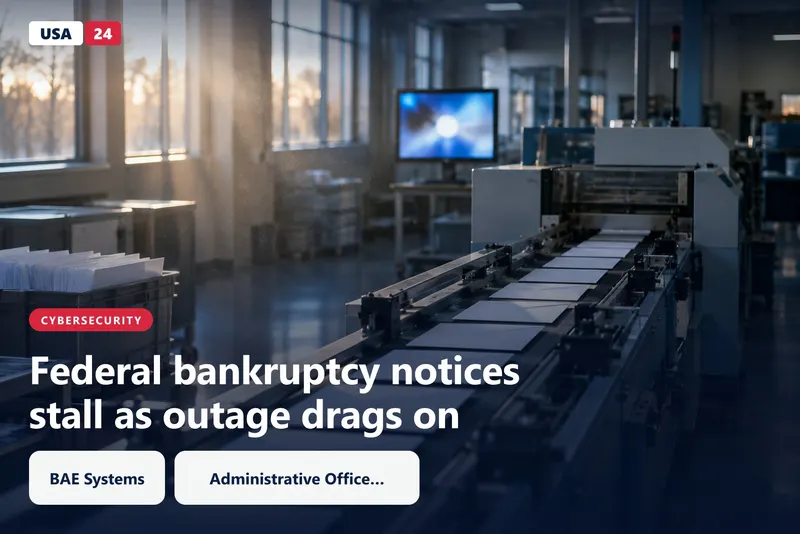
Federal bankruptcy notices have not gone out since October 9. That is when a problem at BAE Systems, the contractor that runs the Bankruptcy Noticing Center’s systems and websites, took the center offline. As of October 16, one week in, the judiciary still had no restoration date. One outlet now reports disruptions at 18 states, a figure we could not confirm. USA 24 reported on the outage earlier, and this follow-on covers what has changed: the outage has passed one week, the judiciary has issued its first official explanation, and the disruption may reach beyond federal courts.
What happened and when
The Bankruptcy Noticing Center, or BNC, produces and sends notices for every federal bankruptcy court in the country, according to the Administrative Office of the U.S. Courts and Infosecurity Magazine. BAE Systems runs those systems for the federal judiciary, so one contractor’s outage reaches courts across the country.
BAE notified the Administrative Office late on October 9 about problems with systems that process notices, as the Eastern District of Texas bankruptcy court described it. The Administrative Office published its public notice on October 15 and said all access to BNC systems and BAE-run websites was unavailable. SecurityWeek reports that production and distribution of notices, both paper and electronic, has stopped since October 9.
The timeline, based on the reporting we reviewed:
| Date (2026) | What was reported |
|---|---|
| October 9 | BAE notifies the Administrative Office late in the day about notice-processing problems |
| October 15 | Judiciary publishes its public notice; all BNC and BAE-run website access listed as unavailable |
| October 16 | Websites still offline; no restoration date announced |
The Record framed the episode as courts dealing with outages after a contractor cyberattack. That label has not come from officials, a point we cover below.
Which BNC services are offline now
Four services are down, according to the judiciary’s notice: bnc.uscourts.gov, bankruptcynotices.uscourts.gov, notices.uscourts.gov and the National Creditor Registration Service. If bnc.uscourts.gov will not load for you, the problem is not your connection. The judiciary lists the site among the services that are unavailable.
What the Bankruptcy Noticing Center outage means for creditors
Courts have warned that delayed notices could mean missed deadlines, delayed hearings and creditor meetings, and lost access to creditor lists, according to the ABA Journal. Those are the moving parts of a bankruptcy case. Creditors watch for notices to protect their claims. Debtors and their lawyers track hearings and orders, and trustees depend on the same flow to keep cases moving.
The harm falls unevenly. Creditors with live claims lose the most if a deadline passes unnoticed. Some debtors may welcome a slower pace, but a missed order can hurt them too. Attorneys with large caseloads face the hardest problem, because checking each docket by hand takes time they may not have.
CyberScoop reports that this would be the second incident in as many years to affect U.S. courts, though the details of the earlier incident were not available in the reporting we reviewed. If that pattern holds, the common thread is a shared service that many courts depend on at once.
Some courts are running separate electronic systems. The Southern District of Georgia says its CM/ECF email notification system continues to work normally. That is one court’s statement, not a national finding, so it should not be read as proof that email alerts are working everywhere.
The 18-state claim: what it shows and what it does not
Cybernews reports that 18 state courts or states have so far reported disruptions affecting their own systems. The wording leaves a lot open. It does not say whether those systems run on BNC infrastructure, depend on it indirectly, or fail for unrelated reasons. The claim comes from a single outlet and has not been confirmed against official sources, so treat “18 states” as a reported figure rather than a verified one.
The same Cybernews report says BAE operates systems for other government and military entities. We have not verified the scope of any impact on those clients. A contractor’s incident can reach well beyond its most visible customer, and until BAE or the judiciary names other affected clients, that question stays open.
What BAE Systems and the judiciary have said
BAE says the incident is isolated to the BNC system, that it acted quickly to address it and that it is coordinating with the judiciary. In a statement to Infosecurity Magazine, a BAE spokesperson said the incident is “isolated to the BNC system.” The spokesperson was not named in the coverage.
Isolation describes where the problem sits, not how long it lasts. A system that has been dark for more than a week is hard to describe as a quick fix, and the latest reporting we reviewed shows no restoration date.
The judiciary’s own messaging is narrower. The Southern District of Georgia’s notice says the court “will provide an update when BNC service is restored.” That is a promise of future information, not a timeline.
Officials have not said whether the incident was a cyberattack. Public information shows a loss of service availability but does not explain how the incident started, according to Technadu and Cyberpress. Cyberpress’s headline calls the event a cyberattack, but that is press framing, not an official finding.
On data, the sources reviewed for this story contain no public evidence that data was stolen. That is not the same as ruling it out. Cyberpress reports there was no public evidence of data exfiltration, but we have not checked that claim against an official source, so treat it as unconfirmed.
How to protect deadlines while notices are down
If you are waiting on a bankruptcy notice, do not wait for it to arrive. Start here:
- Check dockets directly on PACER or the court’s CM/ECF system. Do not rely on notices alone.
- Check your local court’s status page. Some courts say their own email notifications still work, so confirm that for your court before you rely on it.
- Write down every deadline and hearing you expected to be notified of, with the date you expected to hear and the order or filing that set it.
- Do not assume a missing notice means a missed deadline. ACA International advises creditors to expect a backlog once service returns.
- Keep your own records of filings, communications and proof of service in case a dispute comes up later.
Lawyers and trustees should calendar from docket entries and court orders, not from the arrival of a notice.
What to watch next
Four things will show how serious this becomes. The first is a restoration date. The judiciary has not announced one, and the Georgia court has promised only an update once service returns. The second is deadlines. Whether courts will extend them is still unknown, and no official has said. The third is cause. A confirmed cyberattack would shift the questions from when service returns to how an intruder got in and what else was reached. The fourth is scope, including whether the 18-state figure holds up and which other BAE clients are affected.
The vendor-risk question reaches past this case. USA 24 has covered FERC’s warning about vendor and AI-tool risks in power-sector cybersecurity, and a compromised ConnectWise credential that opened 173 Microsoft 365 tenants showed how a single outside provider can carry an incident to many customers at once.
Once service returns, expect a backlog of notices. The courts will then have to decide whether lost time justifies extensions, and that answer will show whether the federal system treats notice delivery as a shared dependency worth hardening. The next move belongs to the judiciary and to BAE.