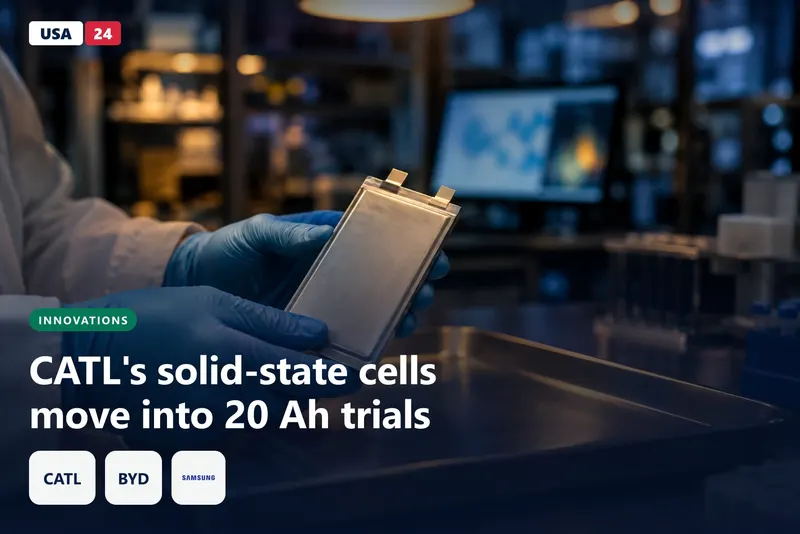
CATL has moved its all-solid-state electric vehicle battery into trials with 20 Ah cells, and it is targeting about 500 Wh/kg of energy density. CATL made the update on October 27 in answers to investor questions on the Shenzhen Stock Exchange's Hudongyi platform, and trade outlets picked it up between October 28 and October 30. Electrek reported the cell size and energy target, while electrive described the move as a step from a 10 Ah-class validation platform to test runs with 20 Ah samples.
For drivers, the answer today is no. The CATL solid-state battery timeline puts small-scale output in 2027 and mass production around 2030, so these cells are not something you can order this year.
What the CATL solid-state battery disclosure actually says
Solid-state batteries swap the liquid electrolyte in a conventional lithium-ion cell for a solid one. The industry has promised that change for years. Electrek notes that Toyota has been promising solid-state batteries for nearly a decade. What makes CATL's update notable is that it puts dates and cell formats on a technology that has mostly lived in announcements.
Across the sources, the key points of the disclosure are:
- Cell format: 20 Ah all-solid-state cells in trial stage
- Energy target: about 500 Wh/kg
- Timing: small-batch output in 2027 and mass production around 2030
- Channel: an investor Q&A answer dated October 27
CATL also held a 39.9% share of the global EV battery market in the first half of 2026, according to SNE Research as cited by Electrek. That scale is why its timeline gets close attention, even at this early stage.
Why 500 Wh/kg matters, and what is still unmeasured
Energy density, measured in watt-hours per kilogram, tells you how much energy a battery stores relative to its weight. Higher density lets an automaker build a lighter pack for the same range, or more range for the same weight. That is why 500 Wh/kg is the number to watch.
The reporting, however, gives a target rather than a result. None of the sources in this brief describes a measured cell-level figure for the 20 Ah format. Until independent test data or a published specification appears, treat 500 Wh/kg as a goal.
Trial production or samples? The wording problem
The sources do not agree on the stage. Tarmac Life and Shanghai Metals Market use the phrase 'trial production.' Electrive and CarNewsChina describe samples. Treat 'trial production' as CATL's own framing. The cell-level details, a 20 Ah format and test runs with samples, are the more precise description.
Readiness is the other clue. CarNewsChina reports that chairman Robin Zeng rated the technology at Level 4 on a nine-level readiness scale. Electrive says CATL reported the same level in June and describes it as laboratory validation and prototype development. That is an early stage. Production lines come later, and CATL's own dates place mass output around 2030.
Which products get CATL's cells first
Shanghai Metals Market reports that CATL reiterated plans for small-batch trial production of sulphide all-solid-state batteries in 2027. Initial deployment is aimed at three areas: luxury vehicles priced above 250,000 yuan, robots and drones. The first buyers would therefore be premium car owners and equipment makers, not mainstream commuters.
Robots and drones are weight-sensitive, so energy density counts there too. Robotics demand is one of the markets battery makers are chasing, and Tesla has started Optimus robot production in Fremont, which shows how seriously the sector is taking humanoid machines.
The reporting does not name a launch vehicle, an automaker partner or a price for the first premium car. Those details remain unconfirmed.
How CATL's timeline compares with rivals
Rivals are working to similar dates. BYD plans sulfide-based all-solid-state production in 2027, according to Electrek's report on its upcoming ultra-luxury EV. Samsung SDI has targeted mass production in the second half of 2027. Toyota and Idemitsu aim for 2027 to 2028, according to CarNewsChina.
| Company | Stated timing | Stage described |
|---|---|---|
| CATL | Small-scale output in 2027, mass production around 2030 | Trial production or samples, 20 Ah cells |
| BYD | Sulfide-based all-solid-state production in 2027 | Production plan |
| Samsung SDI | Mass production in second half of 2027 | Production target |
| Toyota and Idemitsu | 2027 to 2028 | Production target |
CATL's 2027 small-scale date lines up with rivals' 2027 targets. Its mass-production date is the outlier. Around 2030 is later than the production years its rivals have named, which suggests CATL is planning for a slower volume ramp. Every date in the table is a target, not a delivered result. Electrek's note that Toyota has promised these batteries for nearly a decade is a reminder of how long the industry has been making this promise.
The US angle: Solid Power, Factorial and the supply question
This is a Chinese supplier story, but US companies are running on similar clocks. Solid Power said its MOBIUS continuous sulphide electrolyte pilot line at its Thornton, Colorado, facility entered commissioning on October 26, according to Shanghai Metals Market. Electrolyte strongly influences how sulphide solid-state cells perform, so pilot capacity in the US matters for the wider race.
Factorial is another contender. Stellantis tested Factorial's solid-state cells in a Dodge Charger Daytona. Factorial claims 375 Wh/kg and charging from 15% to 90% in 18 minutes, as CarBuzz reports. Those are company or secondary-report claims, and this reporting did not verify them independently.
Materials capacity is moving too. Shanghai Metals Market reports that Tinci Materials completed a sulphide solid-state electrolyte pilot line and started trial production. Investors are watching this electrolyte buildout, including Tianqi, for US and Asian capacity.
If CATL reaches volume first, it would enter with the scale that its 39.9% share implies. US and allied automakers would then need comparable cells from domestic or allied suppliers on a similar schedule. That is the supply-chain question behind the headline.
Whether CATL's cells could reach US buyers depends on trade and import rules for Chinese battery suppliers. This reporting did not check the current status of those rules, so US availability should be treated as an open question.
What shoppers should check before trusting a solid-state claim
A few checks will separate real progress from marketing:
- Confirm that a car is on sale. A solid-state announcement for 2026 or 2027 is pre-production unless you can order a specific model with a price and delivery date.
- Ask what was measured. Cell-level energy density, pack-level range and charging speed are different numbers, and a headline figure may not describe the car you buy.
- Separate claims from tests. Check Factorial's 375 Wh/kg and 18-minute charging figures against independent testing before relying on them.
- Look for the cell format. A lab sample is not a production-format cell, and the sources here use different terms for CATL's work.
The next signals are concrete. CATL needs to publish measured 20 Ah cell data at or near 500 Wh/kg, name a first customer or vehicle, and deliver small-batch output in 2027 on schedule. Solid Power's commissioning and the Tinci pilot line will show whether materials supply can keep pace. For readers, the first useful test is simple: whether a named premium car with a CATL solid-state pack goes on sale in 2027.