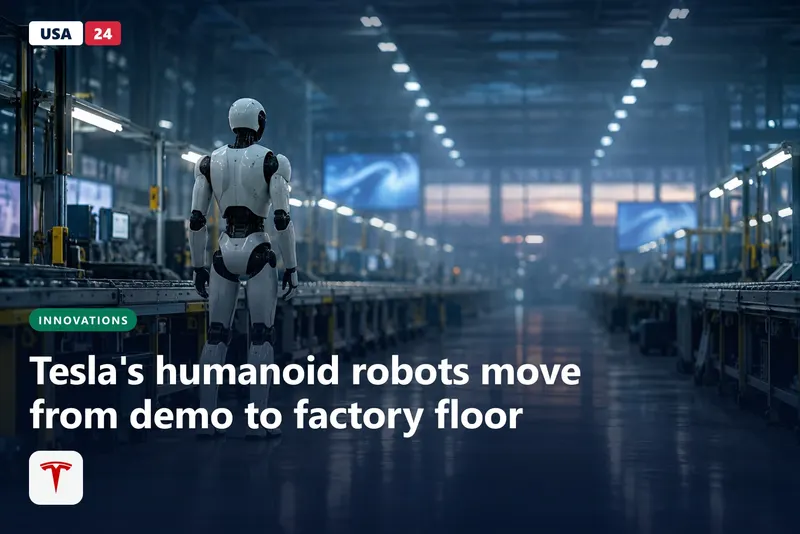
Tesla Optimus production has moved onto a high-volume line at the company’s Fremont, California, factory, and Elon Musk wants 20,000 robots built every week by the end of 2027. Tesla disclosed the start in its third-quarter shareholder letter and earnings call on Wednesday, October 21, 2026, the same report that showed net income fell 43%. The production start is a concrete claim. The volume numbers behind it are still mostly goals.
The Fremont site once built electric vehicles. According to Interesting Engineering, Tesla has repurposed that manufacturing space for its robotics ambitions. The announcement was the main robotics headline of the week, and Quartz led its earnings coverage with the same 43% profit drop.
What Tesla Optimus production in Fremont has actually started
The strongest claim comes from Tesla’s shareholder letter. As TechCrunch quoted it, the company wrote: “The bots coming off this line are the first production-quality bots that we have manufactured.” The letter also said the current process is suitable for a commercial product. That is a claim about manufacturing readiness, not a statement that customers can order one.
On the earnings call, Musk put it more modestly: “started what I’d call early production on a high-volume line in Fremont.” The word “early” carries weight. A line can be high-volume and still be ramping, and the sources reviewed here do not report a confirmed unit count from Tesla.
Musk said it will take about a year to reach full capacity and to start shipping robots to other companies. He also pointed to an AI5-powered upgrade planned for April, with external customer deliveries expected around the end of 2027, according to Not a Tesla App.
Supporting moves are visible in the supply chain. In September, Tesla certified three suppliers, Tuopu, Joyson and Sanhua, as mass production partners for Optimus components. Teslarati reports that Tesla plans to put its AI5 chip into Optimus next year, and Interesting Engineering says the company plans 400 megawatts of training compute capacity by the end of 2026.
How much of the 20,000-a-week target is on record
Musk’s 20,000-per-week figure is a target, not a reported output. Quartz and Interesting Engineering both point to the end of 2027 for that goal. Tech-Insider goes further, but its numbers come from an aggregated report rather than from Tesla. That report describes several hundred robots per week at Fremont, about ten times the second-quarter 2026 pace, and a reported internal target above 1,000 per week by year-end.
Those figures are unverified, and Tesla has not confirmed unit counts. The sources also disagree on framing. One outlet gives the 20,000 target for the end of 2027, while Tech-Insider ties it to Giga Texas coming online. Teslarati reports that Giga Texas is also being built out to make Optimus later, so the second framing is not implausible. Neither has been tested against actual output.
Here is how the main numbers stack up:
| Claim | Status in the reporting |
|---|---|
| Production started at Fremont | Stated by Tesla in its letter and on the earnings call |
| 20,000 robots a week by end of 2027 | Musk target, no confirmed output |
| Several hundred robots a week at Fremont | Unverified figure from an aggregated report |
| Above 1,000 a week internal target by year-end | Reported internal target, not confirmed |
| External deliveries around end of 2027 | Expectation stated by Musk, no buyer price or date |
Anyone quoting a weekly number should say which row it belongs to. The gap between a stated target and a measured rate is the gap between a news item and a forecast.
How the Optimus timeline compares with earlier promises
Optimus was first announced at AI Day on August 19, 2021, and a prototype was shown in 2022, according to Wikipedia’s Optimus entry. The same page records Musk’s June 2024 claims, which put limited production in 2025 and outside sales possible in 2026. Measured against that schedule, the external-delivery target around the end of 2027 is a clear retreat.
- August 19, 2021: Optimus first announced at AI Day
- 2022: Prototype shown
- 2025: Limited production, per Musk’s June 2024 claims
- 2026: Possible outside sales, per Musk’s June 2024 claims
- September 2026: Three Optimus component suppliers certified
- October 21, 2026: Fremont production start announced
- Around the end of 2027: External deliveries expected
The slip is the most useful context for readers. Tesla is now being judged against its own dates, and its third-quarter earnings already showed a 43% drop in net income. The company is also spreading its bets across other projects. USA 24 has covered the Cybercab fleet in Austin and the unsettled pricing for the Roadster, and both raise the same question: when do production claims turn into prices and delivery dates?
Teleoperation and the demo credibility problem
Critics have pointed out that Tesla used teleoperation in past Optimus demonstrations and was not transparent about it, according to the Wikipedia entry. That history explains why a production claim draws more scrutiny than a stage video. A robot that performs work on a factory line is a different proof than one that a person steers from a distance.
Musk has promised a new video showing AI-driven task completion within one or two months, according to Teslarati. Critics also argue that rival humanoid demos run scripted routines. That argument has not been independently tested in the sources reviewed here, so it should be read as a criticism, not a finding.
The video will matter most if it shows continuous, unedited work and reports how long each task takes. Those two details separate a capability demonstration from a sales pitch.
Can you buy a Tesla Optimus robot, and at what price?
No. A consumer purchase is not possible, and none of the sources published a price, a customer list or a delivery date for outside buyers. Treat any number that circulates before Tesla publishes one as speculation.
The likely first buyers are factories, warehouses and logistics firms, though that is an inference from the reporting rather than a confirmed plan. For now, the practical step is to prepare rather than commit. If your business is evaluating humanoid robots, ask Tesla for three things in writing when it opens orders:
- A unit price, and a list of what that price includes
- A firm delivery window for your site
- Service, safety and support terms
Investors face a different question. Optimus is tied to Tesla’s valuation, and a robot that ships in 2027 only changes the earnings picture if the company converts the claims into revenue. Until then, investors are weighing a production start against a 43% drop in profit, and the sources do not show how much Optimus will contribute to earnings.
What to watch before Optimus reaches outside buyers
The next several months will show whether the timeline holds. Watch for these markers:
- The AI5-powered upgrade planned for April
- The promised AI-driven task video, due within one to two months
- Any confirmed unit count or weekly production rate at Fremont
- Progress at Giga Texas as it is built out to make Optimus later
- Output from Tuopu, Joyson and Sanhua as they ramp component production
- The 400 megawatts of training compute planned for the end of 2026
Whether the Fremont line can reach 20,000 robots a week by the end of 2027 remains open. The evidence so far is a line that has started, suppliers that have been certified and a timeline that has already moved once. The real test will be the first delivery to a customer outside Tesla.