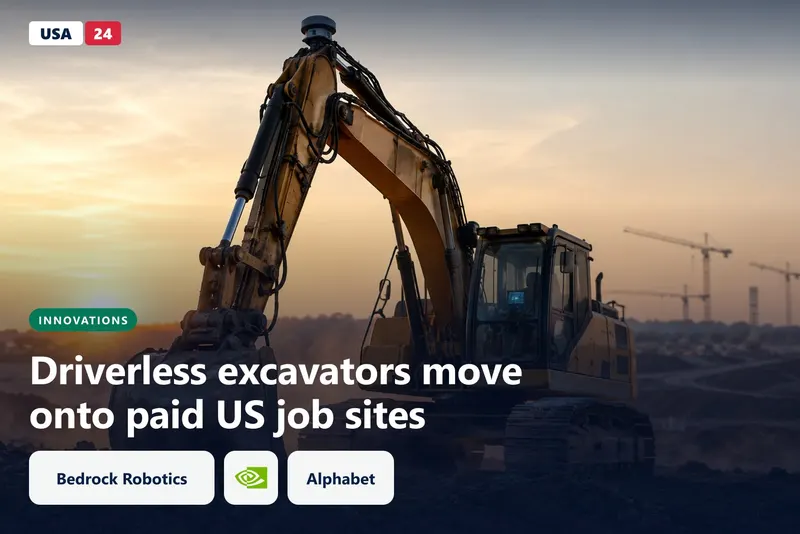
Bedrock Robotics closed a $600 million Series C on Monday, October 26, 2026, at a $4.1 billion post-money valuation. The Bedrock Robotics funding round matters because the product has moved past demonstrations. Since August, the company's driverless excavators have run paid jobs on commercial sites in Texas and Nevada with no operator in the cab.
What the Bedrock Robotics funding round includes
The round was led by CapitalG, Alphabet's growth fund, and Emergence Capital. Nvidia, Bessemer and others also took part, according to Dealroom's note on the round. Total funding now stands at nearly $1 billion, per WOWTALE.
The full press release was not available on a primary company website when this article was reported. The details here come from the announcement as relayed by news outlets and a social media summary of it.
The new valuation is a sharp step up from the last round. Bedrock raised a $270 million Series B in February 2026 at a $1.75 billion valuation, according to Briefs and a Traded VC post on X. That works out to roughly 2.3 times the earlier figure in about eight months.
One outlet, SiliconANGLE, describes the company as valued at nearly $1 billion. That conflicts with the $4.1 billion figure repeated across the rest of the coverage, so the SiliconANGLE line appears to be an error.
How the Bedrock Operator kit works on existing excavators
Bedrock sells an autonomy module called the Bedrock Operator. It fits onto excavators a contractor already owns and lets them navigate job sites and handle earthmoving with minimal human input. The kit adds cameras, LiDAR, GPS and onboard compute, and installation takes about a day, according to a summary of the announcement posted on X by AGTP.
The target machines are excavators in the 20 to 80 ton range, per Dealroom. Bedrock was founded in 2024 by former Waymo engineering leaders. Its software retrofits existing excavators for self-driving operation, according to the Traded VC post. The company's Series A was led by 8VC, and Eclipse was an early backer.
Boris Sofman, Bedrock's co-founder and CEO, described the next goal in plain terms: "The next challenge is delivering that capability to more contractors as a dependable part of how projects get built." That line is less about proving the technology and more about proving it works reliably across many customers.
The retrofit approach is the detail most likely to matter to a mid-size contractor. A firm does not need to buy a new autonomous machine. It can add the kit to equipment already in the fleet. The sources do not disclose unit pricing, so the cost comparison remains open.
Where the driverless excavators are working now
In August, Bedrock's excavators began paid work with no operator in the cab on three live commercial sites in Texas and Nevada. Six customers have deployed since then, and the customer count has more than doubled since 2025, according to the AGTP summary.
Bedrock says the new capital will expand the number of machines equipped with its system and grow its field, commercial and operations teams. The company targets triple-digit autonomous machines in 2027, with bulldozers and loaders next, as Ventureburn reported.
The company's direction goes further than what is running today. Tech Insider describes coordinating mixed fleets across a job site as a goal, not a current deployment. Readers should treat that capability as a roadmap item until customers confirm it in the field.
Why CapitalG and Nvidia are backing construction autonomy
Derek Zanutto, a general partner at CapitalG, framed the investment in broad economic terms: "Construction sits at the foundation of nearly every major economic and industrial ambition in the United States." That argument ties the round to infrastructure spending as much as to robotics.
The investor list tells a second story. CapitalG and Nvidia are both known for backing technology that reaches physical work, and their participation signals that investors see autonomy spreading from robotaxis into heavy equipment. The sources do not describe any technical partnership with Nvidia, so the chipmaker's role should be read as investment, not integration.
Robotaxis draw most of the public attention because they run on public roads. Excavators work on private sites under contract, which changes both the safety debate and the market. For a sense of how autonomy companies present their safety records, see USA 24's coverage of Tesla's robotaxi safety report.
The valuation jump is easier to read side by side with the earlier round:
| Round | Announced | Amount | Valuation |
|---|---|---|---|
| Series B | February 2026 | $270 million | $1.75 billion |
| Series C | October 26, 2026 | $600 million | $4.1 billion post-money |
The sources do not show a published safety record for Bedrock's driverless excavators. That means the valuation rests on deployment momentum and the labor problem more than on public incident data.
What the labor shortage means for contractors
The pitch lands in a tight labor market. According to the Associated General Contractors of America (AGC), 87% of contractors have craft openings, a figure cited in the AGTP summary. Investors in the round say skilled operators are scarce, which is the gap autonomy is meant to fill.
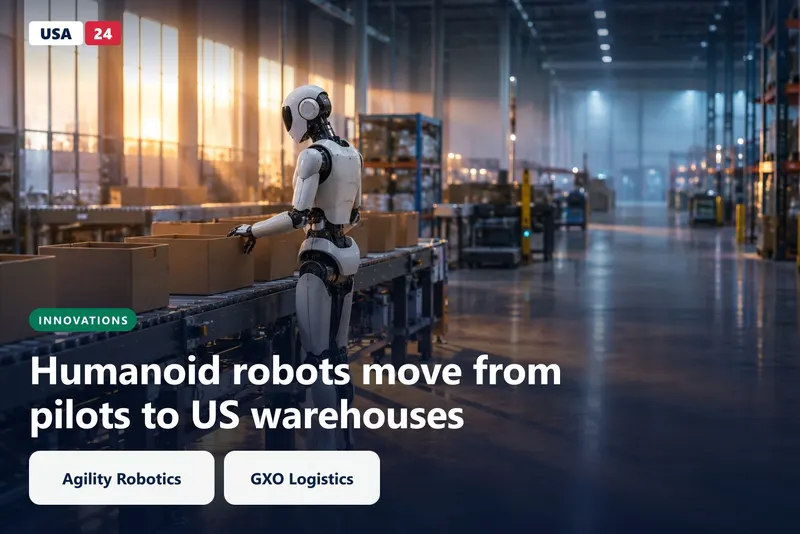
Other robotics makers are also moving into paid US work. GXO and Agility Robotics expanded their Digit humanoid deal to two more US sites, which shows how quickly physical automation is spreading beyond pilot programs.
The harder question is what happens to operator jobs. None of the sources examine how autonomous excavators change the number of operators a contractor needs or what those jobs pay. This article does not fill that gap with speculation, and readers should watch for data from customers and labor economists.
How to evaluate excavator autonomy for your fleet
The general reader needs no action. A construction business that wants to evaluate retrofit autonomy should ask vendors for the following before signing anything:
- How many machines are running live today, and at how many separate sites. Bedrock's public figures are three commercial sites where paid driverless work began in August and six customers since.
- Uptime records, incident logs and safety data for driverless operation. None of the sources publish these for Bedrock.
- Whether your machines fall in the supported class. Bedrock's stated focus is excavators in the 20 to 80 ton range.
- What installation does to your schedule and equipment warranty. The company says the kit takes about a day.
- How the software handles mixed fleets and what support looks like on site. Mixed-fleet coordination is described as a direction, not a deployed feature.
- Pricing in writing. Unit pricing is not public.
What to watch next
The next checkpoint is the 2027 count. If Bedrock reaches triple-digit machines, it will show that the retrofit model can scale beyond a handful of sites. Watch for bulldozers and loaders arriving on the schedule the company has set, and for any published safety data.
One detail needs resolving too. Sources disagree on whether Temasek is a new investor or a participant in the round, so the final investor list may change as filings and announcements settle. If Bedrock's machine count stalls, the $4.1 billion valuation will look like a bet on a labor shortage that autonomy has not yet solved.