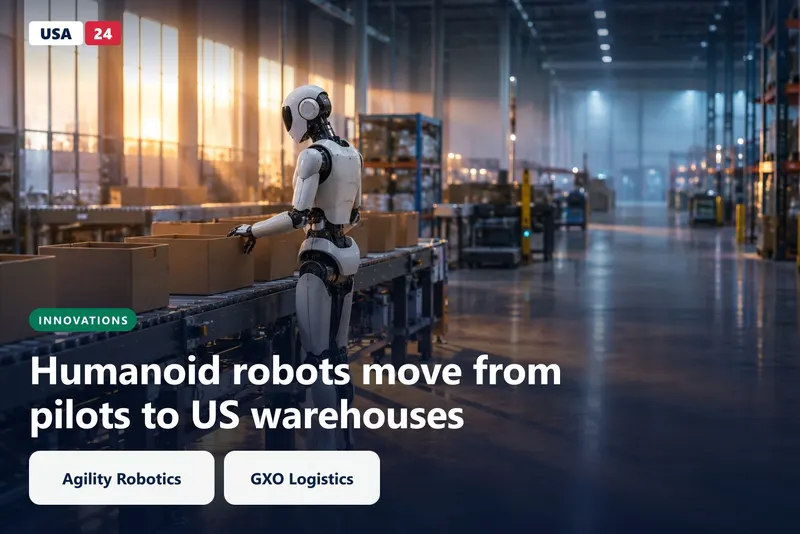
GXO Logistics will put more Agility Robotics Digit humanoid robots into two additional US warehouses, the companies said Monday, with the first deployments expected to start in early 2027. The expansion is among the clearest signs yet that humanoids are moving from pilot projects into contracted work on US logistics floors, though the companies have released few numbers to back that up.
GXO issued a release on the expanded partnership on October 26. Agility published a separate announcement, distributed through GlobeNewswire, that highlights its growing list of enterprise customers. Both are company-issued releases, and no independent reporting has yet confirmed scale, pricing, robot counts or performance.
Where the new Agility Robotics Digit humanoids will work
The new commercial agreement covers two facilities, one in Statesville, North Carolina, and one in Lebanon, Tennessee. The companies say the expansion builds on a Robots-as-a-Service agreement that they describe as an industry first. That model means a customer pays for robot work over time rather than buying the machines outright, but the releases do not spell out the financial terms of this deal.
The expansion also extends work that began in 2024 at GXO's Georgia facility. That history gives the companies something many humanoid announcements lack: an existing site to point to. The releases do not say how the Georgia deployment has performed on safety, uptime or staffing, so the record is a starting point rather than proof of results.
Agility's pitch is to prove value at one site and then expand across a customer's operations. The GXO agreement follows that pattern. Georgia serves as the first proof point, and Statesville and Lebanon are the expansion.
Digit 4 now, Digit 5 later
Deployments at the new sites are expected to start in early 2027 using Digit 4, with a planned move to Digit 5 once that model is commercially available. Agility unveiled Digit 5 on September 15, 2026, and describes it as designed for cooperatively safe work near people.
That description matters in a warehouse, where robots and workers share the same aisles. A robot built to work near people has to meet a higher bar for speed control, sensing and stopping behavior than one that operates behind a barrier. The text available to USA 24 does not explain how Digit 5 differs from Digit 4 in capability, and it gives no commercial availability date. Operators should treat the upgrade as a plan rather than a guarantee.
Which companies are testing humanoids in production
The releases name several other customers, and they show how far Agility is trying to spread beyond logistics. AGCO agreed on October 20 to a Digit pilot at its plant in Hesston, Kansas, with the pilot expected to start in 2027. Toyota Motor Manufacturing Canada signed after a pilot. Schaeffler is deploying Digit in automotive operations, and Mercado Libre is also listed as a customer.
Agility says its pipeline holds more than 30 prospective customers across automotive, logistics, e-commerce, agricultural equipment, consumer products and defense. That spread suggests humanoids are being evaluated for factory lines, distribution centers and fulfillment networks at the same time. The release does not say how many prospects are in paid pilots or how many have signed contracts, so the pipeline reads better as demand interest than booked revenue.
Agility also cites a figure it has disclosed before: "more than $300 million." The text available to USA 24 cuts off before explaining what that number measures, so it should not be read as a sales or funding total until the company says so.
Digit humanoid price is still undisclosed
Neither release gives a price for Digit, a per-robot figure or the value of the GXO contract. The releases also do not say how many robots will go to each site. That leaves buyers without the number most of them want first.
A price point does exist elsewhere in the market. The Next Web reported that Faraday Future unveiled a $2,490 FF Nova humanoid for developers and schools on October 15, and that the company claims it is the first embodied AI humanoid sold in the US for under $2,500 [3]. That product is aimed at developers and classrooms, not warehouse operations, so the gap between the two prices says little about what industrial deployment costs. A robot working a shift in a distribution center is judged on uptime, integration and the labor it supports or replaces, and a sticker price captures none of that.
What warehouse workers and operators should take from this
The timing gives operators a planning benchmark. The first US sites in this expansion are not expected to go live until early 2027, so a company weighing a humanoid evaluation this year should expect a long lead time before it can compare its own results with GXO's.
Workers in the affected regions have the most at stake. Statesville, Lebanon and the Georgia site are where robots will work alongside people first. No staffing impact has been reported, and neither release addresses headcount, job redesign or training. Labor advocates and local reporters should press for those details, starting with the Georgia site, where Digit has been working since 2024.
Manufacturers face a parallel question. AGCO in Kansas and Toyota in Canada are testing the same class of robot for production work, which makes logistics one of several proving grounds rather than an isolated experiment.
Tesla is pursuing a different route. Its Optimus robot is in production at Fremont, as the company moves toward a 2027 target. Agility sells its robot to outside customers, so its success depends on how many companies sign contracts and how each deployment performs, not on one company's factory schedule.
How to evaluate a humanoid robot pilot
Company-issued numbers deserve the same caution as any vendor claim. Tesla's robotaxi safety report, which claims zero injuries across 3.1 million miles, is one recent example of self-reported data that outsiders cannot easily check. Anyone considering a humanoid pilot should ask for comparable evidence, and the GXO and Agility announcements suggest a few practical questions:
- Ask for site-level results, including uptime, incident logs and throughput compared with human-run stations, before accepting performance claims.
- Set success criteria before the pilot begins, covering the specific task, the hours per shift and the metric that ends the trial.
- Request a written safety plan that explains how the robot detects and yields to people, and which standards the design follows.
- Clarify what the contract covers, including maintenance, software updates and upgrades when a newer model such as Digit 5 arrives.
- Document staffing changes, training and job redesign from day one, so the pilot produces evidence for workers as well as management.
What to watch next
Three signals will show whether this expansion becomes routine operations. The first is a go-live date at Statesville and Lebanon in early 2027, along with which Digit model runs there. The second is whether GXO discloses results from its Georgia site, including safety and staffing data. The third is whether AGCO's Hesston pilot starts on schedule and whether Agility explains its "more than $300 million" figure. Until those answers arrive, the deal is best read as a commitment to test humanoids at scale, not as proof that they can do the work.