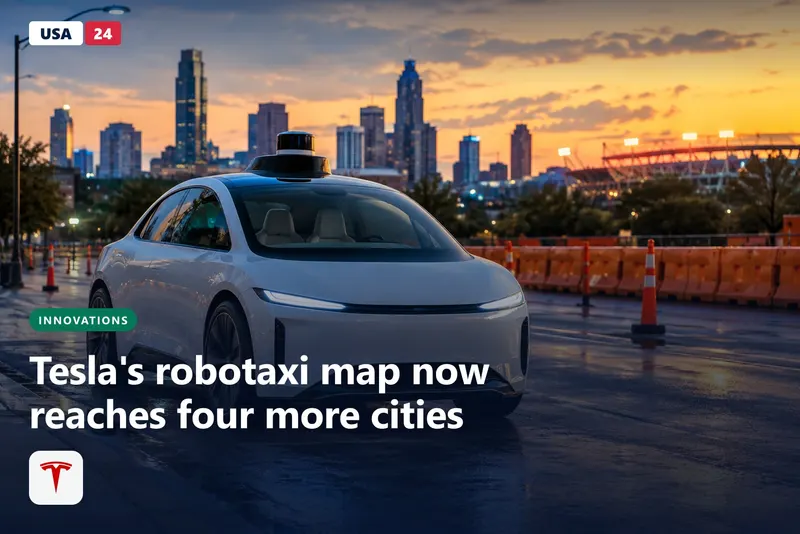
Tesla's new robotaxi cities are Las Vegas, Jacksonville, Phoenix and San Antonio, four markets the company has named but not yet launched. The names appeared on a Robotaxi safety page that went live October 21, 2026, and Tesla updated the page again on October 23. If all four open, the service would reach ten cities across Texas, Florida, Nevada and Arizona.
Tesla robotaxi new cities and which ones were expected
Tesla's safety page lists the four cities as coming soon, according to Tesla North. Tesla has not published a launch date for any of them, and it has not said whether they will launch with a safety monitor aboard.
Two of the names came as no surprise. Phoenix had been staged for months, and Tesla obtained approval to operate in Las Vegas in August, as Not a Tesla App reported. Jacksonville and San Antonio are the genuine additions.
Today the service runs in six US cities: Austin, Dallas, Houston, Miami, Orlando and Tampa. Tesla Oracle counts the four named cities on top of those six, which brings the total to ten. Apart from a supervised pilot in the San Francisco Bay Area, the current footprint is limited to Texas and Florida.
That is why the list matters. Nevada and Arizona would be the first new states for Tesla's driverless rides, and Jacksonville and San Antonio would add cities in states where the service already operates. For riders in the six live cities, the news changes little day to day. For residents of the four named cities, it is the first concrete sign that service may arrive, although no date has been set.
Where the Robotaxi miles are
Austin came first. According to Tesla North, Tesla launched unsupervised rides in Dallas and Houston in April and opened Miami in July. Tesla's report counts 3.1 million autonomous miles through October 18, 2026, while Tesla Oracle cites a larger figure of 3.4 million in its own coverage. This story did not open Tesla's safety page directly, so it could not reconcile the two totals. The per-city figures below add up to about 3.1 million, which matches the October 18 data cutoff.
| City | Autonomous miles through Oct. 18, 2026 |
|---|---|
| Austin | 2,118,015 |
| Dallas | 608,130 |
| Houston | 225,964 |
| Orlando | 61,053 |
| Tampa | 53,117 |
| Miami | 46,262 |
Austin accounts for about two-thirds of the total. Dallas adds roughly a fifth, and Houston about 7 percent. Orlando, Tampa and Miami together logged about 160,000 miles, or roughly 5 percent. Those three Florida markets show how thin the record is for newer launches, and the four new cities would start from zero.
How Tesla counts its safety record
The report covers January 22 through October 18, 2026. It counts collisions Tesla filed with NHTSA under the agency's Standing General Order, and it leaves out miles from rides with a safety monitor aboard. Tesla also excludes two events it says were not injuries: one in which another vehicle pushed an SUV into a stopped Robotaxi, and one in which a rider claimed a pothole caused an injury.
Those rules shape what the numbers can tell you. A clean record on unmonitored miles says little about supervised rides, and the report does not say which kind of ride the new cities will use at launch. The count is also self-reported, filtered through Tesla's own judgments about what counts as an injury.
The broader debate about robotaxi safety centers on the same core questions: how safety data is collected and who counts the miles. Waymo has operated driverless service in multiple US markets, but this brief did not verify new Waymo figures, so this story makes no direct comparison.
The report also landed a few weeks after NHTSA opened a school-zone review of Tesla's robotaxis. That review remains open, and it is the regulatory thread to watch.
Austin's Cybercab geofence and the Dallas question
On October 23, Tesla expanded the Austin Robotaxi and Cybercab geofence to coincide with the 2026 US Grand Prix in that city, as Tesla Oracle reported in a separate story. The change widens the area where riders can be picked up and dropped off during race week.
Austin is the only city where Tesla currently uses its steering-wheel-less Cybercab for Robotaxi service. Tesla says Model Y Robotaxis and Cybercabs run early versions of FSD v15 (Unsupervised). Our earlier story on the Cybercab fleet count covers the vehicle side of the program in more detail.
Dallas is named as the next target for Cybercab ride-hailing, but the sources do not agree on where it stands. Tesla North describes unsupervised rides starting in Dallas and Houston in April. Not a Tesla App and Basenor describe unsupervised Cybercab rides in Dallas as coming next month, citing an earnings-call update. Until Tesla confirms the timing, readers should treat the Dallas Cybercab status as unsettled.
What is still unknown
- Launch dates for Las Vegas, Jacksonville, Phoenix and San Antonio.
- Whether the new cities will launch with safety monitors on board.
- Whether unsupervised Cybercab rides in Dallas have started or are still weeks away.
- Which mileage total is correct, 3.1 million or 3.4 million.
- How and when the NHTSA school-zone review ends.
What riders can do now
- Check the Tesla Robotaxi app for which cities are live before you plan a trip.
- Do not plan around Las Vegas, Jacksonville, Phoenix or San Antonio until Tesla announces a date.
- Before you compare Tesla's miles with another company's, read the method first. The count excludes monitored rides and relies on collisions filed with NHTSA.
- Check Tesla's safety page for updates, since Tesla changed it on October 23.
What to watch next
The next signal is whether Tesla sets launch dates for the four named cities, and whether those launches include a safety monitor. A later safety update should show whether the mileage total moves past 3.1 million and whether the per-city numbers grow in the new markets. Watch for Dallas Cybercab timing and any NHTSA action on the school-zone review. If the four cities open, Tesla's service will move from a Texas-and-Florida network to one that spans four states, and the first safety updates from those markets will show whether the reporting holds up.