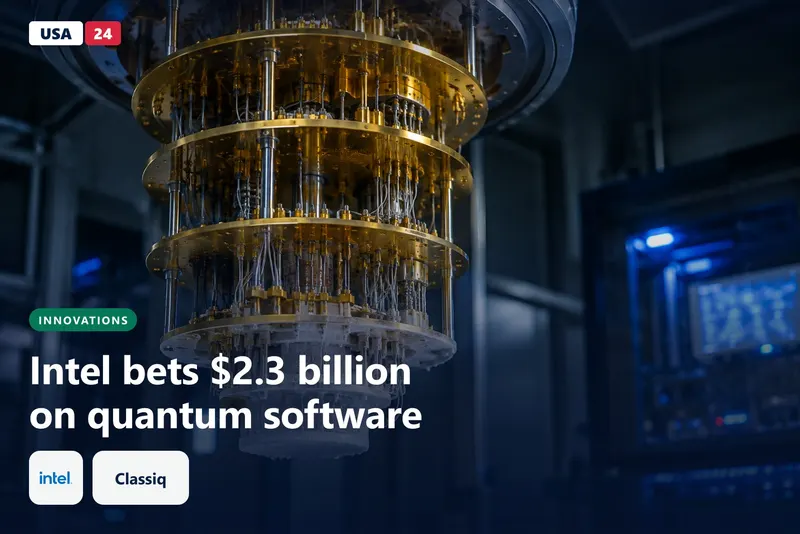
Intel has agreed to buy Classiq, an Israeli quantum software company, in a deal worth about $2.3 billion paid in cash and stock. The Intel Classiq acquisition is the largest transaction yet in quantum computing, and it has kept quantum stocks moving all week. For a chipmaker that has spent a decade on quantum hardware, the purchase is a bet that software customers can produce revenue before a commercial quantum computer does.
The deal broke on Monday, October 26. Calcalist reported the price that day, and Intel's own announcement, dated the same day, describes a definitive agreement to acquire the Tel Aviv-based company, according to Post-Quantum.
What Intel is paying for Classiq
Calcalist puts the price at $2.3 billion in a combination of cash and shares. Globes reports that the cash on Classiq's balance sheet effectively lowers the price to about $2.2 billion. Readers comparing headlines will see both figures, and the gap comes down to how that cash is counted.
Classiq was founded in 2020, employs about 150 people and has raised $200 million. Its software lets developers build quantum programs without deep quantum expertise. The company's stated goal is to become the quantum equivalent of Windows, and its platform works across different types of quantum hardware. Customers include BMW, Merck and Wells Fargo, according to Haaretz.
Classiq's CEO described the company's mission in broad terms. "We established Classiq to build the operating system for quantum, the environment that allows anyone to develop software for quantum computers, not only the quantum experts," Nir Minerbi said, as NextPlatform reported.
The stakes are spread across the founding team and staff. Founders Yehuda and Amir Naveh hold 9%, and Minerbi holds about 3.5%. Employees collectively own about 10%, which Calcalist values at around $230 million at the deal valuation. That figure is the clearest measure of what early staff stand to gain from the exit.
How Intel plans to use Classiq
Intel says it will combine Classiq's synthesis platform with its own spin-qubit manufacturing and quantum software into a full-stack quantum computing platform. Intel has worked on quantum computing since 2015, building silicon qubits with the same equipment it uses for ordinary chips, according to TheNextWeb.
Intel CEO Lip-Bu Tan described the shift in direct terms. "Joining forces with Classiq transforms Intel's Quantum Computing Group into a full-stack quantum computing business," he said, as TheNextWeb quoted him. On the company's Thursday, October 29 earnings call, he went further: "Post-acquisition, Intel will become a full-stack revenue-generating quantum computing company," as Calcalist reported. Tan also said Intel's quantum work is moving from foundational research toward commercialization. He did not mention the price or his own investment in Classiq on that call.
The commercial gap is the central tension. Intel sells no quantum computer and runs no public cloud service on its own quantum hardware, according to Post-Quantum. The deal therefore buys customers, software and developers for a hardware business that is not yet selling products.
Intel also says Classiq's software will keep working with other companies' quantum hardware, and that Classiq will become its global development center for quantum computing, per Globes and TheNextWeb. Those are stated intentions. The reporting does not describe a contractual commitment behind them.
Why Intel's stock fell after a Q3 beat
Intel beat third-quarter 2026 estimates, yet its stock sank, according to Investing.com. The available reporting does not explain the drop. It does show that Intel has not said when quantum computing will contribute meaningfully to profit, a point TradingView raised in its coverage.
A large acquisition adds a strategic story, but it does not add near-term earnings. Investors weighing Intel's stock will want a date for that payoff, and nothing in the reporting provides one.
Quantum stocks, Israel and the deal's place in history
Quantum stocks rose after the announcement on Tuesday. IonQ, Rigetti and D-Wave, which trade as IONQ, RGTI and QBTS, moved higher on the news, according to TipRanks. The rally suggests investors read the deal as a signal for the whole sector, not only for Intel.
The previous record was IonQ's roughly $1 billion purchase of Oxford Ionics. At $2.3 billion, Intel's offer is more than twice that size.
Intel is no stranger to Israeli acquisitions. It paid about $2 billion for Habana Labs in 2019 and about $1 billion for Moovit in 2020. Israeli coverage calls the Classiq deal a milestone exit for the country's tech sector, as Ynetnews and Calcalist reported.
The backdrop is growth. The quantum market is tipped to reach as much as $20 billion in the next few years, according to NextPlatform.
Who gains and who loses
Classiq's employees and investors gain most immediately. Enterprise and research buyers could benefit if Intel keeps the software open to rival hardware, because a tool that runs on several vendors' machines lowers the risk of betting on a single one. Independent quantum software companies lose some room to compete against a rival with a chipmaker's balance sheet and manufacturing.
The deal also fits a wider pattern in US chip policy. USA 24 has reported that CHIPS Act awards of $389 million come with government equity stakes, and that the US has designated helium a critical material as chip supply tightens.
What to watch before the deal closes
The deal is expected to close in the second half of 2027. The sources reviewed do not describe the regulatory approvals it needs, including review in Israel and the US. Four questions will show whether the promise holds:
- Whether Classiq's software still supports rival quantum hardware after closing.
- What regulators in Israel and the US require, and how long their reviews take.
- Whether Intel gives a dated target for quantum revenue.
- How quickly Classiq becomes Intel's global development center for quantum computing.
What readers should do now
Most readers need to take no action. If your team evaluates quantum software, ask any vendor, including Classiq, for written commitments on support for multiple hardware platforms. Check your contracts for change-of-control clauses that would apply if ownership changes, and keep a second vendor in your evaluation until the deal closes.
The next checkpoints are the regulatory filings, the closing date and the first public signs of how Intel packages Classiq with its own spin-qubit work. If Intel can show paying quantum customers before its hardware is commercial, the deal will look like a sound strategy. If it cannot, the price will look like a bet on a timeline that has not yet been set.