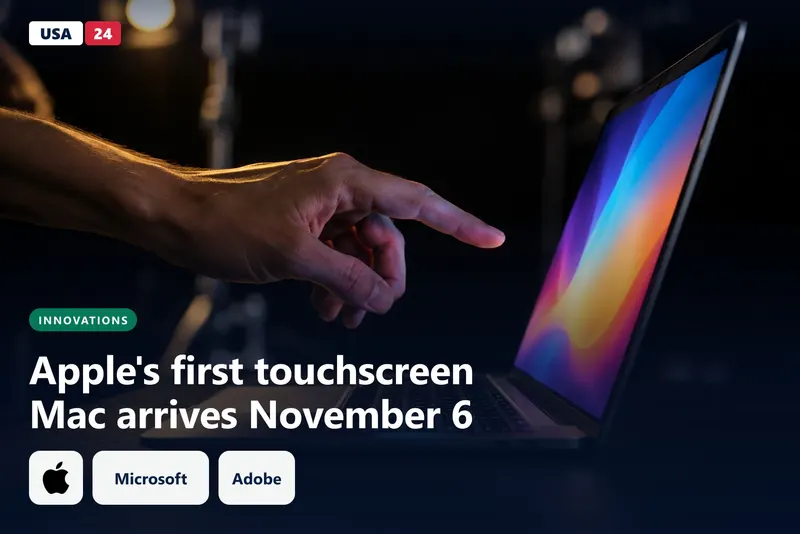
Apple's first touchscreen Mac starts at $2,899, and the company says the first units arrive Friday, November 6. The MacBook Pro with PROLED XDR Display, unveiled at an event in Los Angeles on October 28, ends a long Apple position against putting touch on its laptops.
The timing matters for buyers. The new model arrives in a laptop market that analysts expect to shrink this year, and Apple is asking premium Mac buyers to pay for a feature the company spent years dismissing. The price gap against Apple's cheaper models is the first thing to weigh.
Touchscreen MacBook Pro price and release date
The 14-inch model starts at $2,899 and the 16-inch model starts at $3,399, according to TechCrunch and CNN. Macworld reports that Apple's US premium is $400 over every equivalent non-touch M5 model. Both touch sizes use the M5 Pro or M5 Max chip.
The launch date is less clear than the price. The Mac Observer reports that preorders opened October 28, while TechCrunch says they open October 30. Check apple.com for the live order page before you plan a purchase. Apple says the rollout covers 30 countries and regions.
| Model | Starting price | Touch input |
|---|---|---|
| 14-inch MacBook Pro with PROLED XDR Display | $2,899 | Yes |
| 16-inch MacBook Pro with PROLED XDR Display | $3,399 | Yes |
| 14-inch MacBook Pro with M6 | $1,999 | No |
The M6 model was announced October 27, one day before the touch launch. It is the lowest-cost route into a 14-inch MacBook Pro in this lineup.
How touch works on the new MacBook Pro
The touch sensor sits inside the display panel rather than on top of the glass. Apple says that placement cuts latency, which should make taps feel more immediate. The panel is a tandem OLED design, and MacStories and Inven Global report peak brightness of 2,000 nits, 10,000,000:1 contrast, refresh rates up to 120Hz, and P3 and Adobe RGB color coverage.
Existing Mac apps work with touch from day one because macOS converts taps into clicks. That keeps the launch experience simple, but it also means most apps will not feel designed for touch until developers add native support. Apple does not support the Apple Pencil on this laptop.
Apple also redesigned the hinge for stability and stabilized the 12MP Center Stage camera, according to The Apple Post.
Which apps support touch and when
Apple named Microsoft Word, Adobe Lightroom, DaVinci Resolve and Blender as apps that will add touch support later this year. Apple has not dated most of those updates. Creative professionals who depend on Resolve, Lightroom or Blender may want to wait for the software before treating touch as a workflow tool.
Business buyers face a similar timing question. Word is on the list, but a fleet rollout that depends on touch in office software cannot be scheduled until Microsoft ships that update.
Why Apple changed its position on touch
Apple's resistance to touch laptops was public and long-running. WERSM reports that Steve Jobs once called a touchscreen Mac "ergonomically terrible." Apple's last touch experience on a Mac was the Touch Bar on the MacBook Pro, which the company later removed.
John Ternus, now Apple's CEO, has argued the Mac is built around other inputs. In a WIRED interview, as quoted by The Mac Observer, he said, "The Mac is first and foremost an indirect input device, built around the trackpad and keyboard." At the launch, he framed the change as a new step, saying, "Yes, for the very first time, we are bringing touch to the Mac," according to CNBC.
Apple says display technology, custom silicon and hardware design made the change possible, and that it wanted touch without adding thickness or weight. That explanation is a reasonable reading of why Apple waited. Competitors have shipped OLED and touch laptops for years. Counterpoint Research's David Naranjo told The National that Asus, Lenovo, HP and Dell already brought OLED to premium notebooks, but Apple's entry "could be a turning point."
What the touch Mac means in a shrinking laptop market
The launch lands in a difficult stretch for PC makers. CNBC reports that overall laptop shipments are expected to fall 11% this year. Analysts say the AI-driven shortage of memory has pushed up laptop prices and hurt demand.
Apple has also raised prices on its own lineup. CNBC reports that the company increased prices by several hundred dollars in June. Supply pressure is not limited to memory. The US government recently named helium a critical material as chip supply tightened, which adds risk to the broader hardware market.
CNBC also notes that touchscreens have not typically driven laptop purchases. Apple's touch Mac may win buyers who want the feature, but it is unlikely to change the market on its own. Apple's pricing is under scrutiny across its lineup, as coverage of the $1,999 iPhone Duo preorders also shows.
Is the touchscreen MacBook Pro worth the premium?
The answer depends on how you work. These steps will help you decide:
- Decide whether touch will change your workflow. If you rarely touch the screen, the $400 premium over the non-touch equivalent is hard to justify.
- Consider the $1,999 14-inch M6 MacBook Pro if you do not need touch.
- Check your key apps. Word, Lightroom, DaVinci Resolve and Blender are slated for touch later this year, so confirm current versions before you buy.
- Configure the model on apple.com. Reports list up to 128GB of unified memory and up to 16TB of storage on the M5 Max, but those maximums are not confirmed in the Apple materials reviewed for this story.
- Treat battery claims with caution. Computerworld reports up to 24 hours of battery life, but that figure was not confirmed in the Apple specifications reviewed.
- Plan for November 6 if you want the laptop at launch, and confirm the order date because outlets disagree.
What to watch next
The next few months will show whether touch becomes a real selling point. Watch for the app updates Apple promised later this year, especially from Microsoft and Adobe, and note whether Apple publishes dates for them. Watch for any battery and memory specifications that Apple confirms on its product pages. Finally, watch whether memory costs keep pushing Mac prices higher, because that will shape how many buyers can afford the touch premium.