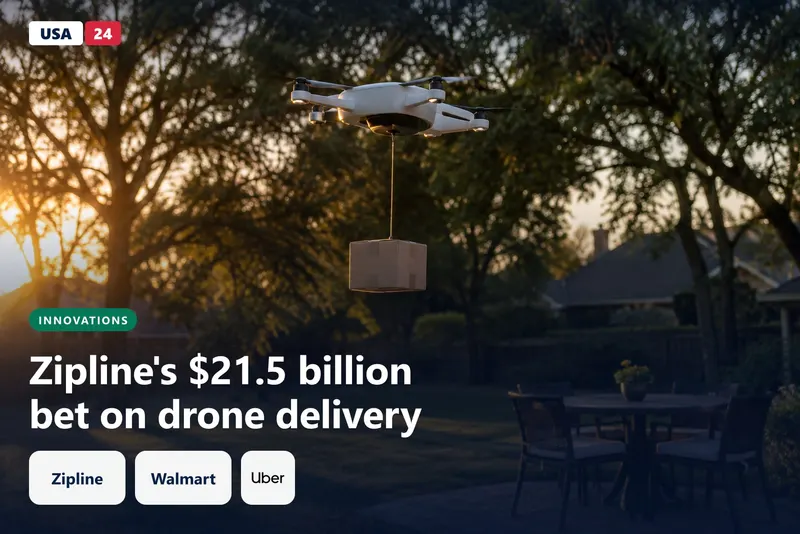
Zipline said Thursday that it raised $1.5 billion at a $21.5 billion post-money valuation. The round is tied to a 300-site expansion with Walmart and a plan to build a nationwide US drone delivery network. Reuters reported that the valuation nearly tripled in about 10 months.
Based on the reporting we reviewed, it is the largest funding event in US drone delivery so far. It lands while federal airspace rules and local noise fights remain unresolved, which makes the deal a test of whether the business can grow faster than the rules around it.
What is in the $1.5 billion round
Par Paradigm, WCM Investment Management and Layer Global led the round, according to Zipline's announcement as republished by Yahoo Finance. Valor Equity Partners, Fidelity, Uber, Tiger Global and J.P. Morgan also participated. Uber's place on the cap table matters because its app is one of the two consumer channels readers can use to order Zipline deliveries.
Matt Huang, co-founder and managing partner at Paradigm, the lead investor, said, "Zipline is now one of the largest autonomous robotics companies in the world." Investors are placing similar bets across automation. Bedrock Robotics raised $600 million at a $4.1 billion valuation to scale driverless excavators, and Tesla has named its next robotaxi cities.
Zipline says the money will go toward expanding US manufacturing, hiring and building out a nationwide autonomous delivery network, per DroneLife's coverage. The company has not published a detailed capital plan in the reporting we reviewed, so the split between factories, staff and network build-out remains unknown.
Walmart's 300 sites and the Dallas-Fort Worth test case
Walmart and Zipline agreed to a multiyear deal to launch 300 additional delivery sites. The partnership began in 2021, and this agreement extends it considerably. Walmart's broader drone program has completed more than two million deliveries, according to Tech Startups.
The sources we read did not name the cities for the 300 new sites or set a rollout schedule. Shoppers in those markets should expect the timing to be set site by site, not all at once.
Dallas-Fort Worth is the proof point so far. Zipline reports more than one million deliveries in the area this year. Its median order arrived 19 minutes after checkout in October, compared with 30 minutes or more for traditional delivery, according to the Dealroom report. Those are company-supplied figures, so the time comparison deserves independent verification.
Smaller businesses may also gain a new channel. DroneLife reports that hundreds of businesses already earn revenue through the service, with dozens joining every week.
Why the valuation jumped and what is still unproven
The latest round compares with a January 2026 raise, as shown below.
| Round | Date | Amount raised | Post-money valuation |
|---|---|---|---|
| Earlier round | January 2026 | More than $600 million | $7.6 billion |
| Latest round | November 5, 2026 | $1.5 billion | $21.5 billion |
The new valuation is roughly 2.8 times the January figure. That multiple is high for any company, and it rests on private-round pricing. No audited financials or profitability data were disclosed, and Tech Insider's coverage notes that the company has not shown its unit economics working at national scale.
The largest long-term claim comes from the Dealroom report, which says Uber is targeting one million deliveries a day by the end of 2029. That is a goal, not a commitment, and no interim milestones were attached to it in the sources we reviewed.
Noise, zoning and who controls the airspace
Noise is the main source of local resistance. Zipline's October software update reportedly cut modeled sound exposure per flight by 68%, according to DroneLife. That figure comes from a model, not from field measurements in neighborhoods, so residents should wait for independent data before accepting it. Wing and Zipline both now market quieter flight designs to win over neighbors, as The Drone Girl reports.
Local governments have limited tools. A Texas city, Round Rock, told DroneXL that its zoning ordinances did not specifically address drone hubs. It also said it could keep hubs away from residential property. Flights over neighborhoods, however, fall under federal control.
A Zipline representative told a Texas planning hearing that the drones carry payloads of up to 8 pounds, according to Citizen Portal. Neighbors at that hearing asked about noise and FAA limits, which shows the issues tend to surface together.
The legal fight is also growing. Fifteen states sued the FAA over the environmental review for commercial drone package delivery, arguing the agency did not adequately study the impacts, as Aviation Week reported.
Where the FAA's Part 108 rule stands
Part 108 is the FAA's beyond-visual-line-of-sight framework, and it is meant to allow routine, scalable drone operations. Aviation Week described the rule as moving toward finalization.
The Flight Brief described a different timeline, with Part 108 phasing in starting July 2026 and including noise standards and setbacks from schools and hospitals. The two accounts conflict. We could not confirm the current effective status from an FAA primary source, so check the agency's own rulemaking pages before making plans around it.
How to check whether drone delivery reaches you
If you live in a launch area, start with the apps you already use.
- Open the Walmart app or the Uber app and enter your address to see whether it is served.
- If you live near a planned hub, contact your city about its location and operating hours. Cities can influence both, even though the FAA controls the airspace.
- If a flight or noise problem affects you, contact the operator first. Route safety concerns to the FAA.
We did not confirm Zipline's published complaint channels beyond the city's own pages, so verify the contact details inside the app before you file a complaint.
What to watch next
The next checkpoints are concrete. Watch for Walmart to name the cities in the 300-site expansion and publish a timeline. Watch for measured noise data, not only modeled figures, and for the outcome of the 15-state lawsuit.
Watch the Part 108 status as well, because a final rule with setback and noise standards would change how quickly hubs can open near homes. Uber's one-million-per-day target will need dated milestones before anyone can judge it. Finally, the $21.5 billion valuation will face its real test once the company shares financials that show whether delivery pays for itself at national scale.