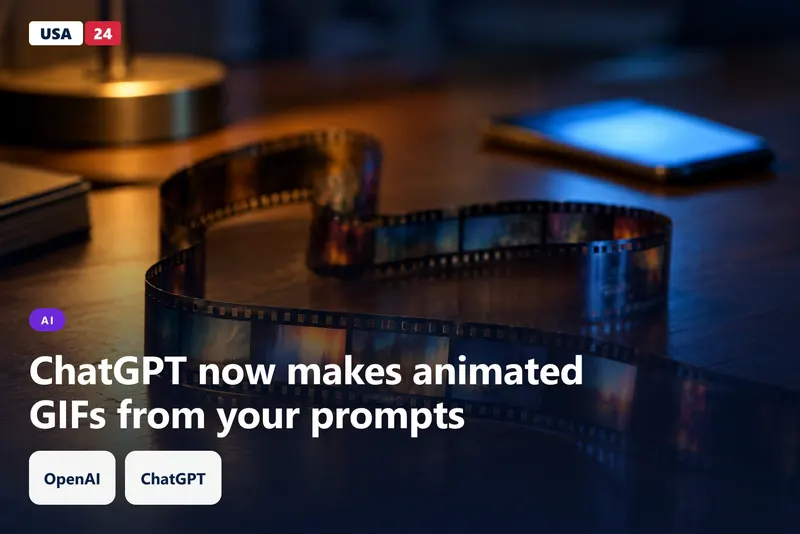
OpenAI has added animated GIF creation to ChatGPT, and the feature reaches free accounts as well as paid ones. The change arrived with ChatGPT Images 2.6, which OpenAI announced on November 4, 2026. Users can type a prompt or upload a photo, generate a looping animation, adjust its playback speed and edit individual frames before sharing it.
The announcement itself was brief. OpenAI's post on X opened with “Images, upgraded—introducing ChatGPT Images 2.6” and said the update adds GIFs and reference images. Coverage ran through November 5, with Neowin and Digital Trends among the outlets covering the launch.
What ChatGPT Images 2.6 adds
The GIF tool is the headline feature, but it is not the only change. Unite.ai and The Next Web both report that people can turn a text prompt or an uploaded photo into an animated GIF, then edit the result. The second addition lets users save reference images of themselves, their pets or characters and reuse them without uploading the file again, according to OpenAI's developer community post.
The release also marks OpenAI's second image update in about two months. The company announced Images 2.5 on September 8, 2026. Neowin and The Next Web put weekly image volume at more than 4 billion across ChatGPT, Codex and the API, up from 3 billion reported in September. Digital Trends' arithmetic works out to roughly half a billion images a day.
The feature also has a longer history. The original ChatGPT image generator launched in March 2025. Wikipedia's GPT Image entry traces the model line back to DALL-E before OpenAI rebranded the feature under the ChatGPT Images name. In about 20 months, the product has moved from still pictures to short animations.
How to make a GIF in ChatGPT
The reports describe a simple flow, but exact menu labels were not confirmed, so follow what your app shows. In general, the process looks like this:
- Open ChatGPT on web, desktop or mobile and check whether the GIF option appears in your account.
- Write a prompt that describes the motion, or upload a photo and describe how it should move.
- Review the output, change the playback speed if needed, and edit individual frames before you share.
- Save reference images only if you are comfortable keeping them in a reusable library.
- If you plan to use a photo of a real person, get that person's permission first and review every output before it leaves your device.
Review your privacy settings after the update, too. USA 24 has covered a report that an OpenAI Codex training setting was turned back on without notice, so checking data controls after any product change is a sensible habit. Read that story here.
Who gets GIF creation, and what is still unclear
Neowin reports that the feature is available globally to all ChatGPT users, including the free tier. The rollout is described as reaching all ChatGPT and Codex users on web, desktop and mobile. For free users, the change is significant because GIF creation no longer appears limited to paid plans, at least according to the reporting.
Several details remain missing. The sources reviewed did not confirm usage limits for free users, caps for paid tiers or generation quotas for GIFs. Neowin's “globally” language also leaves open whether the free-tier feature will reach other markets on the same timeline.
The competitive picture is also shifting. Trending Topics notes that GIF platforms such as Giphy and Google's Tenor supply ready-made animations, while ChatGPT generates new ones. The same outlet frames the launch as a return of motion to ChatGPT, eight months after OpenAI shut down its Sora video app. That Sora framing rests on a single source, so verify it with OpenAI before relying on it.
Speed claims and the new API models
OpenAI's speed claims need careful reading. The table below separates the claims by source and scope.
| Claim | Source | What it covers |
|---|---|---|
| 50% faster | OpenAI's post on X | Ties the figure to the two new API models |
| Estimated 50% speed increase | Neowin | Describes the release overall |
| Generation in as little as six seconds | OpenAI developer community post | Attributed to GPT-Image-2.6 Flare |
| Two new API models | OpenAI's post on X and Digital Trends | GPT-Image-2.6 Flare and Sunburst |
The split matters. OpenAI's own post ties the 50% figure to the API models, while Neowin describes an overall estimate for the release. Until OpenAI clarifies, readers should not assume that ChatGPT output is 50% faster.
Developers get the most concrete news. Flare and Sunburst are new models with new controls, and the reporting reviewed did not confirm API pricing for either one.
Deepfake and consent questions for animated images
Animated outputs carry the same consent risks as still images. Motion can make a fabricated image feel more convincing, which is the central concern for any animation tool. Federal law already reaches the worst cases. The TAKE IT DOWN Act criminalizes publishing non-consensual intimate imagery, including AI-generated deepfakes, according to White & Case's federal AI regulatory tracker. A Justice Department task force focused on advanced AI misuse, which USA 24 has covered in a separate story, signals that federal attention to AI misuse is growing.
The gap is in the safeguards. The reporting reviewed did not confirm what protections apply to animated outputs, or whether OpenAI published a system card or safety note for the GIF feature. Parents and educators will recognize the usual questions: how the tool handles real-person likenesses, what it blocks, and how misuse gets reported. Those answers are the ones to look for before classroom or family use.
What to watch next
Three open questions will shape how this launch lands. The first is whether the 50% speed claim applies to ChatGPT output or only to the API models. The second is what limits free and paid users actually face, which will show whether GIFs are a casual feature or a metered one. The third is whether OpenAI publishes a safety note that explains how animated images of real people are handled.
The Sora question also deserves a clear answer. If OpenAI confirms that motion is returning to ChatGPT after Sora's shutdown, that will tell readers how the company plans to package video-like features going forward. Pricing for Flare and Sunburst will determine how quickly developers build animated image features into their own products.