How data center ballot measures fared across the country
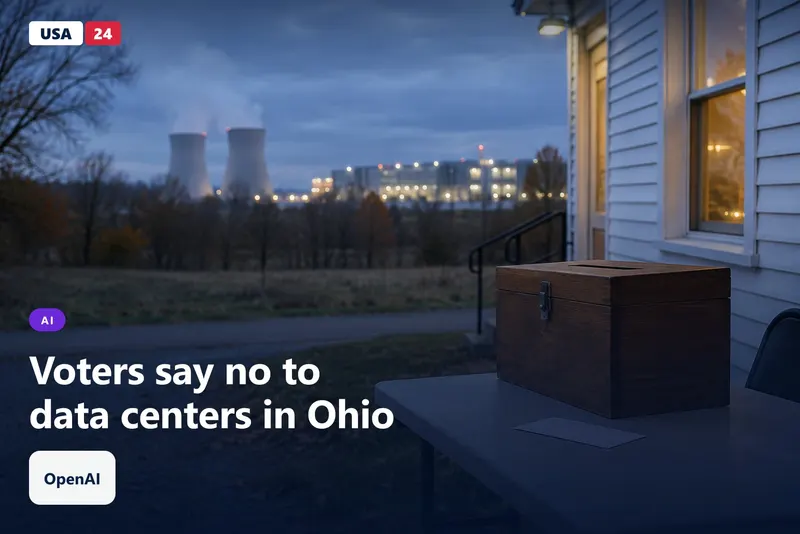
Voters in roughly 10 states rejected 40 of 41 local data center ballot measures on Election Day, November 3, and the results arrived as investors were already uneasy about AI stocks. Ballotpedia and CNBC counted the 41 measures, which would restrict data center construction. Voters sided against the projects in every one except a single measure in Harwood, North Dakota.
These were not candidate races. They were zoning rules, charter amendments and referendums decided by residents of individual towns. That is what makes the count a useful signal. Voters were not asked whether they like AI in the abstract. They were asked whether a specific kind of project should be allowed in their own community.
Fox Business, citing Washington Post reporting, said voters in at least 38 jurisdictions passed measures that limit or block data centers. That figure is framed differently from the 41-measure count, and the sources disagree on totals, a point covered below.
Ohio accounted for more than half of the measures
Ohio alone had 21 of the 41 measures, spread across 18 municipalities, according to Fortune. That is more than half the national total, which makes Ohio the center of the results.
At least 14 Ohio municipalities passed bans or other restrictions, and most of the measures targeted "high impact" campuses drawing more than 25 megawatts. Fortune's analysis also said Ohio is already home to 125 existing data center moratoriums, a sign that local opposition there predates this vote.
The next test in Ohio is statewide. Yahoo News reported that a Prohibition of Data Center Construction Amendment would bar data centers above 25 megawatts of monthly demand and is reportedly headed for next year's ballot. The date and text should be confirmed with the Ohio Secretary of State before anyone relies on them.
The measures also overlapped with the midterm races. CNBC and Forbes reported that Democrats won several key races where anti-data-center messaging featured, including Ohio's governor race, which Amy Acton won.
Which Ohio towns passed data center restrictions
Several towns show what voters approved:
- Defiance approved a charter amendment restricting data center construction, 64.73% to 35.27%, according to Fox Business.
- Granville and Pataskala passed similar amendments by wide margins, with Granville at 82.45% and Pataskala at 73.62%.
- Ashville voters rejected a data center referendum by 81.61% to 18.39%. The town also voted to overturn a municipal agreement that had allowed two data centers.
- Perry voters approved rules requiring developers seeking tax breaks to provide financial guarantees and noise limits, as Forbes reported.
Perry is a useful model for towns that do not want an outright ban. Its rules attach conditions to the tax breaks developers want.
Harwood, North Dakota, was the lone exception. Voters there rejected a proposal that would have required an independent review and a public hearing before approving large industrial projects, including data centers. It was the one pro-industry result in the national count.
Why voters turned against data centers
Stateline's reporting lists the local concerns: energy costs, pollution, water use, noise and loss of farmland. Electricity costs stood out, and the measures that tie tax breaks to financial guarantees reflect that worry directly.
An NBC exit poll found that 56% of voters said AI and data centers were a "crucial or major factor" in their congressional vote, as Stateline reported. A separate breakdown of the same poll, reported by The Hill, put 23% of voters at "crucial" and 33% at "major," and found that 76% would oppose a new data center in their community. Exit polls capture a single day, so treat these figures as directional rather than precise.
The sentiment predates the ballot. A Gallup poll from May, cited by Fortune, found about 70% of Americans opposed data centers in their local area.
Conserve Ohio, a campaign that worked with local leaders to draft ballot language, offered a view of the coalition behind the votes. Nick Owens, an attorney with the group, told Stateline the effort showed "people coming together across communities, putting partisan differences aside."
What the results mean for developers and utilities
The votes do not halt the buildout on their own. An expert quoted by Inc. said projects that already hold construction permits will likely continue, while zoning-type measures restrict how future projects can proceed. Whether bans and moratoriums survive legal challenges, and whether existing permits are honored, has not been confirmed.
Future projects face a different map. A developer may now need approval from a city council, a county commission or a town's voters, in addition to state and utility sign-offs. Projects that move toward towns that have not yet voted could meet a second round of opposition.
For households, the central question is who pays. OpenAI released a National Community Compact and a Compute Campus Policy Blueprint on November 5. According to Inc., the company proposed that its future self-built campuses cover electricity and infrastructure costs and publicly disclose water and power use. USA 24 has covered that response in its story on OpenAI's pledge to pay full data-center power costs.
Investors had already been jittery, and the votes add a local-level risk to the sector. USA 24 also reported on how AI stocks fell after the midterms as governors moved against data centers.
What Congress and Democrats could do next
Democrats take control of Congress in January. Incoming House Democratic leadership, including Ted Lieu, said the new majority would hold AI hearings and pursue "reasonable guardrails on AI," according to WCTI12.
Democrats have also pushed a federal AI pause and superintelligence ban for after the midterms. No federal action tied to the ballot results has been confirmed.
Steps to check for a data center proposal near you
Residents who want a say have a few concrete options:
- Check the agenda for your city council, county commission or township planning board. Proposals usually surface there before a vote.
- Ask whether the developer has a power or water agreement on file with your utility or municipality, and request copies through the clerk's office.
- Look for tax-break terms, financial guarantees and noise limits. Perry's rules show these conditions can be written into local law.
- Watch for statewide proposals. In Ohio, confirm the text and date of the amendment with the Secretary of State before organizing around it.
Open questions behind the vote counts
- Final counts differ. Semafor reported more than 30 localities across nine states. Bloomberg, as cited by AI Weekly, counted 30 of 35 measures failing. Forbes and CNBC reported 41 measures across 10 states. Some results were still being counted when the reports ran.
- Ohio's footprint is unsettled. Forbes counted 154 operational sites, 27 under construction and 57 planned, while The Hill said Ohio has more than 200 data centers. Those figures should be reconciled before anyone quotes one.
- The legal effect is unknown. Whether bans survive court challenges has not been confirmed.
What comes next for the data center fight
The next tests are in Ohio and in Congress. If the statewide amendment reaches the ballot, Ohio voters would decide whether a 25-megawatt threshold applies across the state, which would turn a set of town-by-town votes into one rule. In Washington, Democrats will set the agenda in January and have promised AI hearings.
Watch whether the local bans hold up in court and whether developers shift projects toward towns that have not yet voted. The next several months will show whether the 40-of-41 result changes how data centers get built.