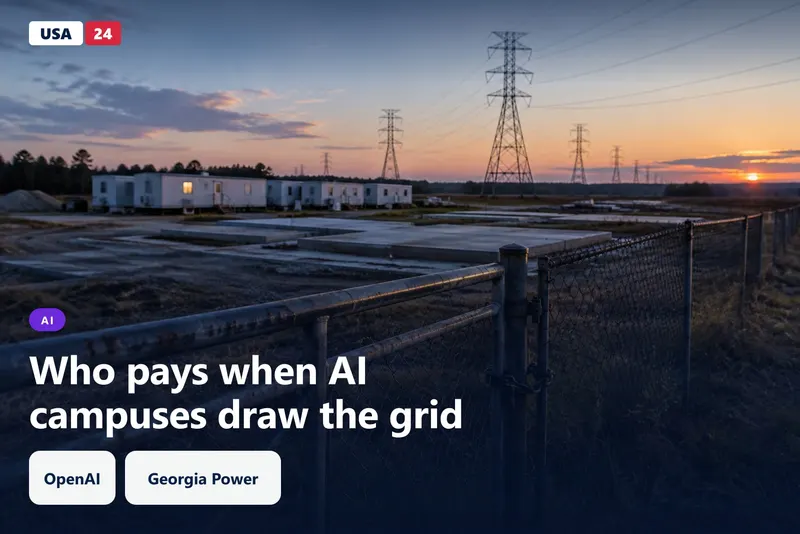
OpenAI will pay the full electricity and grid costs of the data center campuses it owns, and it will stop signing nondisclosure agreements with public officials. The company published the commitments on Thursday, two days after voters in the midterms backed limits on nearly every local data-center measure on the ballot.
Here is what the OpenAI data center power costs pledge actually says, and where it still falls short. The promises answer the two complaints that drove the backlash: power bills and secret deals with local governments. Whether they hold depends on enforcement the company has not described.
What OpenAI actually committed to
The package has two parts, a National Community Compact and a Compute Campus Policy Blueprint, both released on November 5, 2026. Quartz reported the details. For future campuses that OpenAI owns and operates, the company says it will pay the full cost of electricity and required infrastructure. It also says it will protect other customers from costs if a project is delayed or canceled, through financial assurances.
On secrecy, the company says it will bar NDAs with public officials. The exceptions are narrow: security details, trade secrets and competitively sensitive information. Each campus would get its own local compact, a named local point of contact and an annual public report.
Before operations begin, OpenAI says it will publish a water plan for each site, site-level water and electricity use, construction plans and independent noise studies. Those commitments cover the three areas the compact targets most directly: who pays for power, how much water a site uses, and how loud it gets.
OpenAI also wants its sites called "AI compute campuses" rather than data centers. The name change is easy to read as branding. The commitments are the part worth checking.
Why the midterm vote pushed OpenAI to act
OpenAI framed the compact as a response to the midterm results, and the results were lopsided. USA 24 has been tracking the post-midterm backlash, including how AI stocks fell as governors moved against data centers.
According to CNBC, 41 local data-center measures appeared on ballots in 10 states on November 3, and Ohio accounted for 21 of them. Voters backed limits in 40 of the 41, according to Ballotpedia and CNBC's analysis. The lone exception was in Harwood, North Dakota.
Polling pointed the same way. In a CNBC voter poll, 56% of voters said data centers were a major factor in their vote. In CNBC's All-America Economic Survey, 63% said they would oppose an AI data center within 10 miles of their home, while 13% said they would support one.
The backlash reached statehouses too. Texas Gov. Greg Abbott, a former data-center supporter, halted data-center permitting in September, and CNBC reported he later introduced a moratorium. Rep. Greg Casar, D-Texas, who chairs the Congressional Progressive Caucus, said in a statement reported by CNBC: "The revolt against data centers was one of the top issues of the 2026 election."
The OpenAI move also follows Amazon's October announcement that it would stop using NDAs with public officials on data-center projects. Political spending on AI was heavy this cycle as well. USA 24 reported that AI-made midterm ads topped $137 million, and most carried no AI label.
The count is not settled
The tallies disagree, and the sources have not reconciled them. Fast Company reported that 38 of 41 measures went for banning or pausing development, with three not yet reporting. The Washington Post reported at least 38 jurisdictions passed limits or bans, as summarized by Fox Business. A CNBC preliminary tally said roughly two dozen proposals appeared to pass.
This article uses the 40-of-41 figure because it matches the Ballotpedia count cited alongside CNBC's analysis. Treat every number as provisional. A Luminix industry analysis notes that ballot counts remain unofficial until local canvasses are certified.
Who pays when a campus pulls power from the grid
The electricity provisions carry the most practical weight. OpenAI's agreement with Georgia Power for its planned Effingham County campus lets the utility cut deliveries by up to 1,000 megawatts during periods of high demand. That means the campus can be cut back when the grid is stretched, a different risk profile from a facility that expects uninterrupted supply.
Covering the bill for infrastructure at OpenAI's own sites does not settle whether costs spread to other customers in a region. That depends on utility commission rules. The blueprint asks governments to keep residents from subsidizing data-center power costs, but the sources do not say whether any state has adopted such rules.
The blueprint reaches beyond OpenAI's own sites. It asks federal, state and local governments to restrict mandatory NDAs for officials, require disclosure of environmental and employment impacts, and keep residents from subsidizing power costs. The compact pushes for similar rules industry-wide rather than relying on company promises alone.
One roundup also reports an $80 million Georgia community investment, including $4.8 million for school meals and $2 million for parks. The sources do not explain how that money relates to the compact, so readers should treat it as separate until OpenAI says otherwise.
Where the pledges fall short
- Voluntary for now. The pledges are not binding, and the compact does not require partner-owned campuses to adopt every provision.
- No described enforcement. The sources do not describe a penalty or an independent audit mechanism.
- Narrow scope. The commitments cover only campuses OpenAI owns and operates. Partner-owned sites are not bound.
- Competitors unknown. It is not clear whether Google, Microsoft, Meta, Amazon or others will match the NDA and power-cost terms. Amazon's October decision on NDAs is the closest precedent in the sources.
What residents and ratepayers can do now
The steps below are practical suggestions based on the commitments, not recommendations from the sources.
- Ask your county or city whether a proposed data center near you has a community agreement or NDA on file, and request copies of any public compact.
- Ask your state utility commission whether large-load customers pay their own grid costs, and whether that rule appears in the utility's tariffs.
- Attend local zoning and utility hearings, where land and power deals are decided. Ask whether the project has a named local point of contact and a published water and noise plan.
What to watch next
Three developments will show whether this becomes an industry standard or a press release. First, whether Google, Microsoft, Meta or Amazon publish comparable power-cost and NDA terms. Second, whether state utility commissions or legislatures take up the blueprint's proposals. Third, whether OpenAI publishes its first annual public reports and local compacts, and how the Effingham County curtailment clause works in practice.
The buildout is moving on other fronts as well. Google is backing a $19 billion data-center lease for Anthropic in Kentucky, which USA 24 covered in a separate report. If rivals match OpenAI's commitments, the power bill will become a test every new campus must pass. If they do not, the pledge will still serve as a reference point for the lawmakers the blueprint is asking to act.