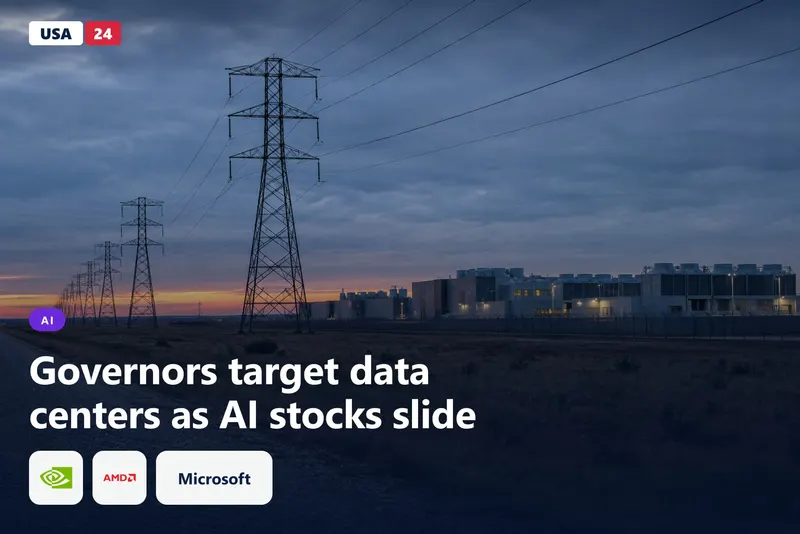
Which governors could halt data-center construction
Voters on Tuesday, November 3, elected governors who campaigned against data-center construction, and investors sold AI chip stocks on Wednesday and again on Thursday. Fortune named three races it said could matter most for AI infrastructure: Gina Hinojosa in Texas, Amy Acton in Ohio and Keisha Lance Bottoms in Georgia.
Hinojosa defeated incumbent Greg Abbott. She has promised a moratorium on data-center construction and an end to subsidies and tax breaks for major developers. She called Abbott's tough talk on the issue "nothing more than an election-year stunt."
Bottoms promised a temporary statewide pause on new construction so Georgia can study the effects on electricity bills, communities and the environment. Her proposal explicitly cites power bills, which makes it the clearest link between the vote and what households pay.
Texas is the biggest test. It is the largest data-center market in the country. A SemiAnalysis figure cited by ETF.com and a Bloom Energy report cited by Fortune both put Texas at nearly 30% of US data-center capacity by 2028. Startup Fortune counted 335 operating Texas data centers and 247 in planning.
Before the vote, Abbott had already paused new grid connections for data centers in August, according to a Yahoo Finance summary of an analyst argument. That pause may already constrain permits, even without new legislation. The reports do not say when either candidate's pause would start, whether it needs legislation, or how it would be enforced.
Why AI chip stocks sold off on November 4 and 5
The selling did not start with the vote count. ETF.com reported that investors had been pulling back from chip ETFs in the weeks before the election over how the AI buildout would be financed. Chip stocks then fell on Wednesday, November 4, with Nvidia, Broadcom and Applied Materials moving sharply lower. ETF.com tied the drop to backlash against data centers.
Yahoo Finance reported that AMD fell 13%, Nvidia slid 7% and Intel dropped 8% on fears of Democratic AI regulation and slower data-center construction. The same day, Rep. Yassamin Ansari (D-Ariz.) called for a pause on advanced AI development until adequate regulations are in place, according to Yahoo Finance and StockTwits. Ansari's call is one lawmaker's statement, and the sources do not describe a bill.
Thursday's early trading extended the decline. Devdiscourse reported Nvidia down 1.5% premarket, Marvell off 4.5%, and IREN, Hut 8 and Applied Digital each falling more than 4%. Premarket numbers can change by the open, so treat them as an early read.
The sharpest market argument came from BCA Research analysts, who wrote that "Tighter data center restrictions on the margin raise the risk to future supply of 'compute,'" especially in Texas, Georgia and Ohio, according to Devdiscourse. Put simply, fewer approved data centers in three states means less demand for the chips that would have gone into them. The selloff also lands while Apple has passed Nvidia as the world's most valuable company at $5.03 trillion, so investors are repricing the whole AI complex.
Why the loss figures disagree
Reports on the same moves conflict, and the Thursday closing figures are not in this brief. The gaps look mostly like timing, since the sources cite different moments in the session. Here is how the main numbers compare:
| Stock or index | Reported moves | Where the figures come from |
|---|---|---|
| AMD | Down 4.74% to down 13.1% | Yahoo Finance, Zetik, Investing.com, Startup Fortune, BigGo |
| Nvidia | Down 1.61% to down 7% | Yahoo Finance, Zetik, Startup Fortune, INDmoney, BigGo |
| Nasdaq | Down about 3.6% to about 5% | Zetik (midmorning), Startup Fortune |
| Philadelphia semiconductor index | Down 3.1% to down more than 9% | Reuters via Finimize, Zetik |
Reuters, through Finimize, reported that the Philadelphia semiconductor index fell 3.1% after Democrats campaigning on data-center limits won races, leaving the index down roughly 25% over the past month. Zetik put the same index down more than 9% in its midmorning report. Startup Fortune said the Nasdaq fell about 5% and headed into correction territory.
Confirm closing prices from an exchange or your brokerage before you publish or trade on any single figure.
Why power and cooling stocks took the bigger hit
The steepest declines were not in the chipmakers. In a Yahoo Finance commentary by Steve Weiss, Vistra fell 14% and Vertiv fell 13%, while Nvidia slipped only about 3% and Broadcom slipped far less. That Nvidia figure conflicts with the 7% drop Yahoo Finance reported in its AMD story, so verify it against closing data.
Weiss argues that chip makers sell worldwide, so a project blocked in one state can move elsewhere and still buy the same processors. Data-center operators, utilities and power equipment suppliers take the hit first, because their revenue depends on specific sites. That explains the pattern: the companies tied to local projects fell hardest.
Investors with broad index funds or retirement accounts that hold chip stocks are exposed too, even if they never bought a single data-center company directly.
What the Microsoft and Nscale report does and does not show
Microsoft will not exercise an option to more than double its rental agreement with Nscale at a Texas data center, a person familiar with the matter told Reuters, in a report the Financial Times published first, according to Investing.com. The original 2025 deal covers about 200,000 Nvidia chips across Europe and the US. The decision reportedly predates Nscale's September IPO filing, and Reuters and the FT both say it was made months ago, before the election. It should not be presented as a reaction to the midterms.
The stakes for Nscale are still large. Reuters reported that Nscale was in talks to sell AI computing power to Anthropic in a deal that could be worth about $45 billion. That is the kind of contract that could be affected if data-center capacity slows. Investors have been weighing whether Big Tech's $3 trillion in AI spending pledges will hold up, and this selloff puts that question in sharper focus.
Local votes and the federal gap
Local fights are already producing results. Time reported that data-center bans or moratoriums passed in counties from Florida to Illinois, and that mayors in Piqua, Ohio and Yukon, Oklahoma were recalled over their support for data-center projects. Duane Morris's November 4 tracker counted 38 outcomes limiting development among 39 local data-center measures decided on election day, according to a summary by INDmoney.
Congress is a different story. No comprehensive federal AI statute exists, and federal policy has focused on preempting state AI laws, according to Time and Investing.com. Nothing in these sources shows Congress has passed data-center legislation. Sources also describe the congressional results differently, so this article does not rely on a specific count of seats.
What to check before the next vote
- Check your county or city agenda for pending data-center zoning, tax-abatement or moratorium items. The Time and Duane Morris figures show these votes are happening well beyond Texas and Georgia.
- Ask your utility whether it plans to pass data-center power costs on to residential customers, and whether a rate case is pending before your state regulator.
- If you hold chip ETFs or index funds, check closing prices rather than premarket quotes, and see how much power and cooling stocks weigh in your holdings.
- Ask officials when a proposed pause would take effect, whether it needs legislation and who would enforce it.
Three things will show what comes next. Closing figures for November 4 and 5 will settle how large the losses were. The text of any pause proposal from Hinojosa or Bottoms will show whether it needs legislation or can move through state agencies. Then there is the BigGo report's UBS estimate that about 30% of projected 2028 US data-center capacity additions could face construction delays. That number will decide whether this is a lasting change in demand or a timing problem. Analysts still disagree on its scale, so permit filings and construction schedules will tell you more than any single trading day.