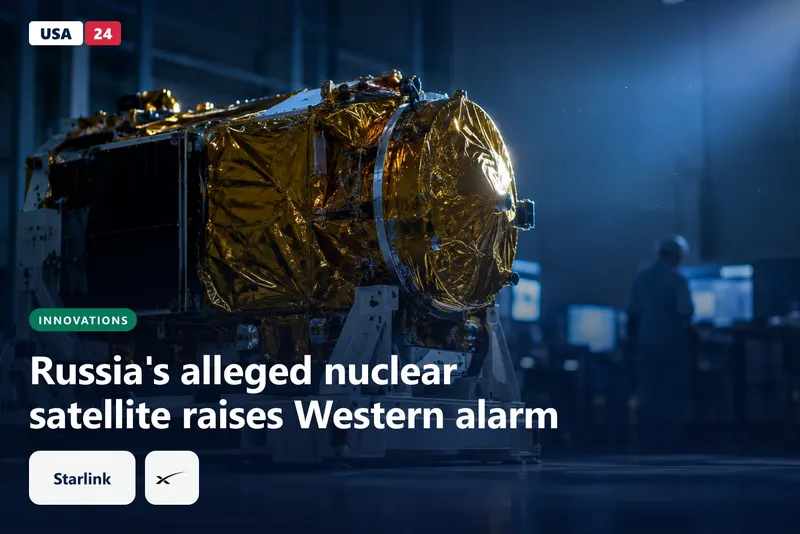
Western intelligence services reportedly believe Russia could launch a nuclear-armed satellite as early as December. German reporting names the craft the Sputnik-S nuclear satellite, a program Moscow denies. The claim comes from a joint investigation by the public broadcasters NDR and WDR and the Süddeutsche Zeitung, published Nov. 23 and picked up across outlets on Nov. 24. No government has confirmed a launch, a payload or an orbit.
The story reaches well beyond Moscow. The reporting ties a possible orbital nuclear weapon to US military and commercial satellites, which puts American space infrastructure at the center of a European investigation. Defense News framed its version as a warning that a launch could come by year's end.
Sputnik-S nuclear satellite: what the reports say
The reports describe a satellite built several years ago and kept in storage near Moscow. The Washington Times reported that Western intelligence believes the craft could be launched as early as December. The same article said Russia's embassy in Berlin rejected the reports as a “propaganda campaign.”
Other officials responded quickly. NATO Secretary-General Mark Rutte said the alliance would defend against threats in space. Germany's Friedrich Merz called the allegations “shocking” while speaking with Rutte in Berlin, according to Fox News. The Kremlin dismissed the claims as unfounded, per Tom's Hardware.
Why the launch date is disputed
Two timelines are in circulation, and they do not match. The Washington Times framed the risk as a launch “as early as December.” The investigation cited an early-November intelligence assessment that a launch could happen “within 60 days,” which would push the window into early January.
Intelligence shared among NATO countries this month reportedly points to a launch window of up to 60 days. The reporting does not say which country produced that intelligence, and it relies on unnamed sources. Yahoo News reported that Germany's military space command assessed Sputnik-S could become operational soon after reaching orbit, which would leave little room between launch and any operational use.
The gap matters for anyone planning around the threat. A December launch would land within weeks of the reporting, while a 60-day window from an early-November assessment leaves room for the picture to change before the story settles.
Is Sputnik-S a weapon or a test dummy?
The reporting itself splits on what the craft is. Security services told the broadcasters they believe it is a “dummy” built to measure how radiation affects satellites and when they suffer serious damage. In that reading, Sputnik-S is a test article for studying nuclear effects in orbit rather than a deployed weapon.
That distinction is contested, and the reporting does not establish that the satellite carries a nuclear weapon. The US government's public position is broader. In October, the Defense Intelligence Agency said that “Russia is developing a satellite designed to carry a nuclear weapon,” a line Fox News quoted from the agency's 2026 Challenges to Security in Space assessment. That statement describes development work, not a confirmed launch.
The reporting also points to Kosmos-2553, a prior Russian test satellite that launched shortly before Russia's full-scale invasion of Ukraine in February 2022, as Defense News reported. Its flight gives analysts a reference point for how Moscow has tested space systems before.
Why a nuclear detonation in orbit is different
A conventional anti-satellite missile targets one spacecraft. A nuclear detonation in orbit could damage many satellites across a wide area through radiation, a point Yahoo News made in its coverage of the reports. That footprint is what separates the scenario from a single-target strike.
History gives the concern some weight. An artificial radiation belt created by an earlier blast damaged several satellites, including Telstar-1. That is the same kind of effect the "dummy" is reportedly designed to measure.
Legally, Tom's Hardware reported that a nuclear device in orbit would breach the 1967 Outer Space Treaty. The treaty bars nuclear weapons in orbit, so a deployed device would be a clear violation rather than a gray area.
Which systems and services are at risk
If the reports are accurate, the most direct targets are US military and national-security satellites, along with commercial communications and navigation services. IBTimes noted that US officials have previously said systems including Starlink could be vulnerable to a space-based nuclear attack. Ukraine uses Starlink for battlefield communications, which gives that warning practical weight.
Consumers would feel any damage indirectly, through GPS, satellite TV, phone and internet service. The reports do not confirm a specific risk to those services, and no source reviewed reports that a current satellite has been damaged.
The US timeline adds context. The White House said in February 2024 that Russia was pursuing a “troubling” capability that had not been deployed, according to the Washington Times. Accounts differ on when US warnings began. Tom's Hardware says the US first warned in February 2023, while IBTimes points to the 2024 statement. Rep. Mike Turner (R-Dayton) wrote to President Trump urging a response and called the situation a “Cuban Missile Crisis in Space,” per the Dayton Daily News.
The same week, SpaceX flew more national-security launches for the US government, as Spaceflight Now reported. On Nov. 24 at 8:08 a.m. PT, USSF-266 lifted off from Vandenberg, the fifth US government mission SpaceX has flown this month. That launch has no connection to the Russian claim, but it shows how often national-security payloads now fly on commercial rockets. For background, read our coverage of SpaceX's classified NROL-136 mission.
What readers and businesses can do now
Most of the practical advice here is about discipline rather than action.
- Follow official statements from US Space Command, the Pentagon and the State Department, and watch for any NATO response.
- Treat social media posts about launches or detonations as unverified until an official source confirms them.
- If you rely on GPS, satellite TV or internet service and notice disruptions, check your provider's service status page before assuming a cause.
- Businesses in satellite-dependent sectors should watch for space-weather or interference advisories and for contingency planning from carriers and space operators.
What to watch next
Ambiguity is itself a pressure point. Whether or not Sputnik-S is a weapon, the claim forces satellite operators and allied militaries to plan for the worst while the facts stay thin. Moscow can benefit from that uncertainty, and allied governments carry the cost of planning around it.
No US government reaction beyond the Defense Intelligence Agency and Congress appears in these sources. The next useful signal is a statement from the White House, the Pentagon or NATO issued after Nov. 24. Watch whether the December and 60-day timelines produce an official launch notice, and whether any government publishes evidence that moves the claim beyond unnamed sources. Turner's letter may prompt congressional follow-up, which would show whether Washington treats this as a near-term threat.