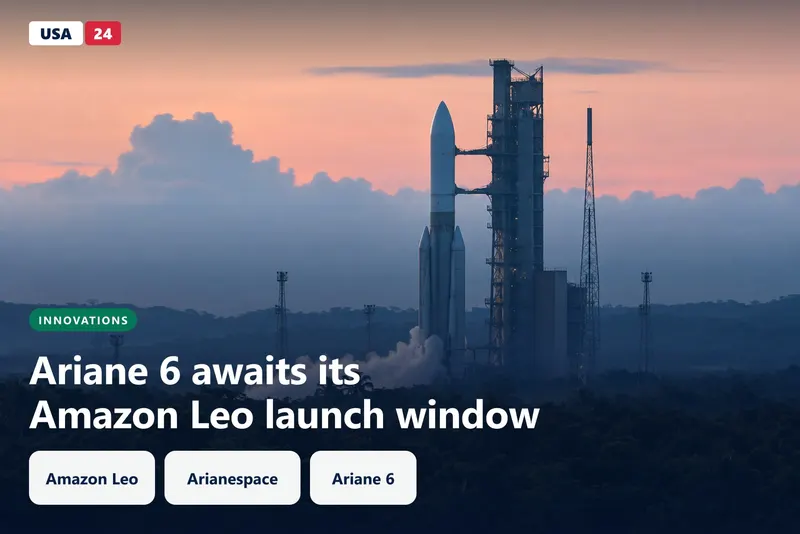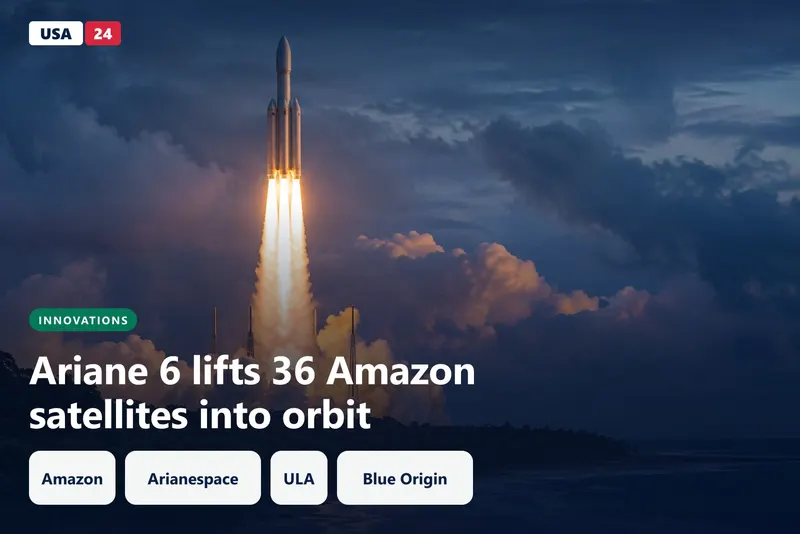
The Amazon Leo launch on Tuesday put 36 internet satellites into orbit from French Guiana, nine days after a Vulcan failure destroyed 40 of the company's spacecraft. An Ariane 6 rocket lifted off from Europe's Spaceport in Kourou at 8:14 a.m. local time, which is 6:14 a.m. Eastern. Liftoff came one day later than the first target window, and the flight was Amazon's first launch since the Vulcan loss.
Arianespace said in its mission release that the mission, designated VA271 and called Leo Europe 4, was the 10th Ariane 6 flight and the fourth Ariane 64 flight overall. It also marked the second flight of the P160C booster configuration. The launch followed a scrubbed attempt that USA 24 covered in advance.
How the Ariane 6 Amazon Leo launch unfolded
Amazon has now flown four Ariane 6 missions for its network this year, following launches in February, April and June. The February flight was the Ariane 64 maiden flight and the first Ariane launch for the program, according to Wikipedia's list of Ariane launches. Space.com reported that the satellites separated about two hours after liftoff.
- Liftoff: 8:14 a.m. local time in Kourou, or 11:14 UTC.
- Separation: The last satellite separated two hours and four minutes after liftoff.
- First contact: Amazon said it had made contact with all 36 spacecraft as they completed their first orbits.
- Next step: Routine health checks come before each satellite climbs to its operating altitude of 630 km.
Amazon's post on X called the Leo Europe 4 flight a mission success, but it stopped short of saying every satellite has passed its checks or reached working altitude. A clean separation is the first test, not the last. The health checks and orbit raising will show whether all 36 spacecraft are usable.
Steve Metayer, Amazon Leo's vice president of production, framed the partnership in one line: “Every Ariane 6 mission we fly with Arianespace builds on the one before it.” Arianespace chief executive David Cavaillolès put the milestone in volume terms: “Having now placed 136 Amazon Leo satellites into orbit this year.” Those statements describe a partnership that now carries a large share of Amazon's near-term launches, and this flight gives the Ariane 6 route a steady run after a rough stretch for US heavy-lift vehicles.
Why the Vulcan and New Glenn losses hit Amazon Leo
The timing is what makes this launch notable. A ULA Vulcan Centaur failed to reach orbit on November 15 with 40 Amazon satellites aboard, and those spacecraft were destroyed. USA 24 reported on Amazon's Ariane 6 comeback after that loss. The sources reviewed do not describe the cause in detail. A ULA investigation was referenced, but its findings were not described in the material available.
Blue Origin added to the setbacks. Its fourth New Glenn rocket, which was meant to carry 48 Amazon Leo satellites, was destroyed along with some launch infrastructure in a pad explosion during a static fire test of its BE-4 engines.
Amazon has relied on several providers, including Arianespace, ULA and SpaceX. That spreads risk, but it also means a single failure can slow deployment. Two US heavy-lift vehicles lost Amazon hardware within weeks, which leaves Ariane 6 and SpaceX carrying more of the near-term load.
Arianespace gains the most visible role in the program this month. SpaceX stands to carry more of the schedule while Vulcan and New Glenn are sidelined. Amazon loses time on hardware it had already built, and the sources do not put a dollar figure on those losses.
Building spacecraft and launching them are separate bottlenecks. Amazon announced in October that it had built its 1,000th satellite at its Kirkland, Washington, facility. This week's losses fall on the launch side of that equation, and the sources do not say when replacement launches can be scheduled on Vulcan or New Glenn.
How many Amazon Leo satellites are in orbit now
Amazon reports more than 430 Amazon Leo satellites in orbit after this flight. StartupHub.ai reported the same milestone, and one source gives a slightly higher figure of 432. This article uses Amazon's number.
The completed first-generation constellation is planned at 3,232 spacecraft, which leaves roughly 2,800 still to launch. The Federal Communications Commission required Amazon to deploy half of its constellation by July 30, 2026. In June the agency partially granted a waiver. At the time of that filing, Amazon had estimated roughly 700 satellites would be in orbit by that date, according to Spaceflight Now.
At roughly 430 in orbit, Amazon is well behind that earlier estimate. None of the material reviewed shows whether the FCC has acted since the June waiver, and the sources do not explain how Amazon plans to close the gap.
Amazon Leo vs Starlink: how far behind is Amazon
Amazon Leo, formerly known as Project Kuiper, is designed to deliver broadband from low Earth orbit and compete with SpaceX's Starlink. Space.com reports that Starlink has more than 11,000 operational spacecraft. Amazon's in-orbit count is not a like-for-like measure, but the gap is still wide, with Starlink running roughly 25 times as many spacecraft.
Amazon is betting that a multi-provider launch strategy can close that gap. This week showed both sides of the bet. Ariane 6 kept flying while Vulcan and New Glenn were out of service, which is what a diversified plan is supposed to do. The losses also show that several vehicles can suffer setbacks within a few weeks.
When does Amazon Leo internet start in the US
None of the sources reviewed give a start date for Amazon Leo consumer service in the United States. Deployment has to continue for months before broad availability is realistic, and the constellation remains far from its planned 3,232 spacecraft.
The launch also has a supply-chain angle. Amazon says more than 600 companies in 13 countries build the Ariane 6 supply chain, and suppliers need two to three years of lead time. That lead time helps explain why Arianespace's expanded agreement, now covering 24 Ariane 6 launches for Amazon, is a longer commitment than any single flight.
What to do now if you are weighing satellite broadband
Consumers have no urgent step today, because no service date has been published. Business buyers and rural operators can take a few practical steps before committing to a satellite-backed plan.
- Check Amazon Leo's official site for coverage maps and pricing once they are published.
- Ask Amazon Leo for coverage and service-level details in writing before signing anything.
- Ask what happens to contract terms if deployment slips, since the constellation is still far from its planned size.
- Keep a backup connection for any site that depends on satellite service.
What to watch next
Amazon's next checkpoint is simple to state: confirm that all 36 satellites have passed health checks and reached 630 km. After that, watch for an updated satellite count and whether the next Ariane 6 flight for Amazon launches on schedule. The Vulcan and New Glenn return dates will decide how much of the remaining build-out depends on Ariane 6 and SpaceX. Any FCC action on the 2026 milestone will also show how regulators view the gap. The next Ariane 6 flight for Amazon will be the next real test of whether the schedule can hold.