Amazon wants its Leo satellites back in the air, and it wants to fly them on a different rocket. Eight days after a ULA Vulcan failure cost 40 of them, the company is working toward its next launch, an Ariane 6 flight that trackers list for November 23 or 24.
The loss is the biggest setback yet for Amazon Leo, the satellite-internet service formerly called Project Kuiper and built to compete with SpaceX's Starlink. SlashGear reports that Vulcan and New Glenn are both grounded, which leaves Amazon leaning on Europe's Ariane 6 while more than 3,000 satellites still need to launch.
Here is what is known, what remains open, and what the delay means for Americans who want to sign up.
What went wrong on the November 15 Vulcan flight
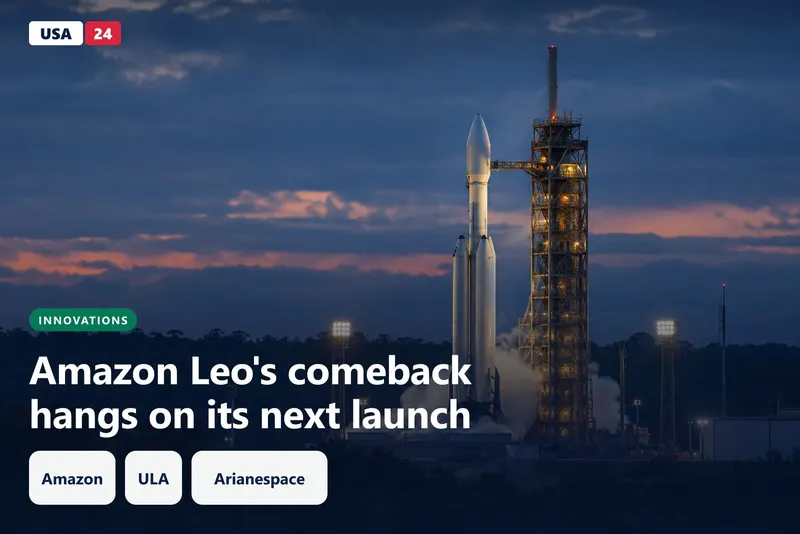
ULA's Vulcan Centaur lifted off from Cape Canaveral on November 15 carrying 40 Amazon Leo satellites. About 10 minutes into the flight, the rocket suffered an anomaly, and the payload never reached orbit, according to SpaceNews.
Spaceflight Now describes it as ULA's first total mission failure. The flight was meant to show Vulcan was ready to fly again after roughly nine months on the ground. Instead, the mission ended with the entire payload lost. BGR notes that it is also the first Amazon Leo failure in 16 launches.
Vulcan first flew in January 2024, and the Space Force certified it for national security missions in March 2025, according to Wikipedia's Vulcan Centaur entry. Northrop Grumman said its solid rocket boosters performed as expected and separated before the anomaly.
In a post on X from its @ulalaunch account on November 15, ULA wrote: "Every flight generates data, and every flight teaches us…" The post appears in an IBTimes UK report on the loss.
Was it a fuel problem? What is still unknown about the cause
The most specific clue so far comes from SlashGear. It reports a preliminary ULA finding that the first-stage booster did not produce enough thrust because its engines were not getting enough fuel. That is a lead, not a conclusion. Other reporting says ULA has not confirmed a cause, and the finding has not been made official.
Spaceflight Now adds another open question. It says it is not yet known whether a countdown problem played any role.
That distinction matters. A fuel-delivery fault during ascent could point engineers toward propulsion hardware and flow systems. A countdown issue would point them toward ground procedures and sequencing. Both could be fixed, but they would involve different reviews and different parts of the vehicle.
For Amazon, the timing question is simple to state and hard to answer. ULA's investigation must finish before Vulcan flies again, and no return date has been made public.
Ariane 6 becomes Amazon's route back to orbit
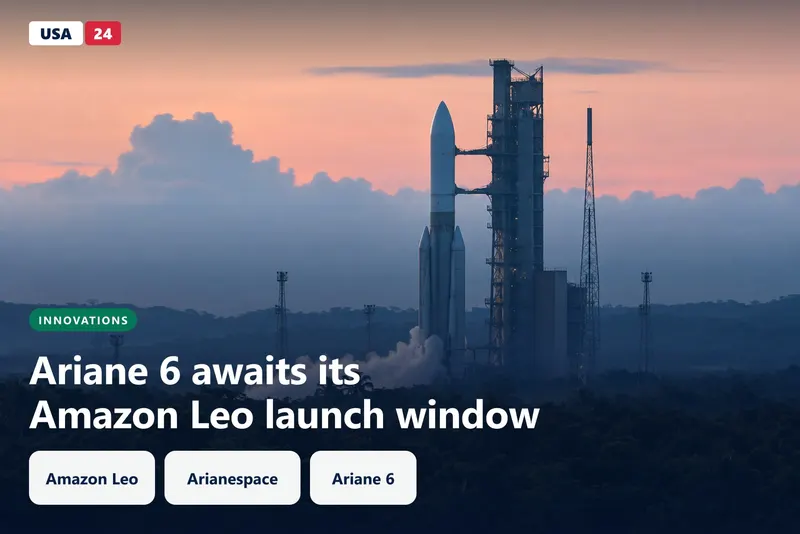
Amazon's next mission is LE-04, which will carry 36 satellites on an Ariane 64 Block 2 from French Guiana, according to Amazon's own mission update. Amazon's page lists liftoff for 6:09 a.m. EST, which is 11:09 UTC, on Monday, November 23. Other trackers disagree.
| Source | Listed LE-04 launch time |
|---|---|
| Amazon mission page | November 23, 11:09 UTC (6:09 a.m. EST) |
| Orbital Radar | November 23 |
| Wikipedia launch list | November 23, 10:12 UTC |
| KeepTrack | November 24, 11:09 UTC, listed as to be confirmed |
The gap may reflect a schedule change that some listings have not picked up. Until Amazon confirms a single time, readers should treat both dates as possible.
The route matters because Amazon bought launches from several providers. According to Spaceflight Now, Amazon holds 38 Vulcan flights, 24 New Glenn launches, 24 Ariane 6 launches and 13 Falcon 9 launches for Leo. That spread means no single rocket is a single point of failure, but two of the four providers are now on the ground. Amazon also says LE-04 will bring the total of Leo satellites launched by Arianespace to 136.
How far behind Amazon Leo's launch schedule now sits
Before the Vulcan flight, about 398 Leo satellites had been deployed across 14 launches. That is roughly 12 percent of the 3,236 required for global coverage, according to Reuters as cited by IBTimes UK. Spaceflight Now puts the number needed above 3,300.
The 40 lost satellites equal about 10 percent of the constellation that was already in orbit. That is a meaningful setback, not a rounding error. NatureWorldNews reports that Amazon had counted on Vulcan to carry close to half of its first-generation constellation, which makes its July 2029 deployment deadline harder to meet.
- November 15: Vulcan mission LV-01 carries 40 Leo satellites and suffers an anomaly about 10 minutes into flight.
- November 23 or 24: LE-04 is scheduled to launch 36 satellites on an Ariane 64.
- Before the end of 2026: Amazon's stated target for initial service in the US, UK, France, Germany and Canada.
- July 2029: Amazon's deployment deadline for the first-generation constellation.
What the Amazon Leo Vulcan failure means for US customers
Amazon has not opened consumer service. It says initial Leo service will begin before the end of 2026 in the US, UK, France, Germany and Canada, and enterprise testers have had access since November 2025, according to Orbital Radar. The loss makes that target harder to hit. Roughly 400 satellites are working, and more than 3,000 still need to go up.
Enterprise and government customers face the more immediate risk. Schedule slips can push back the capacity they planned around. ULA's grounding also affects national security launches on Vulcan, according to SlashGear and NatureWorldNews. For context, USA 24 recently covered SpaceX's classified NROL-136 launch from Vandenberg, a reminder of how much sensitive government work depends on a small group of launch providers.
Amazon Leo is designed to compete directly with Starlink, so every delay in orbit is also a delay against that rival. Each month without a steady launch cadence gives SpaceX more room to widen its lead.
What to do now and what to watch next
Consumers do not need to take any action yet. There is no sign-up to complete and no service to switch on. Readers who want Leo should take these steps:
- Check Amazon's mission page for LE-04 confirmation before assuming the launch happened.
- Treat November 23 and November 24 as possible dates until one time is confirmed.
- Business buyers should compare contract delivery dates against both the Ariane 6 and Vulcan schedules.
- Hold off on planning around the end-of-2026 US start until Amazon names a specific date.
The next few weeks will show whether Amazon can recover quickly. LE-04 is the first real test, and ULA's root-cause findings will determine when Vulcan returns to flight. If both move forward on schedule, the end-of-2026 target stays within reach. If either slips, the Leo story turns into a race to catch up with Starlink rather than a race to launch.