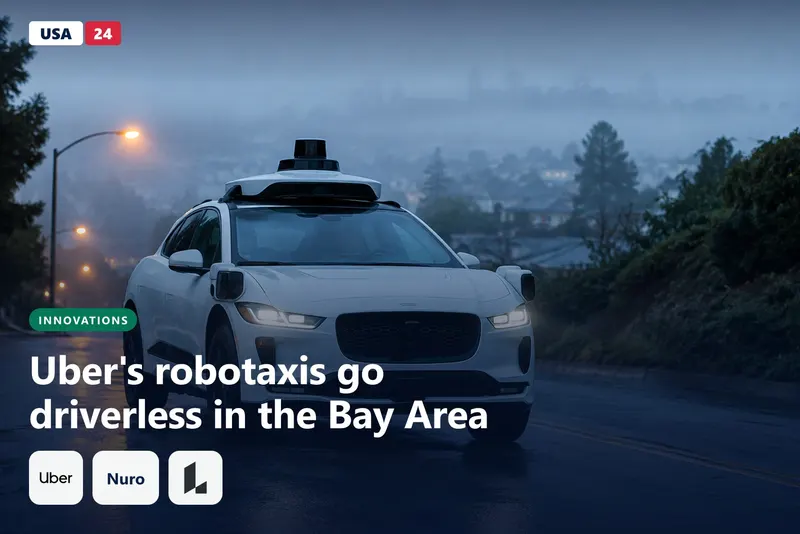
An Uber driverless robotaxi test is now running on Bay Area public roads with no one behind the wheel. On Tuesday, November 24, 2026, Nuro, Lucid and Uber said they had started fully driverless testing of Lucid Gravity robotaxis, according to Bloomberg's report. It is the first step in Uber's robotaxi program with no human in the driver's seat, and it arrives as the public launch has slipped into 2027.
That slip matters. The program was announced in July 2025 with a launch targeted for 2026 in a major US city. The companies are now pointing to the first quarter of 2027 for public rides in the Bay Area.
Where the driverless Uber robotaxis are testing
The tests started in Palo Alto, Mountain View, Los Altos and Sunnyvale, according to Automotive World's report on the joint announcement. The companies said more Bay Area cities will follow next year. The announcement did not say when those cities come online or which ones they will be.
The vehicles are adapted Lucid Gravity SUVs. Each one carries cameras, lidar and radar, plus a roof-mounted sensor halo, and runs the Nuro Driver software. More than 100 updated Gravity robotaxis have been delivered for this phase, per TNW.
How Nuro got to an empty driver's seat
Nuro did not move from safety drivers to an empty seat overnight. According to Electrek, it had run the Lucid Gravity with safety operators around the clock in the Bay Area and Houston since December 2025. Before removing the driver, Nuro ran no-operator tests on a closed course in Las Vegas. Those tests covered pedestrian encounters and right-of-way violations.
Nuro says its Safety Case Framework backed the decision. That framework draws on road data, simulation and closed-course runs. Nuro is one of six companies holding a California driverless testing permit, according to Automotive World. Coverage disagrees on when Nuro received that permit, with some reports saying April and others May.
The sequence is worth noticing. Closed-course tests without an operator came first, and public roads came after. Still, the coverage reviewed for this story includes no public safety data from the driverless testing, so the framework is the company's own account of why it was ready.
When the Uber robotaxi launch could happen
The public launch was first promised for 2026 and now targets the first quarter of 2027, according to Electrek. Uber CEO Dara Khosrowshahi said on November 4 that the company was targeting “a commercial launch in the Bay Area in Q1 2027.” A Lucid post cited in coverage used the looser phrase “early 2027,” so treat Q1 as the working date rather than a guarantee.
The timeline so far looks like this:
| Date | Milestone |
|---|---|
| July 2025 | Uber, Nuro and Lucid announce the program, targeting a launch in 2026 in a major US city |
| October 2025 | The Bay Area is named the program's first market |
| December 2025 | Nuro starts round-the-clock safety-operator runs in the Bay Area and Houston |
| April or May 2026 | Nuro receives its California driverless testing permit, according to differing reports |
| November 4, 2026 | Khosrowshahi points to a Q1 2027 Bay Area commercial launch |
| November 24, 2026 | Fully driverless testing begins on Bay Area public roads |
| Q1 2027 | Target for public rides on the Uber app in the Bay Area |
| Later in 2027 | Expected public launch in Houston |
Employee rides in the driverless vehicles are expected to start soon, ahead of the public launch. Pricing, service area details and employee ride dates have not been disclosed. When public rides open, they will be bookable only through the Uber app.
What is still unconfirmed
Houston is the largest open question. The announcement did not say that Houston testing has also gone driverless. Nuro has run safety-operator tests there since December 2025, but the driverless status of the city remains unconfirmed. EVWire reports that Houston is expected to get public service later in 2027.
Two other gaps need attention. The companies have not released public safety data from the driverless testing, and none appears in the coverage reviewed. The details in this story also come from secondary reports of the joint statement rather than the full releases. Readers should check the official Uber and Nuro announcements before relying on any single date or number.
What the commitment means for Uber, Lucid and fleet operators
Uber's purchase commitment is now at least 35,000 Lucid vehicles equipped with the Nuro Driver. That is up from 20,000 when the program was announced, according to All Motor News. The bigger number signals that Uber wants robotaxis to move from pilot programs to fleet sales. One blog post from EIF reported that Uber's investment in Lucid grew from $300 million to $500 million, though that figure has not been confirmed in the other coverage reviewed.
Scale is the obvious tension. Lucid delivered 3,806 vehicles in Q3 2026, according to All Motor News. A commitment of at least 35,000 cars is many times one quarter's output, so Lucid's production capacity is one of the main variables alongside Uber's order size. Lucid's midsize vehicles are planned for production in the second half of 2027, according to Electron Motion, which means the Gravity carries this program at launch.
In a company statement, Samarth Kejriwal, Uber's Global Head of Autonomous Mobility, called the milestone “an important milestone in our partnership with Nuro and Lucid.” Uber and Lucid investors are most directly exposed to the timeline and the volume commitment.
Fleet operators and businesses that might lease or run these cars should pay close attention to the ownership model. Uber and its fleet partners, not Nuro or Lucid, will own and operate the vehicles. That puts operating costs and utilization on partners, so anyone weighing that role should read the terms closely once they are published. Waymo already sells paid, fully driverless rides across much of the Bay Area, so Uber and Nuro will not be first to market in 2027. For how Waymo is handling its own setbacks, see USA 24's report on the freeway ride pause. Tesla is taking its own route to the same market, and USA 24 has reported that it plans to end Cybertruck production in mid-2027 to make room for the Cybercab.
What to watch next and what readers can do
There is nothing to do yet. Bay Area residents cannot book these rides today, and they will not be able to until public service opens on the Uber app. When it does, check the app directly. Treat early reports with caution and rely on official launch details from Uber and Nuro.
The items to track over the coming months are:
- Whether employee rides start soon, as expected
- Whether the Q1 2027 target holds, and whether the “early 2027” wording in Lucid's post signals a later date
- Houston's driverless status and its later-2027 public target
- Any public safety data from the Bay Area tests
- Pricing and service area details, which have not been disclosed
Employee rides are the next real signal. If they begin on schedule and public riders can book in the first quarter, the program will have turned a testing milestone into a service. If the date slips again, the questions will shift from the technology to whether the Uber fleet model can absorb a commitment of 35,000 vehicles.