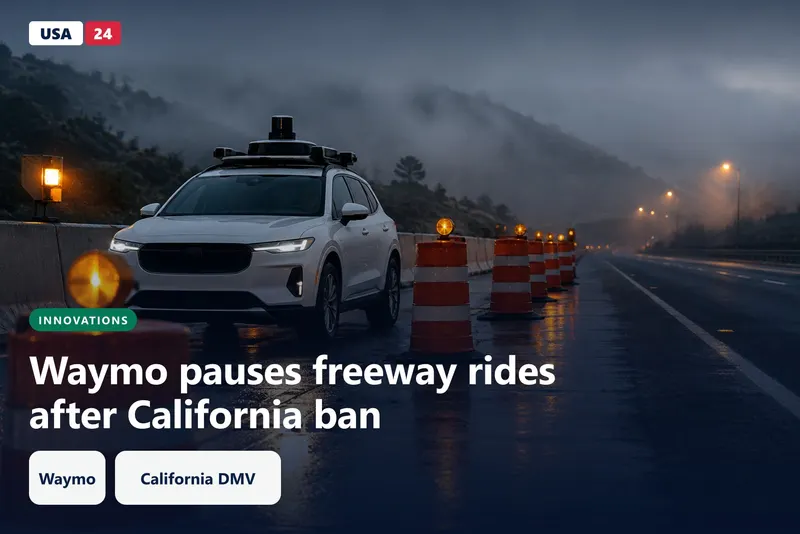
Waymo has halted driverless freeway rides in every market where it offered them, after California's Department of Motor Vehicles said the service poses an imminent hazard to public safety. The state order took effect November 11, but the wider fallout only became public in the past few days, when the DMV issued its statement on Tuesday, November 17.
Why California pulled Waymo off freeways
The DMV did not soften its language. According to a Reuters report carried by Yahoo Finance, the department said: "The Department determined that Waymo's driverless freeway operations pose an imminent hazard to public safety."
The agency pointed to repeated entries by Waymo vehicles into active construction zones. The ban bars Waymo from operating or testing driverless vehicles on state freeways, according to Al Jazeera. It stays in place until Waymo shows the DMV that it has taken effective corrective action.
That last condition is the important part. The order has no fixed end date. Waymo has to produce evidence, and the DMV decides whether that evidence is enough.
Which markets lost freeway rides
Waymo operates in 15 US cities, but it offered freeway rides in only a few of them. Coverage names San Francisco and Los Angeles as freeway markets. Al Jazeera adds Phoenix, Miami and Austin as places where highway service has paused, while CarScoops reports that city-street robotaxi service continues in markets such as Denver, Las Vegas and Dallas.
That split is the main reporting gap. Outlets do not agree on which cities lost freeway rides, so riders should confirm the status in their own market before planning a trip around a highway route.
Waymo describes the move as temporary. A company spokesperson told Al Jazeera that Waymo has "temporarily restricted commercial freeway rides in all markets where we operate that service." The company says it continues freeway testing with trained specialists behind the wheel.
The California ban stops at the state line. According to InsideEVs, the ban itself does not extend beyond California, which makes the wider pause a company decision rather than a regulatory one. Al Jazeera and The Hill both report that Waymo has framed that pause as a performance review.
Riders in those markets lose the highway option entirely. TechRepublic reports that they will see slower surface-street routes and longer trip times, which matters most for commuters who used freeways to save time.
The construction-zone incidents behind the order
The most specific episode happened on Interstate 280 in San Francisco. A Waymo vehicle tried to pass California Highway Patrol cruisers that were running a traffic break, according to The Hill and TechRepublic. Footage of an earlier overtaking attempt on a San Francisco freeway, dated November 6, also circulated, according to CarScoops.
Waymo has said that no injuries or collisions were reported in the construction-zone encounters on U.S. 101, according to CBC. That detail matters, but the DMV's order rests on the pattern of entries rather than on injuries described in the reporting.
Construction zones are a hard test for any driver, human or automated. Lanes shift, barriers move and signage changes within a short stretch of road. A DMV official told The Hill that Waymo must show "sufficient evidence" that its vehicles can detect and respond safely to construction zones before freeway service resumes.
How the pause builds on the May suspension and June recall
This is Waymo's second freeway pause this year. TechRepublic reports that the company first suspended highway rides in May to fix construction-zone handling, and that its freeway service only began in 2025. The timeline below collects the dates reported so far.
| Date (2026) | What happened |
|---|---|
| May | Waymo suspends highway rides to fix construction-zone handling |
| May–June | Roughly 3,800 vehicles recalled for software updates, per TechRepublic |
| June | The Hill reports "nearly 4,000" robotaxis recalled after 13 construction-zone instances |
| November 6 | Footage of an overtaking attempt on a San Francisco freeway circulates |
| November 11 | California's DMV ban on driverless freeway operations takes effect |
| November 17 | DMV statement calls the operations an imminent hazard to public safety |
The recall figures differ. TechRepublic puts the May–June software recall at roughly 3,800 vehicles, while The Hill reports "nearly 4,000" in June. Treat both as approximate. The pattern matters more than the exact count: the company has already used software updates to address work-zone behavior, and the DMV now wants proof that the fix holds.
Freeways are also where a robotaxi earns its keep for commuters. They turn a long surface route into a faster trip, so pausing them pushes riders back onto streets where the service already runs. That is why the pause affects more than a few trips.
What riders should do until freeway rides return
The reporting does not include formal consumer steps beyond checking whether a trip will use a freeway. The practical moves are simple:
- Check the route before you book. In paused markets, expect surface streets for trips you once took on the highway.
- Add time to commutes and airport runs. TechRepublic reports longer trip times on surface streets in freeway-enabled markets.
- Confirm your city's status. Reports disagree on which markets are affected, so check current local coverage before planning around freeway service.
- Plan for an open-ended pause. Neither Waymo nor the DMV has announced when freeway service will resume.
What to watch as Waymo tries to resume freeway service
Three open questions will decide how long this lasts. The DMV has not publicly said which corrective steps it will accept. It is unclear whether the national pause outside California will continue past Waymo's evaluation period. And the timing of any return remains unknown.
Waymo has signaled a cooperative posture. A company spokesperson told The Hill that Waymo is "working with the California DMV and other state officials diligently and responsibly to resume freeway operations."
Fleet operators, investors and rival robotaxi companies will watch the timeline closely. Any return will carry a message for the whole sector: a state regulator can pull a driverless service off highways over work-zone behavior, and the operator must prove a fix before it comes back. For a sense of where competing vehicle plans stand, USA 24 covered Tesla's decision to end Cybertruck production in mid-2027 to make room for the Cybercab, at this earlier report.
The next signal will come from the DMV's response to whatever evidence Waymo files. A quick acceptance would turn this into a short operational setback. A slow review would keep highway rides off the table in California for an extended period, and riders in the affected cities would keep taking surface streets.