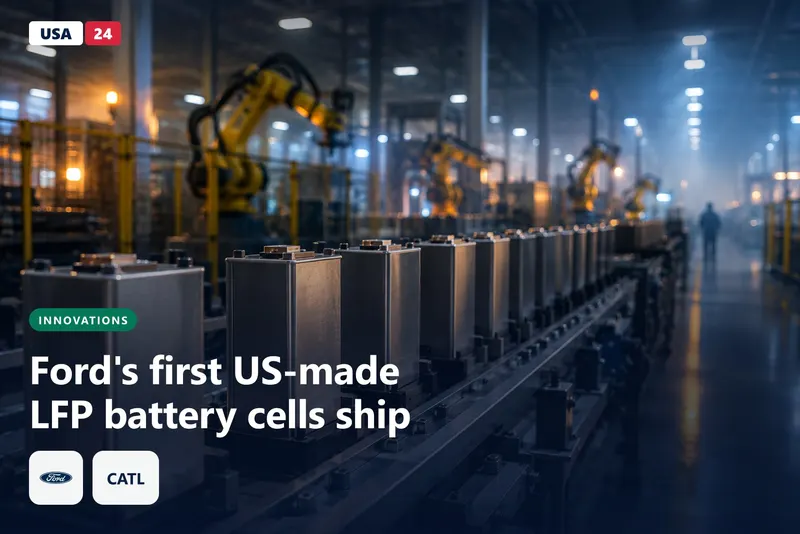
The Ford LFP battery plant in Michigan has started producing lithium iron phosphate cells, and the first ones are already on their way. Ford says the prismatic cells come off the line at BlueOval Battery Park Michigan in Marshall and are headed to the Louisville Assembly Plant in Kentucky to power Fathom prototypes. The company announced the milestone on Wednesday, November 18, 2026, in a post on its From the Road news site.
Chief executive Jim Farley posted on X: "Ford is officially in the battery business." According to Yahoo Finance, the same post said Ford will be the first to deliver LFP batteries in the US for mainstream consumer automotive use.
That is a bold claim, and the details behind it matter. Ford owns and runs the plant. The cells are made under technology licensed from CATL, the Chinese battery maker, so the factory is American while the core design comes from a Chinese company.
What Ford is building in Marshall
The investment is large. Ford put $3 billion into BlueOval Battery Park Michigan, a facility of roughly 2 million square feet with a targeted annual capacity of 20 GWh, according to InsideEVs and Yahoo Autos.
Each line can produce up to 40 prismatic LFP cells per minute, and Ford says two lines will run at full ramp-up. The company claims that makes the plant one of the fastest LFP prismatic lines outside China. The reporting does not independently benchmark that claim.
Ford chose prismatic cells because they fit directly into the chassis, which lets the battery pack act as part of the truck's structure and cuts cost, according to IAA Mobility. LFP chemistry also uses no nickel or cobalt, which Ford credits with holding costs down.
When production started, and what is shipping
The start date depends on which report you read. Detroit News reports that the Marshall plant launched production on October 10, and that packs are now shipping to pre-production Fathom trucks undergoing testing. Other outlets describe cell production beginning in October without a specific day.
The distinction between cells and packs matters. Ford's own announcement focuses on cells shipping to Kentucky, while Detroit News describes finished packs going into test vehicles. The sources do not fully reconcile the two. A separate battery pack facility on the same Michigan site is due in 2027, ahead of the Fathom's launch, according to Interesting Engineering and Technology.org.
Why the CATL license matters for Ford's costs
Ford licenses CATL's designs and know-how, but the plant is Ford's to run. That arrangement gives Ford a faster route to LFP production than building the chemistry from scratch.
LFP is widely used in China and is generally cheaper than nickel-based cells. Ford's Explorer and Capri electric models already use LFP batteries, but those packs come from outside this plant. Making LFP cells in Michigan puts that chemistry inside a US factory that Ford controls.
Farley has pitched the Fathom as a rival to Tesla and Chinese automakers, according to Technology.org. Tesla is making its own product moves, including plans to end Cybertruck production in mid-2027 to make room for the Cybercab, as USA 24 reported.
CATL is also pursuing solid-state cells, a separate effort covered in our report on its 20 Ah cell trials. The Ford deal covers LFP cells, so the two programs should not be confused.
Which Fathom details are confirmed
Ford has not published official battery capacity, range, towing, payload or charging figures for the Fathom. Its marketing does describe a planned electric pickup with bidirectional power capability and a starting price under $30,000.
The table below separates what is reported from what is confirmed.
| Detail | What the sources report | Status |
|---|---|---|
| Starting price | "Under $30,000" in Ford marketing; $28,350 per Detroit News | Conflicting figures |
| Standard battery | Roughly 64 to 67 kWh, per a MotorTrend estimate cited by Yahoo Autos | Estimate, not a Ford spec |
| Optional larger pack | Nickel-based pack targeting over 300 miles of range | Estimate, unconfirmed |
| Deliveries | Fourth quarter 2027 (Detroit News); late 2027 (Technology.org) | Reported, not confirmed by Ford |
Price is the largest open item. Ford's "under $30,000" and Detroit News' $28,350 are not the same number, and buyers should not treat either as final. The sources also do not say whether the Fathom will use the Michigan LFP cells or the optional nickel-based pack.
The platform question is clearer. The Fathom sits on Ford's Universal Electric Vehicle platform and is the first vehicle built on it, according to Detroit News.
When buyers could see a Fathom
Deliveries are the nearest hard date. Detroit News reports they begin in the fourth quarter of 2027, and Technology.org says late 2027. Ford says full-scale manufacturing begins next year, according to InsideEVs.
That leaves buyers waiting at least a year. The Fathom is not on sale, and the reporting does not describe any order process.
What the plant means for Michigan, Kentucky and US policy
For Michigan, the plant adds battery manufacturing work. For Kentucky, the Louisville Assembly Plant becomes the first site to receive prototype cells from Marshall. Technology.org reports that the Fathom is being built around cells from this plant.
A 2025 SEC filing points in a different direction. Ford said then that it would repurpose its Kentucky battery capacity for grid-scale energy storage systems and use the Michigan plant for smaller cells for home storage, according to an SEC exhibit to Form 8-K. Those plans do not obviously fit with Michigan cells now headed to Kentucky for Fathom prototypes. The sources do not explain how Ford reconciles them, so it is worth watching as both sites ramp.
The CATL arrangement also matters for US rules on Chinese battery technology. This article did not check the current regulatory status, and the reporting reviewed does not confirm any review of the license. Treat regulatory risk as unresolved until that is checked.
What readers should do now
No action is needed now. There is no Fathom to buy, and the reporting does not describe an order process. Readers who want to follow the program can:
- Watch Ford's official Fathom announcements for the final price, battery size and range.
- Check whether the 2027 pack facility opens on schedule at the Marshall site.
- Compare any quoted price against both the "under $30,000" claim and the $28,350 figure until Ford settles it.
The next signals are concrete. Watch whether Ford confirms a price and battery specification, whether the 2027 pack facility opens on time, and whether prototypes built with Michigan cells move toward the late 2027 delivery window. Those milestones will show whether this becomes a durable domestic supply chain or stays a strong first step that still depends on licensed Chinese chemistry.