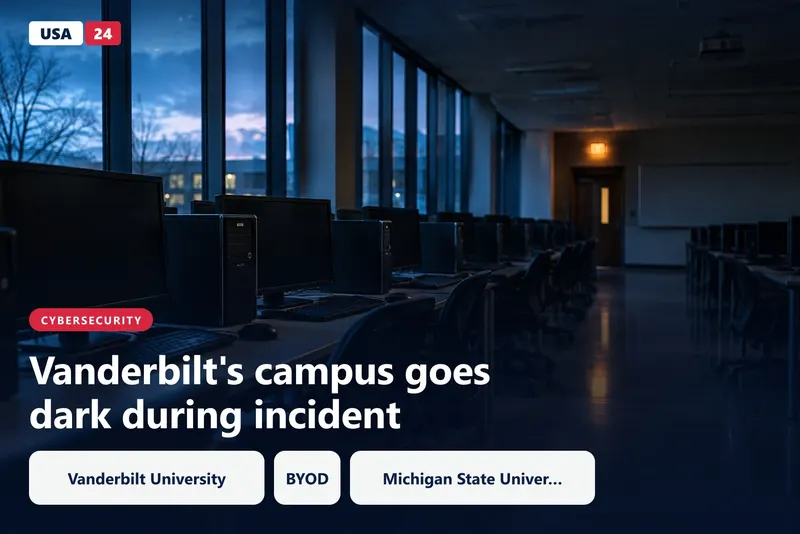
Vanderbilt University told students and staff to switch off their devices and leave campus Wi-Fi on Nov. 9, during an active cyber incident. Two weeks later, the school has not said who was responsible, and it has not confirmed the most serious claim in the Vanderbilt ransomware attack: that a group calling itself BYOD took more than one million Social Security numbers.
The incident is best read as one stop in an ongoing campaign, not a single breaking event. BYOD has posted new victim listings since then, including universities and a state agency. Its claims remain unverified, but the pattern is what makes this story worth following.
What Vanderbilt told its community on Nov. 9
The university's first public warning was blunt. Its campus notice told people to "SHUT DOWN YOUR DEVICE IMMEDIATELY to help prevent potential further security risks," as Axios reported. Vanderbilt also asked people to stay off campus Wi-Fi while the incident was active.
Vanderbilt said the incident affected devices, systems and cloud services. Later, WSMV reported that campus Wi-Fi had come back, while access to school systems and applications remained restricted. FOX 17 reported that the incident disrupted classes.
An unnamed Vanderbilt spokesperson told The Record that the IT team is "actively investigating and working to contain the situation." The same report put the university's size at about 14,000 students and more than 6,000 staff, which shows how many people could be affected if records were taken.
Keep Vanderbilt Health separate from the campus incident. Vanderbilt University Medical Center was hit by a ransomware gang in 2023, and Vanderbilt Health reported that its systems were not affected this time.
What BYOD claims in the Vanderbilt ransomware attack
BYOD posted its claim on its leak site. According to CyberScoop, the group says it encrypted Vanderbilt databases and took more than one million Social Security numbers, along with names, emails, and student and employee records. SOFx quoted the alleged ransom note: "If you could not tell already, your databases are locked," it reads.
Reports also say victim computers played an automated audio message naming BYOD as the intruder, according to Cryptika.
Those are claims, not findings. Vanderbilt has not confirmed that BYOD is responsible or that the claimed data theft happened. The one-million figure comes from the group alone, and a leak-site post serves the attacker's pressure campaign. Until the university or an independent investigator says otherwise, readers should treat the number as a worst-case scenario rather than a count.
Still, the stakes explain the attention. Social Security numbers are among the identifiers criminals use to open new credit accounts and file false tax returns, so even an unverified claim pushes people to act.
Michigan State, New Mexico and Texas on BYOD's list
The group's recent activity reaches well beyond Nashville. Around Nov. 15, BYOD posted new leak-site listings for Michigan State University and the Texas Health and Human Services Commission, according to the Vanderbilt Hustler timeline. Both listings are unverified, and the Texas agency listing carried a "final warning" label.
BYOD claims Michigan State held personal information on 1.3 million current and former students. Michigan State said it found no evidence that attackers compromised its central Active Directory or took other university data, QUE.com reported. The university's account and the group's claim point in different directions, and only an investigation can settle that.
Earlier, the group claimed roughly 36,000 compromised systems at the University of New Mexico Health Sciences Center, where ambulances were diverted beginning Oct. 26. Tech-Insider reported the figure, and neither UNM nor any outside party has verified it.
Taken together, the list shows a group that moves across sectors. A university, a health system and a state agency all appear, and each claim arrives without independent confirmation. That makes the campaign harder to dismiss and harder to size. USA 24 has seen this pattern before: its coverage of the Premise Health insider breach shows how a healthcare exposure count can keep rising as more information emerges.
Who BYOD is and why universities are attractive targets
BYOD first appeared in late September 2026, and its operators are unknown. Breach News reported that researchers have noted overlaps with the EndZone and UmBra extortion brands, but no shared ownership has been established. The group mainly targets higher education, healthcare and corporate entities, according to Cybernews.
Universities make appealing targets for a practical reason. They hold large volumes of sensitive records, and an outage can halt research and administrative work at the same time. The Vanderbilt disruption to classes shows how quickly a cyberattack moves from an IT problem to a campus problem.
The broader market is crowded. The Record reported that Trellix tracked record ransomware group and victim-post numbers from April to September. A crowded field gives a new group reason to post loudly, which may help explain why BYOD has generated so many claims in a short time.
Extortion claims of this kind are not limited to universities. USA 24 has covered similar assertions from n0n Ransomware, which claimed Chase, Visa and Mastercard data was taken through a vendor breach.
Vanderbilt cyberattack class action and open questions
A former Vanderbilt master's student has filed a class action in federal court in Tennessee. The suit alleges the university did not adequately encrypt personal data, according to the Nashville Scene. The available reporting does not establish the filing date, the docket number or the case's status, so treat the suit as pending and unproven until court records are public.
Several questions remain open:
- Whether BYOD holds the data it claims, and how many people are affected.
- How many people Vanderbilt will notify, and when.
- Whether Michigan State and the Texas HHSC confirm any listing.
- Who runs BYOD, and whether it links to EndZone, UmBra or other groups.
How to protect yourself after a Vanderbilt data breach
Vanderbilt's own guidance points toward caution, and the steps below follow it.
- Confirm whether you received an official notice before you act on it. Use only official campus channels for updates.
- Watch for phishing that uses the incident. Vanderbilt warned about unexpected pop-ups, file changes and password requests, according to Axios and Vanderbilt Hustler's live coverage. Do not click links in unsolicited messages that mention the incident.
- Reset passwords only through official campus IT. Vanderbilt required password resets for all users, according to the Vanderbilt Hustler.
- If your Social Security number may have been in university records, place a credit freeze with Equifax, Experian and TransUnion. A freeze costs nothing and blocks most new-account checks until you lift it.
- If you took part in research that stored data on university systems, ask the study team whether your records were involved.
What to watch next in the BYOD campaign
The next signals should be concrete. Vanderbilt needs to say what data was involved and how it will notify people, because that step turns a claim into a count. Michigan State and the Texas HHSC will either confirm or dispute their listings. The Tennessee case should reveal a filing date and docket. Researchers will keep trying to pin down who runs BYOD, and if they tie it to EndZone or UmBra, the group's history gets longer. Until then, the accurate framing is the one this story has used throughout: a campus claim the school has not confirmed, inside a campaign that keeps adding names.