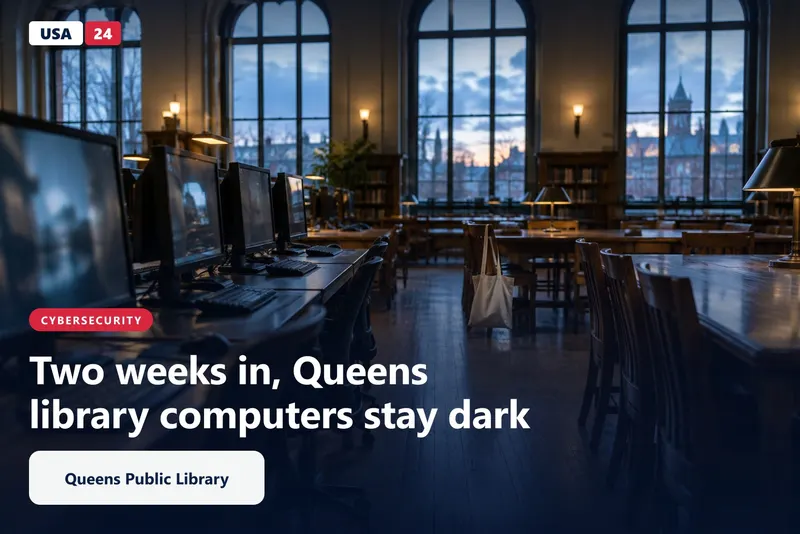
The Queens Public Library ransomware outage has now run for more than two weeks, and the system still has no date for full service. Staff first identified the attack on Nov. 4, when they could no longer log in to the network, according to QNS. The library's website and app remain offline, and most of its public computers are still dark.
What the attack knocked offline
The system first reported a systemwide network outage that Wednesday. NY1 reported that the disruption hit the website, the app, checkout and return machines, renewals, on-site computers and free Wi-Fi access at all 66 branches. The Queens Gazette said the outage also affected more than 1,400 people employed by the library.
The library serves 2.3 million residents, according to The Cyber Express. That scale explains why a partial outage ripples across the borough. For residents without reliable home internet, a branch computer or Wi-Fi connection is often the only practical way to apply for jobs, finish school work or fill out government forms.
Which Queens library branches have computers back
According to QNS, computer access has been restored at seven branches:
- Central Library
- Far Rockaway
- Flushing
- Glen Oaks
- Hunters Point
- Jackson Heights
- Kew Gardens Hills
Some digital resources and basic library functions have returned. Customers still face disruptions to several services, and the website and app remain down. The gap between those two facts is the real story: the library is recovering in pieces, not all at once.
"We remain extremely grateful for the public's support and patience as we work to completely restore our technology," said Dennis Walcott, the library's president and CEO, in a statement. The message acknowledges that the work is still underway, but it does not offer a date.
Is the Queens library open, and when will the website return
Yes, the branches are open. "All QPL locations remained open as scheduled," officials said, according to the Queens Gazette. Open does not mean fully working, though. A visitor could walk into a branch and find that its public computers, Wi-Fi or checkout and return machines are unavailable.
The website and app are a different matter. Both remain down, and the library has not given a timeline for bringing them back. That matters for anyone who renews items, uses digital media or manages an account online, because those tasks have no working online path for now.
Before you visit, check queenslibrary.org or call your local branch. Confirm that the computer or service you need is available, especially if you plan to print documents or submit an application online.
Who is behind the attack and what data may be exposed
No ransomware group has claimed the attack, and the identity of the attackers remains unknown. The NYPD said in its own statement that it was "aware of a cybersecurity incident impacting Queens Public Library computer systems," and that it is working with the library and the FBI, according to NY1.
The library has not disclosed a ransom demand. It also has not confirmed whether patron or staff information was accessed or stolen. TMCnet's coverage makes the same point, noting that the attackers' identity and the status of patron information remained unresolved.
The silence stands out against groups that publicize their victims. USA 24 recently reported that n0n Ransomware claimed Chase, Visa and Mastercard data through a vendor breach, which shows how differently claims and confirmations can play out.
A November roundup from newspaceeconomy.ca lists a Vanderbilt University incident, a DonorPerfect platform restriction, an Expedia provider-access confirmation and a Charleston County incident among recent US disruptions. The roundup cautions that attack method, responsible actor and data impact have not been disclosed. Reporting that patron records were stolen would go beyond the facts available.
What Queens residents and IT teams should do now
For patrons:
- Check queenslibrary.org or call your branch before visiting, and confirm that the service you need is working.
- Treat any unexpected library email, text or call that asks for a password or payment details as suspicious until you verify it on the library's official website.
- No public instruction to reset passwords has been reported, so do not change your library password based on an unverified message. If you reuse that password elsewhere, change it on those other accounts now.
For IT and public-sector teams:
- Segment networks so that a compromise in one system cannot reach public Wi-Fi, staff systems and back-office data.
- Test restores from offline or immutable backups, not just the status of backup jobs.
- Rehearse manual operations, such as paper checkout and manual circulation, so branches can keep serving people during an outage.
Coverage by TMCnet makes the general point that public libraries run many public-facing systems on shared networks. That design is efficient, and it is also why one intrusion can take down so much at once.
Why the Queens outage matters beyond Queens
The outage has drawn attention beyond the library. In a November 17 report, POLITICS NY said Gov. Kathy Hochul addressed the outages, including the library attack, alongside an FAA ground stop. Its headline described her remarks as "deeply unsettling" while noting she is fully confident in New York's cybersecurity readiness.
In a November 23 editorial, amNY called on New York City to harden its systems. It pointed to a library that has been "attempting to recover from a ransomware attack that crippled its digital resources and even its most basic functions."
The burden falls unevenly. A patron with a laptop and a home connection loses a few conveniences. A resident who depends on a library computer for a job application or a government form loses something harder to replace.
Three developments will show how serious the damage is. The first is a restoration date for the website and app. The second is a public claim from a ransomware group, which would give investigators and patrons something concrete to assess. The third is any confirmation from the library about whether patron or staff data left its systems. Until those arrive, Queens residents should plan for gaps rather than expect a quick return to normal.