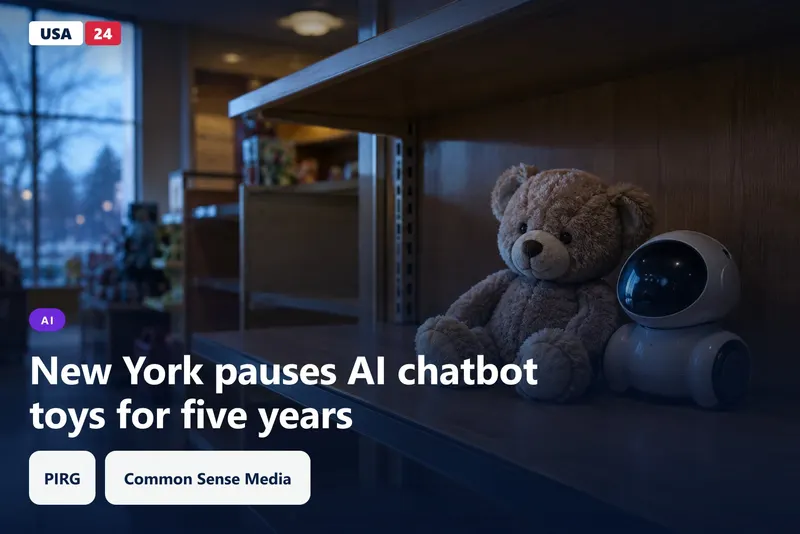
The New York AI chatbot toy ban pauses the manufacture, distribution and sale of talking toys with internet-connected chatbots for five years. Gov. Kathy Hochul signed the bill on Tuesday, November 24, 2026, the day holiday shopping begins. The law does not take effect for about three months, which means these toys can still be bought this season.
The governor’s office timed the signing to the start of holiday buying and urged families to check gift toys before they purchase, according to a release from the governor’s office. The law is narrower than its headline suggests. It targets toys with internet-connected chatbots rather than AI products in general, and it is a pause rather than a permanent ban.
What the New York AI chatbot toy ban covers
The bill, numbered S.9408A and A.11144B, bars manufacturing, distribution and sale of internet-connected AI toys in New York for five years. WBNG reported that the covered products include talking dolls, stuffed animals and robots that hold open-ended, internet-driven conversations with children. Those are ordinary gift categories, which is why the warning lands on people who are shopping for kids.
The governor’s office said some banned models could record audio and perform facial scans of users, as News10 reported. Hochul’s signing statement said parents “should not have to worry that dangerous chatbots disguised as toys could expose their children.” That line frames the law as a child-safety measure first and a market rule second.
Retailers and manufacturers must stop making and selling covered products once the law takes effect, WHEC reported. The obligation falls on sellers and makers, not on parents who already own a toy.
Why the state pointed to watchdog testing
State officials cited consumer-watchdog findings that some AI toys exposed children ages 3 to 12 to sexually explicit content and gave dangerous household instructions, according to WBNG. PIX11 reported that testing by the Public Interest Research Group found toys that suggested where to find dangerous objects and gave sexually explicit information. Hochul also referenced a Common Sense Media study in which a toy suggested a tester jump from a roof or window.
The Public Interest Research Group’s “Trouble in Toyland” report tested seven AI toys and found that some could answer inappropriate questions, per WHEC. Seven products is a small sample. A state ban on a whole product category will likely lean on evidence like this, so the quality of the testing may face scrutiny if the rule is challenged.
State Sen. Andrew Gounardes, the bill’s sponsor, put the policy in simpler terms: “Kids want to play, kids deserve a real childhood.”
When the ban takes effect and why the timing matters
The signing and the start of the holiday shopping season fall on the same day, but the sales ban does not. NBC News reported that the law takes effect 90 days after signing and described the start as February. Counting 90 days from November 24 lands on about February 22, 2027.
| Date | What happens |
|---|---|
| Tuesday, November 24, 2026 | Hochul signs S.9408A and A.11144B |
| 2026 holiday season | Covered toys can still be bought |
| About February 22, 2027 | Law takes effect, 90 days after signing |
| Five years | Length of the pause |
That gap has two effects. Parents get a warning during the season when most gift buying happens, while the rule itself is not yet enforceable. The first holiday season fully under the pause will be 2027, when the ban is already in force for the entire shopping period.
How New York compares with California and its chatbot rules
California was the first state to restrict these toys, and New York is the second, according to NBC News. The sources reviewed for this story do not describe California’s rules in detail, so readers who buy or sell in that state should check its law directly.
The governor also signed a law in October that limits certain unsafe chatbot features for minors, including features that foster emotional dependency, as CBS6 Albany reported. The exact date of that earlier law was not confirmed. Hochul also signed the RAISE Act on frontier AI safety, per the governor’s release. Taken together, the toy ban is one piece of a broader state push on AI products used by young people.
The fight over AI and children is also moving through the courts. Virginia and Oregon have sued SpaceX over Grok’s sexualized deepfake images, a separate case that shows states are willing to test AI products under consumer and child-protection law.
Parents and child-safety advocates gain a clear state rule that does not depend on a voluntary industry standard. Toy makers that built conversational features into children’s products lose a sizable New York market, and other states now have a template to copy.
Which AI toy features to check before you buy
You do not need to wait for February to be careful. Before buying a talking doll, plush or robot for a child, check these points on the box, in the app and in the privacy policy:
- Whether the toy connects to the internet and uses a chatbot to hold conversations.
- What personal information it collects, including any audio recordings.
- Whether it uses facial scanning or other camera features, which the governor’s office said some banned models did.
- Whether parental controls exist and whether you can limit or switch off conversation features.
- Whether it has an age range that fits the child, and whether the conversation is open-ended.
If you buy online from a seller in another state, do not assume the New York rule covers that purchase. The reporting reviewed for this story does not say whether the ban reaches online sellers or out-of-state shipments.
Open questions on enforcement, online sales and lawsuits
Attorney General Letitia James said her office will enforce the law, according to WBNG. The reporting does not explain how state officials will inspect stores or police sales, as FOX 5 New York noted. That gap matters most for online marketplaces, where a product can move across state lines in days.
NBC News reported that Amazon and eBay were being urged to stop selling AI toys and that some had been pulled from sale. Other sources reviewed for this story do not confirm those details, so treat that claim as unverified. The reporting also does not say whether toy makers plan to challenge the law in court.
What to watch next
Three things will show how strict this ban really is. The first is whether the February start date holds and whether the attorney general’s office publishes guidance for retailers before then. The second is whether the ban reaches online sellers, which will decide whether a New York family can still buy an AI toy from a website based in another state. The third is whether other legislatures adopt similar language after California and New York. If they do, the 2027 holiday season could look very different from this one.