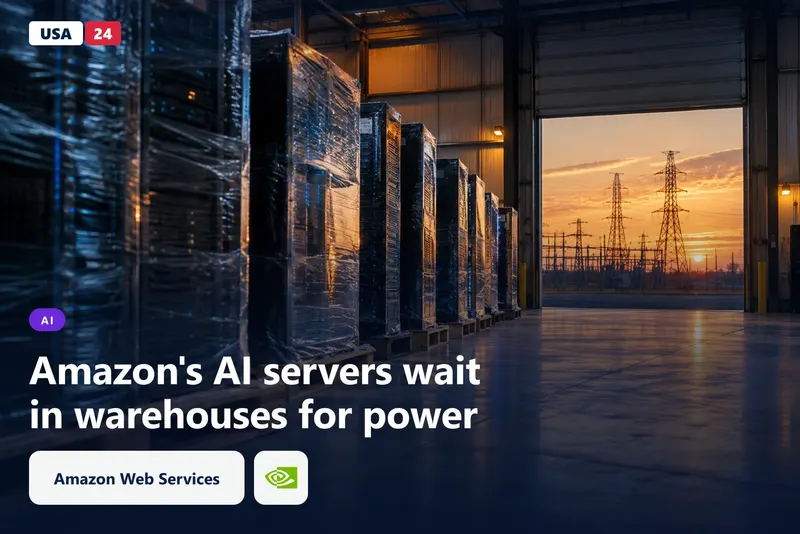
Amazon Nvidia AI servers worth billions of dollars reportedly sit in warehouses because Amazon's data centers lack the electricity to run them. Business Insider's report, as summarized by American Bazaar, puts a headline figure of $5 billion on the idle hardware. It landed two days after Nvidia pitched a faster way to stand up AI data centers, and it points straight at the weak spot in that pitch.
The reporting is not independently confirmed. The original Business Insider article was not retrieved for this story, so the dollar figure, the rack count and the affected sites all come from a secondary summary. Read the details as reported, not established.
What the report says about Amazon Nvidia AI servers
According to the American Bazaar summary, Amazon is spending heavily on AI hardware, but some new server racks are not running because its data centers do not have enough electricity. A shortage of new power capacity is one of several bottlenecks holding back deployment, the summary says. Power is not described as the only constraint.
The most specific detail comes from an internal email cited in the report. It said at least one AWS team lacked "a clear forecasted path" to get the incoming racks into operating data centers. That line describes a planning problem as much as a hardware problem. A team that cannot forecast when power and space will arrive cannot schedule installation either.
The racks are Nvidia systems, which the summary describes as worth billions of dollars in total. Nothing in the sources reviewed gives the rack count, the specific sites or a restart date. No Amazon statement appears in the reporting reviewed for this story, so AWS has not yet explained the delay in its own words.
One more caution: the summary's dates do not line up cleanly. Its link is dated October 23, while the text refers to Saturday, October 24. Treat the timing as approximate until the original is checked.
Why power and site readiness can stall AI capacity
Chips get the attention, but a server rack earns nothing until it sits in a building with power, cooling and networking ready to go. Yahoo Finance's coverage of Nvidia's announcement notes that data center construction can take months or years, and that a facility earns nothing until it processes AI tokens, so each month of delay adds cost [2].
That math explains why idle hardware matters more than its price tag suggests. Every month that racks wait in a warehouse is a month of capital doing no work.
The Amazon report suggests the constraint may be electricity and site readiness rather than chip supply. That distinction matters. If chips are the bottleneck, buying more silicon speeds things up. If power is the bottleneck, buying more silicon mostly builds inventory. Whether the idle racks reflect a temporary delay or a structural limit on grid capacity is still unknown, and the sources do not settle it.
Nvidia's 14-day DSX POD pitch and what it assumes
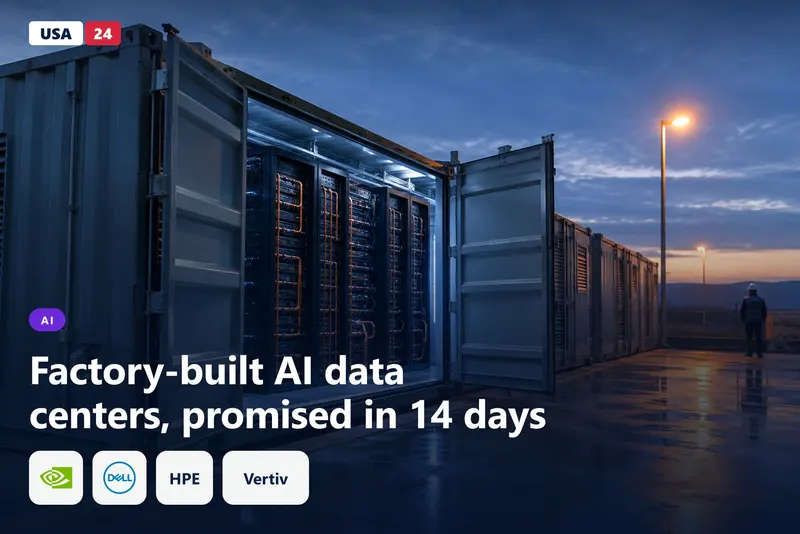
Nvidia unveiled the DSX POD on October 21 at its GTC event in Berlin. The company describes it as a reference design for an AI data center packed into a box about the size of a standard shipping container [2]. Nvidia says the design cuts the time for a new AI data center to start serving tokens from six months to about 14 days, with deliveries in early 2027 [3][4].
Nvidia's material says each DSX POD ships with seven Vera Rubin racks in a 28,000-kilogram container, with cabling and liquid cooling preassembled [4]. PupuWeb's summary puts a single Vera Rubin rack at more than $7 million [4]. By that arithmetic, seven racks represent more than $49 million in hardware before the site is even powered up.
The 14-day claim rests on a prepared site, which is exactly the step the Amazon report suggests is hard [3]. Nvidia's speed depends on power being ready before the container arrives. StockTitan's summary of Nvidia's claims for European AI factories adds that DSX can use up to 100% less cooling water and up to 30% less power for the same output [3]. Those are vendor figures, and the sources reviewed contain no independent test of them.
Nvidia also issued eight press releases in 59 minutes at the Berlin event, according to StockTitan [3]. A busy announcement day does not confirm any single claim, though.
Which numbers hold up and which are still unverified
Not every figure in this story carries the same weight. The table separates what the sources report from what still needs checking.
| Claim | Source | Status |
|---|---|---|
| Amazon has Nvidia racks idle because of power limits | American Bazaar summary of Business Insider | Single outlet, not independently confirmed |
| $5 billion headline value of idle servers | American Bazaar summary | Unverified, original not retrieved |
| DSX POD cuts time to serving tokens to about 14 days | Nvidia, via StockTitan and PupuWeb | Vendor claim, depends on a prepared site |
| DSX POD deliveries in early 2027 | Nvidia, via StockTitan | Vendor timeline |
| About $450 billion in future non-cancelable cloud commitments | DEV Community digest of Anthropic's draft S-1 | Draft filing, reported secondhand |
Who gains and who loses if AI capacity slips
Investors face the sharpest question. The thesis that AI spending converts quickly into revenue depends on capacity arriving on schedule. Shares of Amazon, Nvidia and power-heavy suppliers look most exposed, but the sources reviewed show no price move tied to this report. USA 24 has reported on Meta's $825 billion in AI commitments and a shaky CoreWeave debt market, and the same test applies: how fast does that spending turn into powered capacity? The SEC has also added AI to its 2027 examination priorities, according to a separate USA 24 report, which suggests regulators will pay attention to how firms describe their AI plans.
Businesses that buy cloud AI face the practical risk. Delayed capacity can push back AI projects and pricing. Procurement teams should ask vendors for firm regional capacity dates in writing before they commit to an AI roadmap.
Communities near planned data centers may see the story as support for their case. It strengthens the grid-strain argument that local opposition has been raising, even though it does not identify which sites are affected.
What Anthropic's cloud commitments reveal about the stakes
Anthropic's draft IPO filing, as described in a DEV Community digest dated October 24, discloses roughly $450 billion in future non-cancelable cloud commitments over seven to ten years [5]. The same digest breaks out about $111 billion to Google Cloud and $110 billion to AWS [5]. Those commitments depend on capacity arriving on schedule.
That makes the Amazon story more than a warehouse anecdote. When a buyer has contracted that much compute ahead of capacity, a slow build becomes a financial question as well as an engineering one. Every delay in powering racks lands on someone's plans.
A practical checklist for investors and cloud buyers
- If you hold AI-linked stocks, check how much of your thesis depends on near-term power availability, not just chip orders.
- Ask cloud providers for firm capacity dates by region, in writing, before you commit to an AI project timeline.
- Ask whether a region has confirmed power and site readiness, not only hardware on order.
- Compare a vendor's time-to-tokens claim with the actual build schedule for your region, and treat "14 days" as conditional on a prepared site.
- Wait for Amazon's response and any confirmed rack count before drawing firm conclusions about AWS.
What to watch next
The next signals are concrete. Watch whether AWS responds with a timeline and whether the original Business Insider reporting names specific sites and a rack count. Nvidia's early 2027 delivery window will also test whether the prepared-site assumption holds outside a press release. If other operators describe racks waiting on power, the constraint looks structural, and the build-out timelines the industry has been quoting will need to slip.