Meta's $825 billion in AI commitments landed on a credit market that was already under strain. Meta told regulators Thursday that it has agreed to spend about that much in the future on leases and contracts, many of them tied to AI computing and infrastructure. The same day, Meta shares fell, the chip index dropped about 6.7% and the Nasdaq slid.
What Meta's $825 billion AI commitments include
Meta said in a regulatory filing that it has agreed to spend about $825 billion in the future on leases and contracts. Bloomberg, via Yahoo Finance put that figure up from almost $700 billion in July. The filing came one day after Meta's earnings report, which showed third-quarter revenue up 26% to a record $64.6 billion, according to BigGo Finance.
These are not spending commitments that have already happened. Roughly $355.7 billion covers leases that have not started yet, some running up to 30 years. Another $454.5 billion covers non-cancelable contracts for cloud capacity, servers, network equipment and energy, according to daily.dev's summary of the filing. Non-cancelable means Meta would still owe those payments if demand for its AI projects weakened.
The stock reaction is less settled. Most reports put Meta down more than 7% on October 22, but TipRanks reported a drop of 3%. One report also says free cash flow turned negative for the first time since Meta went public. Meta's 2026 capital expenditure outlook is $135 billion to $145 billion, according to Lapaas Voice.
How the $825 billion total was assembled
Check the headline number before building on it. Pebblous argues that the $825 billion total does not appear as a single figure in the filing, and that the press combined three separate numbers from different notes. That claim has not been verified here. The SEC link in the search results pointed to an older annual proxy statement, not the third-quarter 10-Q, so the primary document was not checked.
The arithmetic adds a wrinkle. The two named components, $355.7 billion and $454.5 billion, add up to about $810 billion. The public summaries do not explain the remaining $15 billion or so. Until someone checks the 10-Q line by line, treat $825 billion as a widely reported aggregate rather than a confirmed filing headline.
Why CoreWeave's bonds set off the selloff
The stress did not start with Meta. It started in neocloud debt, the borrowing-heavy operators that rent GPU capacity to AI developers. On October 14, CoreWeave fell 15.5%, and Nebius, IREN, Hut 8 and Applied Digital dropped 9% to 12%, according to Weiss Ratings. Analysts tie the pressure to rising rates and inflation, and hotter-than-expected inflation raised the possibility of another Federal Reserve rate hike.
CoreWeave's bonds tell the sharper story. Its unsecured bond yields are near 15%, and its five-year credit default swap spread recently hit about 1,115 basis points, up 171% over 12 months, according to Briefs. CNBC reported that the yield on CoreWeave's 2032 notes was about 15.77% on October 15. A CNBC report from October 21 said CoreWeave's stock is down 36% this month and its credit default swap spreads are widening. Reports also differ on swap levels, 1,115 basis points in one and 1,140 in another, because they were captured on different dates.
Barclays credit analyst Andrew Keches wrote in a note to clients that "Sentiment is decidedly negative" about AI bonds. CoreWeave's chief executive, Mike Intrator, went further and called the market's reaction "irrational."
D.A. Davidson analyst Gil Luria put the economics in blunt terms. According to AOL's coverage, CoreWeave borrows at roughly 9% while earning returns near 1%, and Luria warned the equity could go to zero if the AI cycle turns.
The scale of the debt is large. CoreWeave carries about $50 billion in debt, according to InvestorsHub. Briefs reports $20.7 billion of borrowings maturing through 2030, $5.5 billion in cash as of the second quarter, and a market value near $31 billion against a peak of roughly $90 billion. Microsoft accounted for more than two-thirds of CoreWeave's revenue last year, per Briefs, which makes its financing problems a customer problem too.
Why neocloud debt is the weak link in AI spending
The model works when rented capacity stays in demand and lenders keep refinancing. It becomes fragile when borrowing costs climb. The central question, as BigGo Finance frames it, is whether data center operators can fund buildouts without hurting earnings while borrowing costs stay high.
Bets against the group are large. ORTEX estimated that short sellers made about $6 billion in paper profits this month across CoreWeave, Nebius, IREN, Applied Digital and Core Scientific. CoreWeave's short interest rose to 23.7% of its free float from 19.6% at the start of October, according to the same BigGo report.
Gartner forecasts that over 80% of neocloud providers will cease independent operations by 2030, per CNBC's October 15 report. That is a long-range forecast, not a current event, but it shows how seriously analysts take consolidation risk in the group.
Banks are the other channel. J.P. Morgan estimates that large US investment banks and Japan's MUFG could each have roughly $1 billion to $3 billion of exposure to CoreWeave. Banks disclose little, so those figures are estimates, not confirmed exposures.
The wider backdrop matters too. NBC News reported that markets were reacting to Iran war concerns and high AI spending at the same time. Some analyses put off-balance-sheet AI-related commitments across the industry at roughly $3 trillion. AI Daily Signal also described the Nasdaq's drop as its worst day since June, but that claim rests on a single newsletter and was not confirmed here.
What it means for investors and data center projects
Public-market investors feel the first effect. Meta shareholders, holders of Nasdaq index funds and anyone with AI-exposed stocks should expect more volatility while the debt question plays out. Index funds hold the same large names, so a drop in those stocks reaches many portfolios at once.
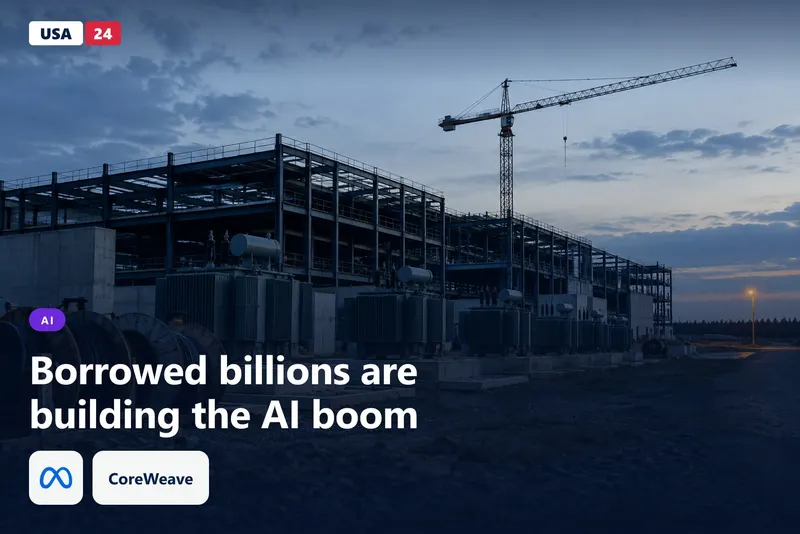
Construction could slow. US data center and power projects rely on this kind of financing. If lenders charge more or pull back, builds can slip and local projects can stall. That matters in communities already skeptical of the buildout. A USA 24 report on polling found that most Americans say AI is bad for society and oppose local data centers.
Customers face contract risk. Companies that depend on CoreWeave capacity could see supply or contract disruption if financing tightens. Microsoft, the largest customer named in these reports, is the company to watch on that front.
What investors can check now
- Review holdings in neocloud and AI infrastructure names, including CoreWeave, Nebius, IREN, Applied Digital and Core Scientific, both directly and through funds.
- Check bond funds for exposure to high-yield data center borrowers, since CoreWeave's bonds show the stress most clearly.
- Read Meta's third-quarter 10-Q before relying on the $825 billion total.
- Track CoreWeave's bond yields and credit default swap spreads, which show how lenders price the risk.
- No direct consumer action is needed. This is general information, not financial advice.
What to watch next
Four things will show whether this is a repricing or a turn. First, Meta's 10-Q should settle whether $825 billion is a filing figure. Second, CoreWeave has to refinance its 2026 maturities, and the sources leave its options unclear. Third, the Federal Reserve's next move will shape the cost of new debt. Fourth, banks may disclose more about exposure than today's estimates. If CoreWeave's bond yields stabilize while it keeps adding capacity, the selloff may look like an overdue repricing. If yields keep rising, the data center plans that depend on cheap credit will likely slow first.