Nvidia DSX POD, a factory-built reference design for Vera Rubin AI data centers, can cut deployment at a prepared site from about six months to as little as 14 days, the company says. Nvidia unveiled it on October 21, 2026, at GTC Berlin. The release on Nvidia's newsroom pitches the product for Europe's infrastructure build, but the deployment logic applies to American operators too.
What Nvidia DSX POD actually announced
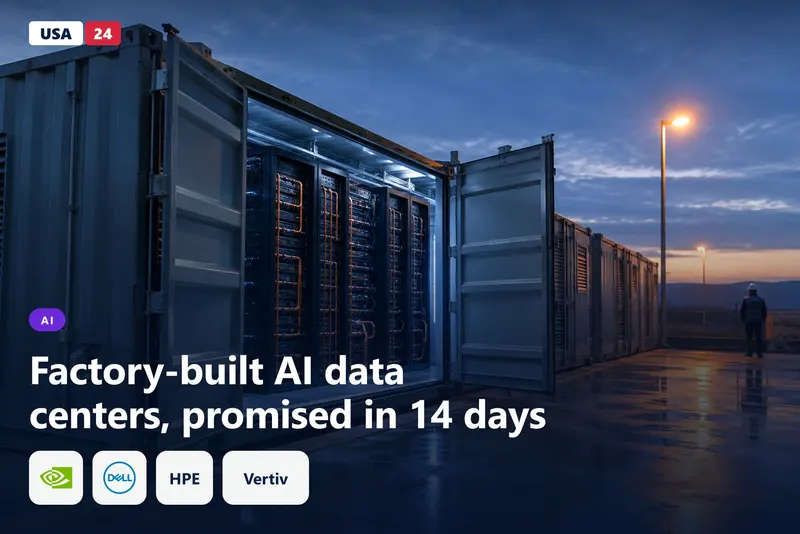
DSX POD is not a single machine Nvidia builds and ships. It is a reference design that partners assemble inside modular shipping containers and validate before delivery. Nvidia's DSX POD product page calls it a repeatable, validated architecture that lets partners preintegrate compute and supporting infrastructure in the factory.
That distinction shapes who wins. Nvidia sells the blueprint, while partners build, ship and support the hardware. The design targets complete Vera Rubin AI factories, not chips or racks sold on their own.
AI Weekly's daily roundup also reported that Nvidia named suppliers for substrate and advanced-packaging expansion at GTC Berlin, and it noted new sovereign-cluster progress in Kazakhstan. The AI Weekly roundup treats those items separately from DSX POD, and this story has not verified them in depth.
How moving the work into a factory shortens deployment
Building an AI data center on site usually means many trades working in sequence on cabling, rack-level power, networking, piping and liquid cooling. Nvidia says DSX POD moves that work from the customer's site into the factory. Partners finish rack-to-rack wiring and functional testing before shipment, so the on-site job becomes connection rather than construction.
Nvidia says the approach can cut deployment time at a prepared site from about six months to as little as 14 days. The units are designed to connect to existing power, cooling and networking. Converge Digest carried the same 14-day target.
The logic is straightforward. Work that normally happens in the field, where weather, crew schedules and site access are hard to control, happens in a controlled building instead. Nvidia has not published a breakdown showing where the saved months come from, so the mechanism is clear but the math is not.
Which partners would build and ship Nvidia DSX POD
Nvidia names 17 partners, including Anduril, Crusoe, Dell Technologies, Foxconn, HPE, Lenovo, Schneider Electric and Vertiv, according to AI Chat Daily. Partner deliveries are planned for early 2027. Dell, HPE and Vertiv are American companies, so they could see new orders if the design sells. Schneider Electric is headquartered in France and Foxconn in Taiwan, which shows how global the supply chain behind the design is.
The sources reviewed do not name a US customer that has committed to DSX POD. Without a named buyer or a public price, it is hard to judge demand.
BigGo cites one analysis arguing that Nvidia is moving from selling chips and racks toward pre-integrated infrastructure, which raises its revenue per gigawatt of data center capacity. That is an analyst's view, not a company disclosure, but it explains the strategy. If Nvidia sells the full system, partners carry more of the factory work and more of the delivery risk.
What the 14-day claim does and does not prove
The figure is "as little as 14 days," which is a best case rather than an average. It applies at a prepared site, and the sources reviewed do not specify the power, cooling or grid requirements that define "prepared." Those are the constraints that matter most in many US markets, where grid connections and cooling capacity can be the slowest parts of a project.
That constraint cuts both ways for US operators. A developer with a powered, cooled site ready to receive hardware could benefit a lot. A developer still waiting on utility approval gains little from a faster build. Analytics Insight and other outlets repeat the 14-day figure, but the sources reviewed include no independent test of it. Coverage that repeats Nvidia's number does not confirm it.
Nvidia CEO Jensen Huang's framing at the launch is revealing. AI Weekly quotes him saying: "an AI factory creates value when it starts producing tokens — not when construction is complete." That shifts the yardstick from build time to time-to-output. Buyers should measure both, because a fast install that takes months to reach production has not solved much.
Pricing, specs and the numbers still unverified
Several details are circulating, but most come from secondary reports rather than Nvidia's own release. Treat them as provisional:
- Pricing: Nvidia has not disclosed pricing. One secondary report cites an analyst estimate placing a single Vera Rubin rack above $7 million. That figure is an estimate, not a company number.
- Racks per container: Secondary reports say each container holds seven Vera Rubin racks. That figure did not appear in the Nvidia newsroom text reviewed for this story.
- Container weight: About 28,000 kilograms, according to BigGo, a single source that Nvidia has not confirmed in the text reviewed.
- Delivery: Partner deliveries are planned for early 2027. That is a plan, not a commitment.
What US operators should do before early 2027
Enterprise buyers and IT managers weighing AI capacity have time to prepare. No consumer action is needed. Here is a practical checklist:
- Ask every vendor for written pricing. Nvidia has not published any, so any cost model is an estimate until a quote arrives.
- Document site readiness, including available power, cooling loop capacity, network handoff points and grid interconnection status. Ask partners for exact specifications, since the sources reviewed do not include them.
- Confirm rack count and container weight against Nvidia's technical documentation before planning floor loading, trucking and crane access.
- Request factory acceptance-test records, and ask for delivery dates tied to a specific site rather than a general early 2027 window.
- Compare bids on time to first productive compute, not only on time to install.
Investors who hold Nvidia stock or AI infrastructure funds should read this as a product announcement, not a revenue event. No financial impact has been disclosed.
What to watch next
Three signals will show whether DSX POD changes the schedule for US builds. The first is whether Nvidia publishes pricing or a configuration sheet that confirms the rack count and container weight. The second is whether a named customer, US or otherwise, commits to an order before partner deliveries begin in early 2027. The third is whether an outside builder measures time from a prepared site to live compute and gets close to 14 days.
Capital is also racing toward AI infrastructure. USA 24 has reported that OpenAI is nearing a roughly $30 billion funding round, a reminder of how much money is chasing compute. If factory-built data centers hold up, the bottleneck moves away from construction crews and toward power, cooling equipment and grid access. That is where the next fight over AI capacity is likely to happen.