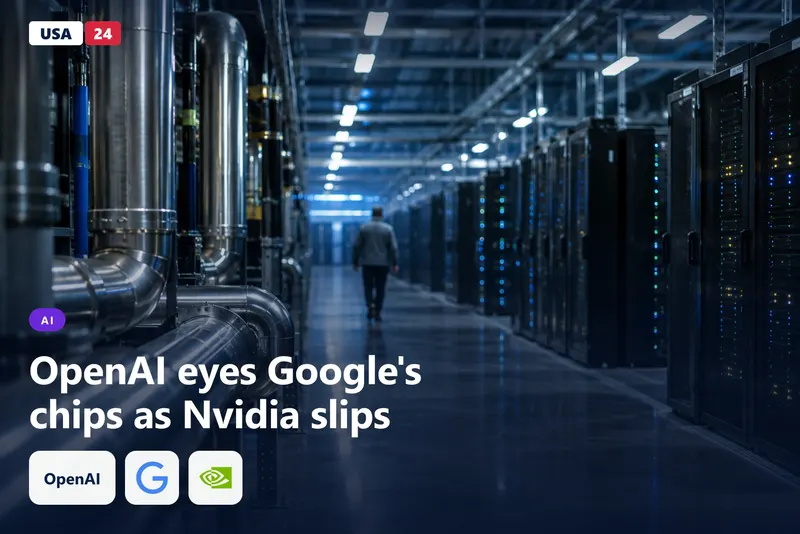
OpenAI plans to buy Google's tensor processing units, according to a report from The Information that surfaced late on Tuesday, October 27. If the OpenAI Google TPU deal happens, Nvidia's biggest customer would gain a second chip supplier, and Google would add a hardware sale to its cloud business. Neither company has confirmed it.
The Information cited a single person familiar with the matter, and Reuters carried the report the next day. Other outlets followed, including BetaNews, which summarized the plan. The story is about a day old, so the real test is whether either company says something on the record.
What the report says OpenAI wants to buy
The report says OpenAI intends to buy TPUs, a step that would take it beyond renting them. The coverage does not say how many chips are involved, what they would cost, when deliveries would start, or which workloads would run on them. SiliconReport left those details out as well.
OpenAI declined to comment. Google did not respond to requests for comment at the time of reporting. One outlet says final terms are still being worked out, as described in a KuCoin flash report. If that is accurate, nothing has been signed yet.
- Reported on the night of October 27, 2026, citing a single source
- Price, chip count, delivery schedule and workloads: not disclosed
- OpenAI: declined to comment
- Google: no response at the time of reporting
- Confirmation from either company: none so far
How the OpenAI Google TPU deal differs from renting
OpenAI is not new to Google's chips. According to a Motley Fool summary, OpenAI began renting Google TPUs in June 2025. That same summary says OpenAI later described that work as early testing and said it had no plans to deploy at scale.
The timing also stands out. The report arrived one day after OpenAI said its models would be available to developers through Google Cloud, according to an Aiera summary. Ownership of hardware would be a deeper commitment than a cloud listing.
Thomas Kurian, who runs Google Cloud, said Google offers “a broad selection of models, including those from OpenAI,” as BetaNews quoted him. The source gives no further context for that remark, so it does not confirm a chip purchase.
Are Google TPU chips for sale to outside buyers
Google is now selling TPU hardware directly. It began letting outside customers run TPUs in their own data centers in April, and deliveries started in the April-to-June quarter, according to The Next Web. The same report says Google's own researchers have had to wait for access because capacity has sold out.
Demand is the main reason. Anthropic's April deal with Google and Broadcom covers multiple gigawatts of TPU capacity, with first capacity expected in 2027. For what Anthropic's IPO filing disclosed about its models, see our report on the filing. TechTimes reports that Anthropic's strategy spans Amazon Trainium, Google TPUs, Nvidia GPUs and AMD GPUs.
A Google executive, identified in one report as Amin Vahdat, said: “The next generation of AI will require a diverse range of compute,” according to the KuCoin flash report. Oracle is also offering TPUs in its cloud, according to CryptoNews. That means cloud buyers may see more chip choice over time.
What the reported deal means for Nvidia and Alphabet shares
Nvidia closed at $217.94 on Tuesday, according to Yahoo Finance. It was roughly $218 on Wednesday morning, about 9% below its October 6 record of $239.24. Investors are already weighing whether AI infrastructure spending will keep paying off, and a report that Nvidia's largest customer may buy a rival's chips adds to that worry.
Nvidia remains central to OpenAI's plans. Citing Nvidia CEO Jensen Huang's August statements, reports say OpenAI has about $600 billion in Nvidia servers committed through 2030. Nvidia says OpenAI's current and planned commitments total about 12 gigawatts. According to RuntimeWire, the reported TPU purchase would be in addition to Nvidia GPUs, not instead of them. The report as relayed does not say OpenAI is cutting back on Nvidia.
Alphabet closed at $320.58 on the report day, up 1.19%, per Yahoo Finance. Alphabet has had its own pressure this quarter, so see our story on its Q3 miss and negative free cash flow for that context.
Analysts note that TPU software still trails Nvidia's. Any purchase could therefore be smaller or slower than the headline suggests.
Who gains and who loses
Nvidia shareholders face a possible shift in pricing power and demand for AI chips, though the deal is unconfirmed. Alphabet shareholders would gain a hardware sale to one of the largest AI developers, which would show that TPUs can win big outside customers.
OpenAI gains a second supplier and more leverage in negotiations. It also has to make TPU software work for its most advanced models. CryptoNews reports that OpenAI is hiring an engineer to optimize those models for TPUs, and that it is building its own Broadcom-designed chip, called Jalapeño, which it plans to deploy by the end of 2026.
Enterprises and ChatGPT users are not directly affected by a chip purchase. Extra capacity could support more models and features later, but no timeline has been given. The Anthropic arrangement suggests a pattern: large AI developers are signing multi-gigawatt commitments with Google, and the hardware is not expected to arrive all at once.
What to watch before anything changes
Readers do not need to act now. An unconfirmed report is not a sound basis for changing a portfolio, so investors should wait for a company statement, a filing or comments on an earnings call before making moves. Useful signals include:
- An official announcement from OpenAI or Google confirming a purchase
- Disclosure of price, chip count and delivery dates, none of which has been released
- Whether Google names OpenAI as a TPU buyer on its next earnings call
- Whether Nvidia's commentary on OpenAI commitments changes
- Whether OpenAI sets a timeline for Jalapeño beyond its end-2026 target
The next real signal will probably come from a company statement, not another anonymous report. If a deal is confirmed, the first numbers to watch are chip count and delivery dates, because they determine whether this is a modest supply hedge or a real shift in who supplies OpenAI's computing power.