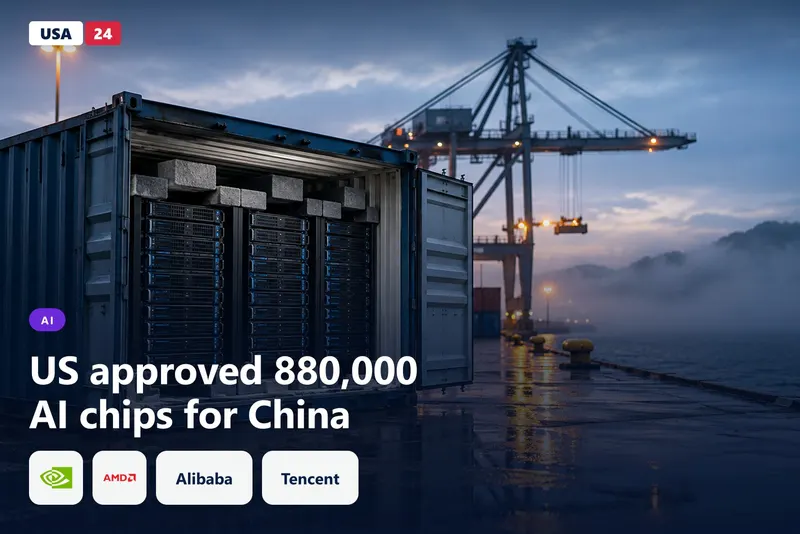
The Nvidia B300 export rule is now showing up in the hardware market. CNBC reported on November 25 that sellers are floating thousands of Nvidia B300 GPUs since the Commerce Department announced new limits on remote access to advanced chips. The report relies on three people familiar with the matter, so it is reporting rather than a government finding, but it points to a rule that is starting to bite.
The rule targets a gap that had been open for years. US law already barred direct sales of the most advanced Nvidia chips to China. Chinese firms could still reach comparable computing power by renting cloud capacity in third countries, and the new rule is meant to close that path.
What the Nvidia B300 export rule requires
The Bureau of Industry and Security (BIS), part of the Commerce Department, issued an interim final rule on November 16, 2026. It requires licenses to export advanced AI chips and servers to data centers anywhere in the world that may supply substantial computing power to companies in China or other restricted countries. According to TechCrunch, the compute test is more than 12 million aggregate total processing performance, or TPP.
The rule took effect on November 19, 2026, after publication in the Federal Register, according to a Lexology analysis. Public comments are due January 19, 2027. Commerce said the rule was written at the direction of Treasury and the National Security Council. It also formally scraps the Biden-era AI Diffusion Rule, according to The Next Web.
Existing overseas data centers that serve covered customers have 90 days from the rule's start to obtain a license. The rule also tightens checks on chip foundries and packagers. Operators with hardware already installed abroad have a clock running, and they cannot wait for the comment period to close before deciding what to do.
US Trade Representative Jamieson Greer described the rule as closing "loopholes" that let Chinese firms reach advanced chips indirectly. Speaking to CNBC's Squawk Box, he said, "For a long time, we have not allowed the sale of Blackwell chips." That framing treats the rule as enforcement of an older policy rather than a new prohibition.
Why thousands of B300 GPUs are for sale
CNBC reported that sellers have offered thousands of Nvidia B300 GPUs since the rule was announced. Its reporting cites three people, and one seller told a broker that the sale was tied to the rule. No official count of offered units exists, and no exact figure has been disclosed, so "thousands" is the most precise description available.
According to AI Brief, the listings describe sellers offloading hardware that was intended for data centers where Chinese companies would rent access. If that is accurate, the logic is straightforward. Capacity built for customers the rule now restricts becomes harder to place, so sellers look for buyers elsewhere.
On its November 17 earnings call, Nvidia said it was still studying the controls. The company still expected strong performance because demand exceeded supply, according to CNBC. Nvidia has also warned customers that the rule could expose them to legal action, according to MLQ.ai.
The timing also lands during a broader pullback. For the market side of the story, USA 24 has reported on how the Nvidia rebound faded as AI stocks sold off across Asia and Wall Street.
The resale story is best read as early evidence, not proof. Anonymous sellers and one broker are a thin basis for a market-wide conclusion. Still, if the offers are real, they suggest some buyers and sellers are repricing hardware tied to Chinese demand, which is the kind of pressure the rule is meant to create.
Which overseas data centers face a license
The table below summarizes the core terms reported across the coverage. Check each one against the Federal Register text before using it for compliance.
| Term | Detail |
|---|---|
| Rule issued | November 16, 2026 |
| Rule effective | November 19, 2026 |
| Comment deadline | January 19, 2027 |
| Compute threshold | More than 12 million TPP |
| License window for existing data centers | 90 days |
| Countries named for added licensing | Indonesia, Malaysia, Singapore, Thailand and Brazil |
Two open questions shape who is covered. Silicon Report says licenses apply to companies headquartered in the five named countries, while other coverage, including The Next Web, says they apply to data centers in those countries that serve Chinese firms. Latham & Watkins reads the rule as not appearing to reach US-located data centers serving restricted entities, while noting that further action is possible.
The threshold is also contested. CryptoBriefing estimates the equivalent at roughly 760 Nvidia H100 GPUs, while TechTimes puts the China-access license line near 200 GPUs. The sources differ on how the 12-million-TPP test converts into chip counts, so buyers should not rely on either figure.
Operators are already responding. Malaysian data-center operator YTL Power said its co-location services are unaffected, according to AI Affairs. Southeast Asian operators and their US customers now face licensing and due diligence requirements that can affect deals and compliance work.
What GPU renters and buyers should check now
Most readers will never buy a B300. But anyone who rents GPU capacity overseas, buys cloud AI services built on foreign hardware or sources used accelerators should take a few steps. The aim is to document what you are buying, not to reach a legal conclusion.
- Ask each overseas provider whether it serves China-headquartered customers, and how it screens them.
- Confirm the physical location and operating company of any data center that hosts your workloads.
- Read your contract for export-control representations, and ask what happens if a license is required.
- For resold or secondhand GPUs, request the seller's chain of custody and documented export status before any payment.
- Ask counsel whether your provider's answers meet your own compliance obligations.
Individual consumers are not directly affected by the rule. The practical effects show up in AI pricing, cloud capacity and supply chains, which can reach ordinary users through service prices and availability.
Megaspeed, Beijing and the bill in Congress
The rule did not appear out of nowhere. Before it, Chinese firms including Moonshot AI, ByteDance, Alibaba and Tencent reportedly sought Nvidia compute in Malaysia, Singapore, Thailand and Indonesia, according to WPNews. US investigators examined whether Singapore-based Megaspeed helped Chinese clients obtain controlled chips, according to Euronews. The US later added Megaspeed to the Entity List in November, and in July it accused Moonshot AI of reaching Nvidia chips through a facility in Thailand, according to Chip Dispatch.
Commerce had already moved in June against Chinese firms' overseas units that bought chips directly, per The Next Web. The new rule carries that approach into remote access, which earlier controls left open.
Congress is also moving. The Remote Access Security Act has passed the House but not the Senate, according to Chip Dispatch. Whether the Senate acts will determine whether remote access becomes a statutory matter or stays a regulatory one. The policy debate is widening beyond chips as well. OpenAI's Pachocki has proposed industry-wide caps on frontier AI models, a different kind of control that targets models rather than the hardware that runs them.
Beijing's response has not been verified in this reporting. A TechTimes headline describes it as economic coercion, but the Chinese government statement behind that description has not been reviewed, so the label should be treated with caution.
What to watch next as the rule takes hold
The winners and losers are not yet clear. Chinese firms that relied on third-country capacity lose a route to advanced compute, and operators that serve them face license costs and tighter screening. Nvidia faces a possible demand shift and legal exposure, while resellers holding B300 inventory may find a short-term market if buyers accept the risk.
Three things will matter most in the coming weeks. The first is the Federal Register text, which should settle the scope and threshold disputes. The second is whether the offered B300 units lead to confirmed sales, which would show the resale signal is real. The third is whether Beijing responds with formal measures and how the Senate handles the Remote Access Security Act.
If the 90-day window is counted from the November 19 effective date, existing overseas data centers would need licenses by about February 17, 2027. That date, rather than the January comment deadline, is the one operators with installed hardware abroad should have on their calendars.