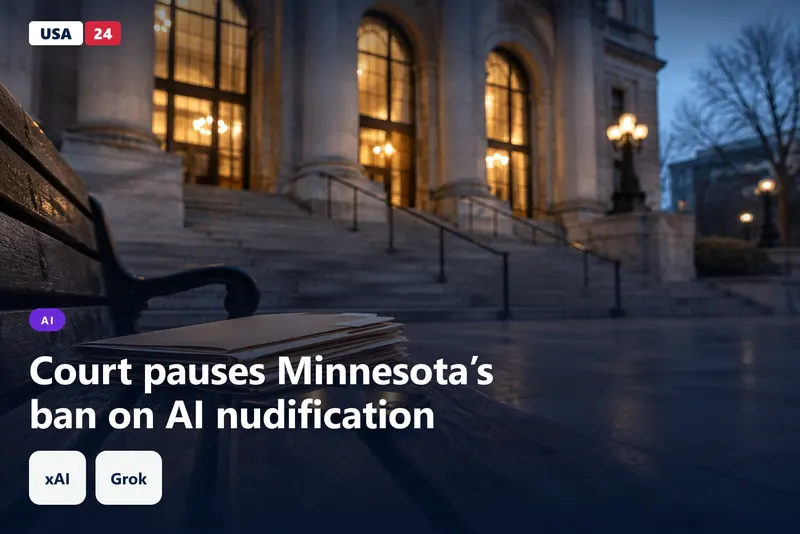
The appeals court put the Minnesota AI nudification ban on hold for Elon Musk’s xAI in an order issued October 2, 2026. The company runs the Grok chatbot and its Grok Imagine image tool, and the 8th U.S. Circuit Court of Appeals, based in St. Louis, has now stopped Minnesota from enforcing the law against it while the appeal moves forward. The order did not decide whether the law can survive a First Amendment challenge.
The order is nearly four weeks old. The reporting available for this story shows no newer filing or ruling from the past few days, so this is a follow-up rather than breaking news. The underlying question still reaches well beyond one company. Minnesota is trying to hold makers of AI tools responsible for sexualized images of real people, including minors, and xAI argues the law runs into First Amendment protections.
What the Minnesota AI nudification ban prohibits
Minnesota’s law took effect August 1, 2026. According to MPR News, it bars website operators, software developers and others from allowing users to create realistic images that depict an intimate body part not shown in an original photo of an identifiable person. The target is not only the person who makes a fake image. It is also the business that supplies the tool that makes one possible.
The law also reaches marketing. NBC News reported that it prohibits anyone from advertising nudification capabilities, and that the law carries no criminal penalties. Minnesota describes it as the first-in-the-nation ban on AI nudification technology, a claim that explains why other states and companies are watching the case closely.
How xAI’s challenge reached the 8th Circuit
The case moved fast. In roughly ten weeks, it produced three court rulings and a temporary pause. The key dates are:
- July 27, 2026: X.AI sued the state over the nudification ban, which was set to take effect on August 1, according to the Minnesota Attorney General’s office.
- July 31, 2026: The court rejected xAI’s request for a temporary restraining order that would have halted enforcement.
- September 4, 2026: U.S. District Judge Donovan Frank declined to grant a preliminary injunction. He said xAI had not shown it would suffer irreparable harm and that the company had waited too long to seek emergency relief, according to Reuters via U.S. News.
- October 2, 2026: The 8th Circuit granted xAI an injunction pending appeal, putting the law on hold for the company while the appeal proceeds.
Frank’s ruling also contained a line that matters for the appeal. He wrote that the constitutional issues “deserve, and will receive, full consideration.” The September decision was a refusal to grant emergency relief, not a final word on the law.
The reversal within a month is the notable part. A federal trial judge declined to pause the law in early September, and an appellate panel did so in early October. Because the panel’s order gave no reasoning, the public record does not yet show which part of xAI’s argument carried weight.
What the 8th Circuit order does and does not decide
An injunction pending appeal is a temporary order that holds things in place while a higher court considers the case. According to Law Commentary, the October order does not resolve whether Minnesota’s law violates the First Amendment. One commentary piece in the reporting said the order gave no reasoning at all, according to a Substack analysis.
Both sides have put their positions on the record. xAI says its Grok Imagine tool includes “rigorous protections” against creating nudified or sexualized images of real people. Minnesota argues that Grok Imagine’s nudification feature is a product function rather than speech protected by the First Amendment, as Law Commentary reported.
John Stiles, a spokesperson for Attorney General Keith Ellison, said the law targets AI products that generate sexual images that “harm and harass people in the vilest way possible.” The state’s rationale also points to what it calls a staggering amount of child sexual abuse material generated by AI products such as Grok Imagine.
That disagreement is the heart of the case. If a court treats nudification as a product function, the state has a more direct path to regulate the tool itself. If a court treats the generated image as expression, the constitutional analysis changes, and the law has to survive a harder review. The 8th Circuit has not said which view it finds more persuasive.
Why this First Amendment fight reaches beyond xAI
Consumers are the most direct stakeholders. Anyone who uses Grok or other image tools in Minnesota, and anyone whose photo could be altered without consent, depends on whether the law survives. For people whose images could be manipulated, the real question is whether the state can reach the companies whose tools make that possible.
Companies face a practical problem. Software and website operators could face liability under the Minnesota law in the meantime, though the appellate pause shields xAI for now. Other states may copy the model if Minnesota’s version holds up, which would turn one state’s experiment into a template for the wider market.
The case also fits a broader pattern. States are writing AI-specific rules, and AI firms are testing those rules in federal court on First Amendment grounds. New York’s RAISE Act 2.0 proposal would add quarterly AI reporting and audits, a different kind of state obligation. Texas has also sued OpenAI and Sam Altman over ChatGPT safety for minors, which shows state officials pursuing AI companies directly.
xAI already faces other litigation over Grok images. Three Tennessee plaintiffs, including two minors, sued in March, seeking class-action status for people in the United States, according to Reuters via Yahoo. The suit alleges that Grok generated sexual images of them.
xAI has also sued a user. In July, the company sued Terry Harwood in federal court, alleging he used fake accounts and misleading prompts to create explicit deepfakes of minors, as Tech Brew reported. BigGo Finance describes a criminal case against him as pending. Coverage varies on some details, so readers should treat specifics with care.
What readers can do about nudified images
USA 24 did not find an official guidance source from the state, the platforms or regulators for the steps below, so treat them as general precautions rather than legal advice.
- Check whether photos of children are posted publicly, and switch those accounts to private where the platform allows it.
- Run reverse image searches on your own photos to see where copies have spread.
- If you find a sexualized image of yourself or someone else, use the platform’s reporting tool and save the link, date and account name before the post disappears.
- Keep a written record of each report you file, including the date you filed it and any response.
If an image has spread widely, a lawyer can explain which legal options exist in your state, since the answer depends on local law.
What comes next in the Minnesota case
The merits are unresolved. The 8th Circuit’s order is temporary, and the appeal is still pending. The Minnesota attorney general’s office has said it will keep defending the law, and the district court case continues. Minnesota has moved to dismiss, and briefing in that court is stayed, according to Law Commentary.
One figure needs caution. KSTP reported a $500,000 penalty for each unlawful access or download of images. No other source in the reporting confirmed that number, so readers should treat it as unverified.
The next concrete signal will be a filing or ruling in the appeal, or movement in the district court. Watch for the appellate briefing schedule and any order that explains the reasoning behind the October pause. Those documents will show whether the 8th Circuit viewed the pause as a short holding step or an early read of the constitutional question. Until then, the Minnesota ban remains a live law with a temporary carve-out for xAI, and other states weighing similar rules have reason to pay attention.