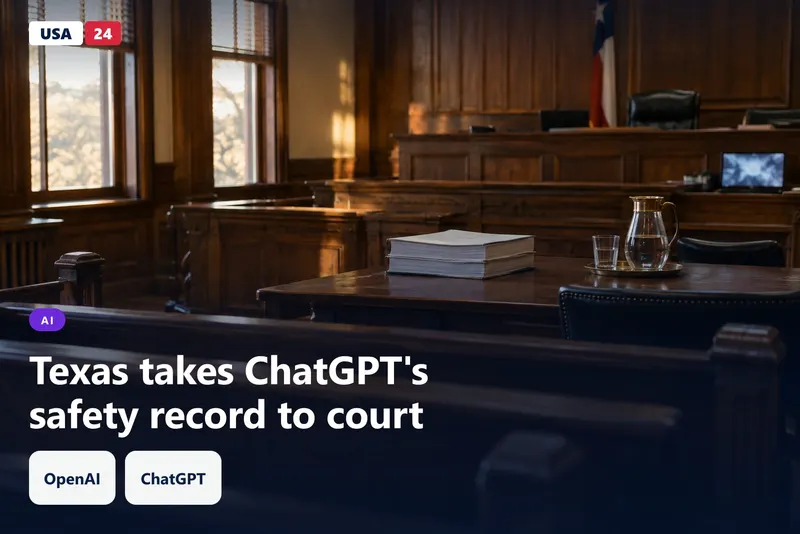
Texas sues OpenAI and CEO Sam Altman over ChatGPT safety, and the request is unusually broad. On October 23, Attorney General Ken Paxton asked a court to stop new AI models from being released in Texas unless an independent, court-approved evaluator reviews and approves their safety measures. He also wants OpenAI barred from offering ChatGPT to minors in the state.
The 67-page petition was filed in a Collin County district court and names six OpenAI entities along with Altman himself. Paxton announced the case in a statement that said, in part, “OpenAI has the responsibility to protect users.” The suit is about a week old and still drawing coverage. It matters beyond Texas because it asks a judge to require pre-release safety review of AI models, a request that goes beyond the federal debate over AI.
Why Texas sues OpenAI over ChatGPT safety claims
The core allegation is deception. Texas says OpenAI misled Texans about ChatGPT’s safety and reliability and failed to warn them about its dangers, according to USA Today’s report, carried on Yahoo. The petition also alleges that the company created a product without adequate safety testing.
Harm sits at the center of the filing. As Fox News quoted it, the petition says that without adequate safeguards, “mass shooters have been aided and abetted in deadly rampages, vulnerable people have been encouraged into suicide.” It further alleges that the chatbot has encouraged self-harm, provided information to mass shooters and exposed minors to potentially addictive interactions.
These are allegations, not findings, and no court has ruled on them. The filing also cites the death of Adam Raine, a 16-year-old whose parents sued OpenAI and Altman in California, according to Martin CID’s summary of the petition. Private litigation over similar harms already exists, so the Texas case joins a broader legal fight.
Paxton framed the case as a matter of corporate accountability. In a statement reported by The Texan, he said, “powerful technology companies are not above the law.” That language signals that Texas views ChatGPT as a consumer product subject to the same rules it applies to social platforms.
How the ChatGPT age checks are described in the petition
Age assurance is where the minors claim becomes concrete. According to the petition as summarized by Martin CID, the free version of ChatGPT has no age verification at all. The paid version asks users for an age but does not check it. The parental controls OpenAI added in September 2025 are optional, so a family has to switch them on.
That gap is the heart of the argument. A teenager who wants to avoid a parent-linked setup can use the free tier, and the petition treats that opening as a central failure. Reporting so far describes OpenAI’s response only in general terms. According to AOL’s report, the company says it builds child safety protections into ChatGPT and will keep improving them.
The statute at the center of the minors claim is the Securing Children Online through Parental Empowerment (SCOPE) Act, which the Legislature passed in 2023 as HB 18. It does not ban minors from digital services outright, as Martin CID notes. That means the case turns on what the act requires of ChatGPT specifically, and a judge would have to decide whether the company’s safeguards met those requirements.
What Texas wants a court to order and what it could cost OpenAI
The petition asks for two main forms of relief, according to USA Today’s report:
- A bar on releasing new AI models in Texas unless an independent, court-approved evaluator reviews and approves their safety measures.
- A bar on OpenAI offering ChatGPT to minors in Texas.
On money, Paxton seeks more than $1 million in monetary relief, according to Crypto Briefing. Under the Deceptive Trade Practices Act, penalties run $10,000 for each violation found, plus surrender of any profits made unethically, as the Houston Chronicle reported. The per-violation structure matters more than the headline figure. If a court counted each affected user or each interaction as a separate violation, exposure could grow far beyond $1 million. The reporting does not say how Texas would count violations.
The minors request is the least settled part of the case. One analysis reads it as having no exception for parental consent or school use, while other reports describe it more broadly as a ban on minors’ access. The court would draw that boundary. Texas Policy Research also points out that the lawsuit itself does not put any restrictions into effect, so nothing changes for users until a judge rules.
Texas also wants Altman held personally liable. The petition alleges he directed the conduct at issue and made deceptive statements about OpenAI’s products, according to the Dallas Express.
Eight states and Paxton’s record against tech companies
Texas is not acting alone. At least eight states have filed lawsuits against OpenAI, according to AOL’s report. Those suits accuse the company of violating state consumer protection laws by hurting children and deceiving adults. Florida’s complaint, filed in the Tenth Judicial Circuit, alleges that OpenAI “knowingly released and aggressively marketed ChatGPT to the public—including to children.”
Paxton has used this playbook before. He has sued TikTok, Roblox and Snap under the same consumer protection and child safety laws. A Texas Tribune report on the Snap suit described accusations of inappropriate content and addictiveness. In August 2025, Paxton also launched an investigation into Meta AI Studio and Character.AI over allegedly deceptive mental health claims.
Politics also surround the case. Paxton is the Republican nominee for U.S. Senate in Texas. A week before the suit was filed, campaign finance reports showed Elon Musk had spent nearly $200 million on ads supporting Paxton’s campaign, according to Texas Tribune reporting cited by The Next Web. That backdrop is documented, but the reporting does not tie it to the legal merits, and this article does not either. For more on how AI rules are shaping the race, read our midterms coverage.
Federal regulators are working in adjacent territory. The FTC has demanded that Anthropic executives testify in its own AI consumer-harm probe, as USA 24 reported. That action is separate from the Texas suit, but it shows that scrutiny of chatbot harms is spreading across agencies.
What parents and Texas users can do now
Nothing has been ordered, so most users do not need to change anything yet. These steps make sense today:
- Parents should open ChatGPT’s parental controls and check the age settings on each teen account. The controls are optional, so confirm they are actually enabled.
- Find out whether teens use the free version, which the petition says has no age verification.
- Ask whether any teen uses the paid version. The petition says its age prompt is not checked.
- Texas residents who want to follow the case can watch the Collin County district court docket for new filings and hearing dates.
- If a teen shows signs of distress after using a chatbot, talk with them directly and contact a doctor, a counselor or the 988 Suicide and Crisis Lifeline.
What to watch next in the Collin County case
No court date, hearing or ruling has been reported. Four developments will show where this goes.
First is OpenAI’s formal response. Early reporting is inconsistent. One account said the company had not responded at the time of filing, while another described its general commitment to child safety. A filed answer or motion will be a clearer signal than either.
Second is the definition of “offering ChatGPT to minors.” A ban that covers free, paid and school-based access is a very different order from one that carves out parental consent. The judge would have to draw that line.
Third is whether the court takes up the request for pre-release review. An order requiring court-approved evaluators for AI models would be a new kind of remedy, and other states with pending suits are likely to watch it closely.
Fourth is how the other suits move. At least eight states are pursuing similar claims, and their outcomes will shape how much leverage Texas carries into negotiations or trial.
The next filings will show whether Texas treats ChatGPT as a product that needs better warnings and age checks, or as a model that needs court-approved clearance before it reaches Texans. Those theories carry different costs for OpenAI, and the answer will matter well beyond Collin County.