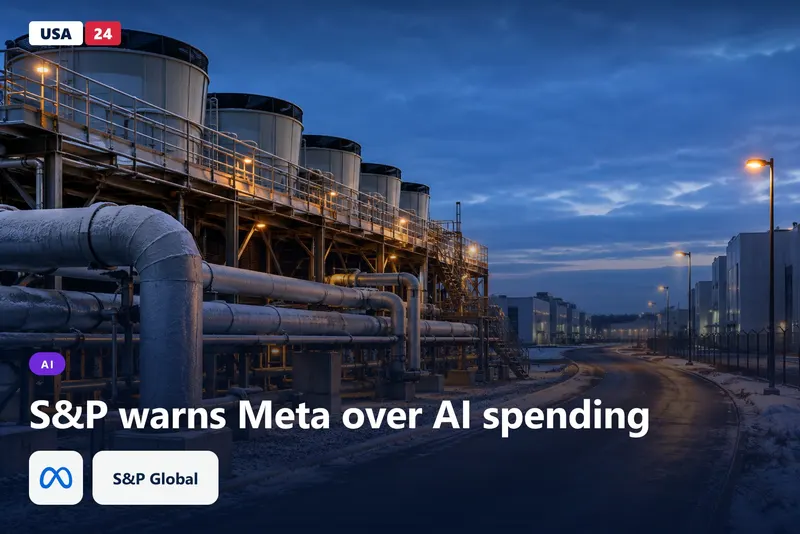
S&P Global Ratings moved its credit outlook on Meta Platforms to negative from stable on Friday, October 30, citing AI spending that has pushed the company's free cash flow into deficit. The agency affirmed Meta's AA- issuer credit rating, one of the higher rungs on its scale, so the change is a warning rather than a downgrade. Even so, it puts a formal credit-market signal on one of the largest AI spenders in the industry.
The timing is hard to separate from the sell-off. The market had already spent about a week repricing AI spending, and the S&P action landed while Meta was pursuing a stock sale that Reuters-based reporting puts at $97.5 billion to help fund its AI buildout.
What the Meta credit outlook change actually means
An outlook is S&P's view of which direction a rating is likely to move over the medium term. A negative outlook does not mean a downgrade has happened or is scheduled. It means the agency sees enough risk that the rating could fall if current trends continue.
S&P was specific about its reasons. The agency said it is less certain Meta will curtail AI spending as previously expected, and it called Meta's multiyear AI investment plan very ambitious. In other words, S&P did not assume the spending would slow on its own.
Bondholders are the most direct audience for this change. But Meta is also a major holding in many US index funds and retirement accounts, so the outlook reaches a far wider group of savers than the bond market alone.
Why negative free cash flow worries credit analysts
Free cash flow is the cash a company generates from operations after capital spending. It is the money left over to repay debt, buy back stock or pay dividends. When it turns negative, a company is spending more on infrastructure than it brings in, and the gap has to be covered elsewhere.
Meta posted approximately -$2.12 billion in free cash flow for the quarter, according to Crypto Briefing, which describes it as the company's first negative free cash flow in more than a decade. One quarter alone does not decide a rating. S&P's concern is the trend, and it expects Meta's leverage could rise above 1.0x as early as 2027. Daily.dev's summary of the report puts Meta's leverage at about 0.1x last year.
The agency also drew a competitive contrast. S&P said Meta has less capacity than Amazon, Microsoft and Google to monetize its AI investments because Meta has no cloud business that rents out computing power. Those rivals can sell AI capacity to outside customers, which gives them a direct way to earn back infrastructure costs. Meta does not have an equivalent channel.
Meta's chief executive argued in mid-October that the core business and strong credit let the company fund its AI costs. He also said other tech companies would rent Meta's compute if its own AI products fail. That fallback is harder to execute without a cloud business, which is the gap S&P pointed to.
The AI spending bill behind the warning
S&P's capital spending estimates climb every year in its projections. The agency's figures, reported by BigGo Finance, put Meta's capex at about $140 billion this year, $225 billion in 2027 and $252 billion in 2028. Reporting also cites roughly $825 billion in future data center and AI infrastructure commitments.
| Metric | Figure |
|---|---|
| Outlook | Negative, changed from stable on October 30, 2026 |
| Issuer rating | AA-, affirmed |
| Q3 free cash flow | About -$2.12 billion |
| Leverage last year | About 0.1x |
| Leverage expected | Above 1.0x as early as 2027 |
| Capex this year (S&P estimate) | About $140 billion |
| Capex in 2027 | $225 billion |
| Capex in 2028 | $252 billion |
| Future AI and data center commitments | Roughly $825 billion |
Not every outlet agrees on the capex number. One headline cites a $145 billion AI spending plan, while S&P-based reporting uses about $140 billion for this year. Check which figure a filing or the rating report uses before quoting either one.
Naveen Sarma, the US media and telecom sector lead at S&P Global Ratings, put the risk in plain terms. "If capex remains elevated and continues to grow at a faster pace than we expect, credit profiles will continue to weaken and cash flows will be negative," he said, as quoted by CXO Digital Pulse.
What would trigger a downgrade
S&P flagged two conditions. The first is an adjusted debt ratio above 1.0x on a sustained basis. The second is free cash flow that stays negative past 2028. Startup Fortune reports both thresholds. A trend that persists long enough would give S&P reason to lower the rating.
Those thresholds rest on forecasts, not outcomes. Whether Meta crosses them depends on how capital spending, operating cash flow and borrowing evolve across 2027 and 2028. The company can influence those trends by slowing spending, growing revenue faster or raising more equity. S&P, however, said it is less certain Meta will curtail its spending.
This is not the first time the agency has applied this kind of pressure. According to Benzinga, S&P previously cut Oracle's outlook earlier this year. The pattern suggests that credit analysts are now scrutinizing AI-heavy balance sheets as closely as they once scrutinized traditional capital-intensive businesses.
Meta's pushback and the stock sale figures
Meta disputes the assessment. A company spokesperson said Meta respectfully disagrees with S&P's view of its AI monetization capabilities and pointed to significant product and business opportunities. The available remarks did not include specific revenue figures to answer the agency's concern.
Analysts are not uniform in their concern. One portfolio manager quoted by Benzinga argued that worries about Meta's debt look overstated, because hyperscalers have much stronger debt coverage than the broader market. Both views are defensible, which is why the outcome remains open.
The stock sale numbers also do not match. Reporting based on Reuters puts Meta's sale at $97.5 billion. USA 24's earlier coverage used $95 billion, describing it as the company's first share issuance since 2013. A separate report says Meta started a $35 billion share sale that same week. Based on the reporting available, it is not clear how those figures relate to one another.
USA 24 did not access S&P's full rating report, so the agency's reasoning in this story comes from press coverage of it. Treat the details as reported, not verified against the primary document.
What bondholders and investors should do now
This is general information, not investment advice.
- Check how much META you own directly and through index, sector and target-date funds. Meta is a large position in many US funds, so your total exposure may be higher than you expect.
- Read S&P's rating update and Meta's own SEC filings before making decisions. Look for capital spending guidance, debt levels and free cash flow.
- If you hold Meta bonds or bond funds, check the current rating and ask your fund manager how a possible downgrade would be handled.
- Compare any stock sale figure against the company's filing. Early coverage has already produced several different numbers.
- Avoid acting on headlines alone. A negative outlook is a signal, not a verdict.
If you use Facebook, Instagram or WhatsApp, this rating action does not change those products or your account.
What to watch next
The next signals will come from filings and earnings, not headlines. Watch Meta's quarterly free cash flow and any change to its capital spending estimates, since S&P's thresholds depend on those trends. Watch whether the stock sale closes at the size the company's filings show, and whether leverage moves toward 1.0x in future reports.
Watch for revenue Meta ties directly to its AI products, because that is the evidence that would answer S&P's monetization concern. The market is also testing how much patience it will give AI spenders. OpenAI cut its funding target to $20 billion as AI stocks sold off, and Intel's stock plunged despite 78% AI data center growth after a weak fourth-quarter forecast. Investors are signaling that growth alone is not enough.
Meta's next test is whether a company without a cloud business can turn its AI bet into cash flow fast enough to satisfy the rating agency, the bond market and its shareholders.