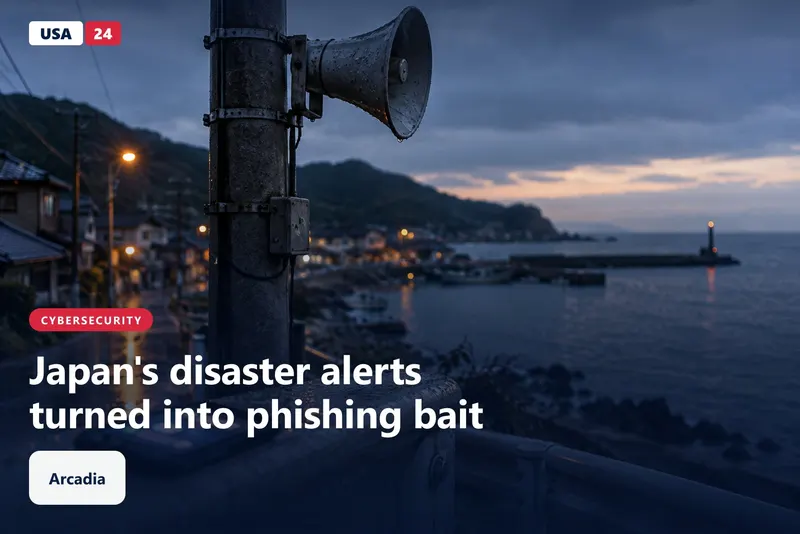
The Japan disaster alert hack gave attackers access to the system that 875 Japanese public bodies use to send warnings, and Cybernews reports the intruders used it to send phishing emails. Osaka-based Arcadia, which runs the service, detected the unauthorized access on October 11, 2026. The public account arrived 26 days later, on November 6, so this is a disclosure story rather than a fresh intrusion.
What happened at Arcadia
Arcadia operates a disaster information distribution service used by 875 Japanese public organizations. According to Cybernews, the company detected unauthorized access on October 11, 2026. The intrusion forced Arcadia to shut down some servers, and that shutdown disrupted the delivery of disaster-prevention emails from local governments.
The reporting reviewed does not say whether the service has been fully restored. Alerts like these often carry evacuation and safety information, so even a short outage carries real risk for residents who depend on them.
The sources reviewed also do not name the affected municipalities. That gap makes it harder for residents to know whether their own local alerts were affected.
How the Japan disaster alert hack sent phishing emails
The most specific claim about the abuse comes from a secondary source. A social media summary posted by International Cyber Digest says the attackers sent about 1.42 million phishing emails through the service and that Osaka police are investigating. That figure comes only from that post. Neither Arcadia nor police has confirmed it in the sources reviewed, so treat it as unverified.
The exposure figure has a firmer basis. Cybernews reports that 3.13 million email addresses may have been exposed. The social post rounds that to 3.1 million. The key phrase is 'may have been exposed,' because the reporting does not establish how many of those addresses were read, copied or misused.
Here is how the main figures stand:
| Claim | Figure | Source | Status |
|---|---|---|---|
| Public organizations using the service | 875 | Cybernews | Reported |
| Date unauthorized access was detected | October 11, 2026 | Cybernews | Reported |
| Email addresses possibly exposed | 3.13 million | Cybernews | Reported as possible |
| Email addresses possibly exposed (rounded) | 3.1 million | International Cyber Digest post | Secondary |
| Phishing emails sent | 1.42 million | International Cyber Digest post | Unconfirmed |
What the CEO's AI claim does and does not establish
International Cyber Digest also relays that Arcadia's chief executive suspects artificial intelligence played a role. No original Japanese-language statement from the company was located in the reporting reviewed. The exact wording and the AI claim therefore remain unverified, and any direct quote should wait for confirmation from Arcadia or a Japanese news outlet.
The AI question matters for two reasons. If AI tools helped attackers write convincing lures or scale a phishing campaign, defenders face a faster and cheaper threat. But an AI explanation is also easy to offer after any breach, and it does not identify who was behind the intrusion. Who carried out the attack is not confirmed in these sources.
Our coverage of a WorkOS breach that exposed customer conversations to AI-driven attackers is a useful comparison, but it does not establish a link to this case.
Why trusted alert channels make effective phishing lures
Emergency messages are built to get attention fast. People read them on a phone, often under stress, and many are primed to act. An email that appears to come from a local disaster system can earn a click that an ordinary spam message never would. The attackers did not need to invent a trusted sender. They borrowed one.
The supply-chain logic applies too. An attacker who reaches one vendor gains access to every customer that vendor serves. Our report on the cPGuard supply chain attack that pushed a backdoor to about 2,950 servers shows the same pattern, with trusted software carrying the threat into many organizations at once.
The theme has appeared in US systems this year. In September 2026, Thomson Reuters disclosed that C-Track, a court case management platform operated by its subsidiaries, exposed court records and sensitive personal information across courts in at least 12 US states. According to Help Net Security, that breach began in March and was discovered in June 2026. The Japan case is separate, but both show trusted public-facing systems becoming attack channels.
What this means for US emergency alert systems
No US organization is confirmed as affected by the Arcadia incident in the sources reviewed. The story still matters to American agencies, because its core lesson is about trust. Whether any US-based alert vendor or government agency uses Arcadia or shares its infrastructure is unknown, and that is the first question a county emergency manager or state IT office should be able to answer.
Many US counties and states send emergency notices through third-party notification platforms. Those systems hold contact lists, sending rights and administrator credentials that an attacker would want. Agencies that rely on them should review administrator access, confirm how quickly they can revoke sending credentials, and ask vendors whether they have checked for comparable intrusions.
The Japan case also shows what is at stake beyond phishing. When an alert service goes offline, the public loses a channel it depends on in the moments it needs it most.
How to spot emergency alert phishing and what to do
Treat any alert email that asks you to click a link, log in or confirm personal details with suspicion, even if the logo and wording look official. These steps reduce the risk:
- Do not click links or enter passwords from the message. Open a new browser window and type the agency's web address, or use a bookmark you saved earlier.
- Compare the sender's address with the agency's official website, and look for small misspellings or unusual domain endings.
- Check whether the same alert appears on the agency's official website, app or verified social accounts.
- Report suspicious messages to the sending agency and to the Federal Trade Commission at reportfraud.ftc.gov.
- If you entered a password, change it now, update any other account where you reused it, and turn on multifactor authentication where it is available.
What to watch next
Several questions remain open. Arcadia has not confirmed the 1.42 million phishing figure or the 3.13 million exposure count in the sources reviewed. Osaka police's investigation could name a suspect or method, which would help settle the AI question. It is also unclear whether Arcadia has fully restored service to local governments.
Watch for a formal statement from Arcadia, which would carry more weight than secondhand summaries, and for any response from Japanese authorities or the local governments that depend on the platform. If the scale of the phishing campaign is confirmed, expect pressure on alert vendors to prove how they protect the messages governments send in an emergency.