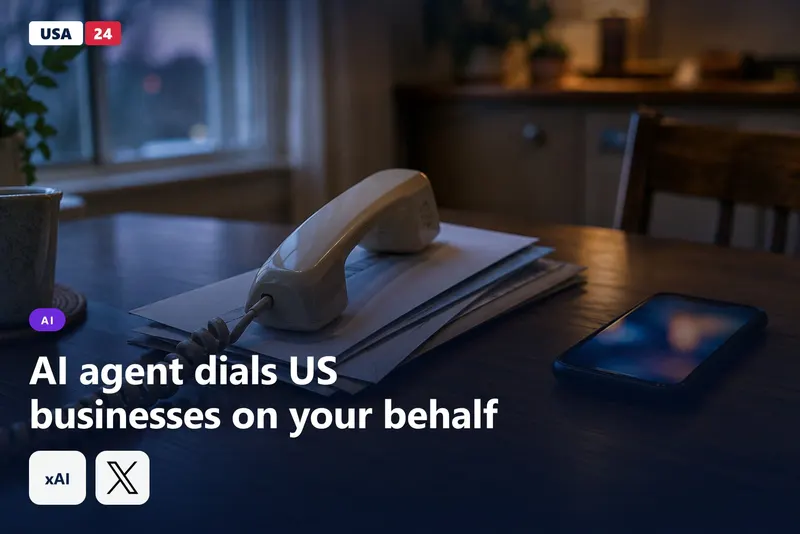
A paying X subscriber can now tell Grok Bot to dial a business, sit on hold, negotiate a bill and report back. The AI agent does the talking, but xAI’s terms make the person who sent it solely responsible for every call. Grok Bot phone calls reached a broad set of US users this week, and the company’s own documents place the legal weight on those users.
Elon Musk pushed the feature on X on November 3, 2026, posting, “Try asking Grok @Bot to make calls!” Creator Peter Yang said the same day that all Grok Bot users should now be able to call US businesses. The rollout raises consumer-protection, telemarketing and liability questions, and the answers already show up in the fine print.
How Grok Bot phone calls rolled out
Musk first described the calling capability on October 25, 2026. He said an agent could call someone or a business and summarize the response. According to Teslarati, the feature first appeared only in preview builds, with no release notes.
Reports disagree on the timeline. One write-up by Flavio Copes dates xAI’s announcement to November 4, which conflicts with the November 3 promotion date. Skipcall says Grok Bot itself entered beta on August 11, 2026, so calling is a new capability on an existing product, not a debut.
Grok Bot is an always-on agent that runs on its own cloud computer, according to Skipcall. It is separate from the Grok chatbot inside X and from the Grok app. xAI sells a different product, Voice Agent Builder, for businesses that run phone agents. Callers still need a phone number, and calling is limited to US numbers.
What the Comcast demo showed
In creator Peter Yang’s demonstration, Grok Bot dialed Comcast, worked through the phone menu and negotiated a bill over a call of about 25 minutes, according to Gate.com. The bot paused for his approval before accepting final terms. The Rundown AI reports early examples that also included a pizza order.
That approval step is the most useful detail in the demo. The agent handled the menus and the back-and-forth, while a person made the final decision on the deal. The available reporting does not include call success rates, and the demo is a single example. One independent account says the calling feature was undocumented and that early independent tests failed, but no second source confirms that.
Calls appear to run inside the platform through a temporary number. xAI has not said which number it uses. That matters because recipients rely on caller ID to decide whether to answer, and an undisclosed number makes a callback harder.
The terms put the legal risk on the user
The Grok Bot Terms make the customer the “caller of record” and solely responsible for calls. That includes compliance with telemarketing, robocall, caller ID and call-recording laws, such as the Telephone Consumer Protection Act. Bereaonline reports that the terms were updated on October 31, 2026, and examines who is responsible under them.
The terms also set limits on what the bot can do:
- Prohibited: marketing, mass calls, fraud, harassment, impersonation and calls to emergency services.
- Required: each call must identify itself as a virtual assistant calling on the user’s behalf, and must warn that the call may be recorded.
That split is the story. xAI gets a feature that works without a person on the line, and the user takes the exposure if a call breaks telephone rules. A user who sends a bot to call a business could face liability for a violation, and nothing in the terms shifts that burden back to the company.
What happens when the bot misstates a price or a policy is not settled. The terms put responsibility on the user, but a company’s terms do not resolve every liability question. Courts and regulators will decide how far a contract can move telephone-law exposure, and nothing in the reporting shows that test has happened yet.
Google already offers consumer calling tools, including Call for Me and Ask for Me. According to Skipcall, Grok Bot differs in two ways: it says it is an AI, and its terms put liability on the user. This is not the first time USA 24 has covered an AI tool that acts for a user within limits. Claude Personal Finance can read bank data but cannot move money, and OpenAI’s Codex training setting reportedly turned back on without notice. Both stories turn on how much control a person keeps.
Who can use it and what it costs
- Plans: X Subscription Premium, Super and Ultra.
- Price: Premium starts at $30 per month, according to AI Tool Ranked.
- Geography: calling is limited to US numbers.
- Per-call fees: none have been announced, though compute limits tied to weekly usage caps may apply.
The state question is murkier. Grok Bot told one tester that calls work everywhere in the US except Washington and Illinois. That is the bot’s own answer, not a published rule, and another account says no country list exists. Until xAI publishes a rule, treat the state answer as unverified.
What is still unconfirmed
| Question | What the reporting says |
|---|---|
| Which states are covered | Only the bot’s own answer, which excludes Washington and Illinois; no published rule |
| Which number the bot uses | Not disclosed; calls appear to use a temporary number |
| Usage limits and charges | Unclear whether calls count against limits; no call pricing announced |
| Official documentation | One independent account calls the feature undocumented; not confirmed by a second source |
| Tesla vehicles | Unconfirmed whether owners can request calls from inside vehicles |
| Maker’s legal name | Sources use SpaceXSI or SpaceX Super Intelligence LLC; terms sit at x.ai |
Who else feels the impact of AI-voiced calls
Subscribers are not the only people affected. The businesses and customer-service lines a bot calls must handle an AI-voiced caller they did not choose. Anyone who receives such a call may not know the speaker is software, which makes the disclosure requirement the main protection for recipients. The bot is barred from marketing and emergency-services calls, which limits the most obvious abuse, but the reporting does not describe how xAI checks compliance.
What to do before you let Grok Bot call anyone
- Check your plan. Confirm that your X tier includes Grok Bot before relying on it for calls.
- Expect the disclosure. The bot should say it is a virtual assistant calling on your behalf. Treat a call that skips this as a problem to report to xAI.
- Assume the call is recorded. The terms require a warning, so plan what you say with that in mind.
- Keep calls to businesses you are permitted to contact. Do not use the feature for marketing, mass calls, impersonation or emergency services.
- Stay on the line for final terms. In the Comcast demo, the bot paused for approval before accepting terms, and that is the safest pattern to copy.
- Watch your usage. Calls may draw on weekly limits, and xAI has not said whether they do.
What comes next
Three developments will tell readers more than any demo. The first is a published list of states and a clear statement of which number the bot dials from. The second is pricing or a usage rule for calls. The third is whether a disputed call reaches a regulator or a court, which would test whether a terms-of-service clause can move telephone-law liability onto the user. Until then, the feature will spread across X faster than its rules settle, and the people on the receiving end of these calls will have the least say in how it works.