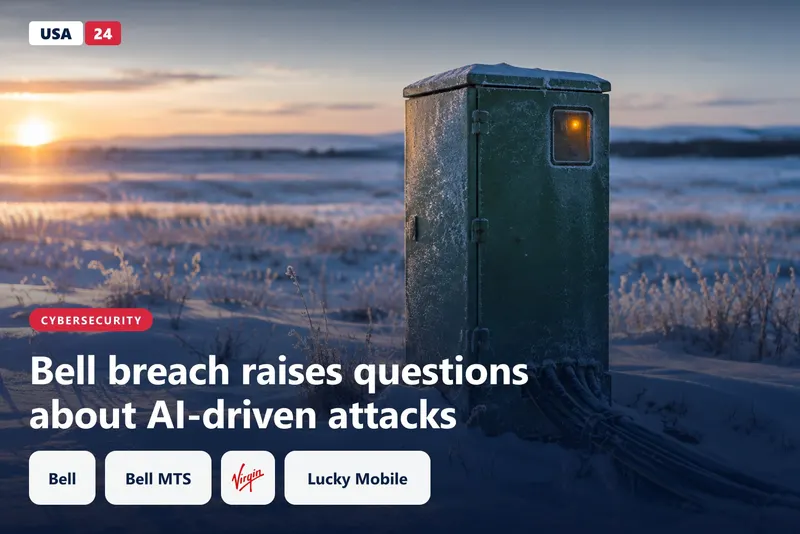
Bell Canada says an "agentic threat actor" broke into some of its internal systems on November 17, 2026, and stole enterprise customer data. The Bell Canada data breach has reportedly reached several subsidiaries, and the Royal Canadian Mounted Police is now involved. Bell has not said who is responsible, and it has not confirmed whether AI tools were used.
The story is Canadian, and no US customer impact has been reported. It still matters to American readers because it is one of the clearest recent examples of a company describing an intrusion in terms that point toward automated or AI-driven tooling. The framing is moving faster than the confirmed facts.
Bell Canada data breach: what happened on November 17
According to reporting from BetaKit and BleepingComputer, an attacker accessed some of Bell's internal systems on November 17, a Tuesday. One of the systems involved is used to order and provision circuits, the telecom connections that business customers depend on. Bell says the attacker exfiltrated some enterprise customer data.
Bell says it contained the incident and removed the threat actor. In an email to customers, the company wrote: "Upon discovering the incident, Bell immediately removed the threat actor and initiated emergency protocols." The reporting so far does not explain how the attacker got in.
Ellen Murphy, a Bell spokesperson, described the November 17 incident as involving an agentic threat actor in an email quoted by The Globe and Mail.
The timeline is still loose. One report says Bell emailed customers on Monday morning, while other outlets published the disclosure on November 20. Until Bell publishes a dated notice, the exact date of its first customer message should be treated as unconfirmed.
Which Bell brands and customers are affected
Bell has named five brands in connection with the incident: Bell, Bell Aliant, Bell MTS, Virgin Plus and Lucky Mobile. Its breach notice to customers describes names, addresses, phone numbers, email addresses and account details as affected. Yahoo News Canada reported that customers of Virgin Plus and Lucky Mobile were among those affected.
Here is the short version:
- Bell: enterprise customer data was taken, according to the company
- Bell Aliant, Bell MTS, Virgin Plus and Lucky Mobile: reported as reached by the breach
- Total number of affected customers: not disclosed
Bell says highly sensitive data, including credit card numbers and bank account details, was not affected. That is the most reassuring line in the notice, but it is the company's own assessment, and no independent audit has been published. Bell has not said how many customers were affected in total.
Bell MTS email lockout
Bell MTS, the Manitoba arm of the company, said the same attacker obtained some personal information about its customers, according to CBC News. It also tied a multi-day email lockout for some customers to the cyberattack. Some customers were locked out of email for more than two days.
Bell MTS has not said how many of its customers had personal information taken, or which data types were involved. It has also not confirmed that the same actor caused the email outage. Those gaps matter, because a lockout and a data theft can be separate problems with separate fixes, and the public record does not yet show whether they are linked.
What the agentic label does and does not confirm
The word "agentic" is Bell's own. Outlets have read it as a hint that AI was involved, but the company has not confirmed that AI tools were used, and it has not explained the term. In a statement to BleepingComputer, Bell said: "We currently do not know the attribution." No group has claimed the attack, and Bell has not been contacted by anyone claiming responsibility.
In the AI industry, an agent usually means software that plans and carries out a sequence of actions with limited human direction. If an intruder used a tool like that, it could probe systems and move between them faster than a manual operator. That is a hypothesis, not a finding. Bell may have meant something narrower, and the public record does not yet separate an AI agent from a scripted attack run by people.
USA 24 has covered ARTEX AI, an AI hacking tool linked to breaches at Barracuda Cloud and ConnectWise. That case offers a useful comparison: AI-branded attack tools are already being tied to real victims, which is why an unexplained word like "agentic" draws attention.
How the RCMP and Canada's cyber agency are involved
The RCMP's cybercrime unit has been contacted, according to VOCM, and Bell is running an internal investigation. Bell also says it is sharing indicators of compromise with enterprise customers and with the Canadian Centre for Cyber Security, as reported by BleepingComputer and The Globe and Mail.
Indicators of compromise are technical clues, such as suspicious internet addresses, domain names or file hashes, that help defenders check whether their own networks were touched. The reporting available so far does not include a public update from the RCMP.
Why US readers should watch AI-driven intrusions
Bell's customers are mostly in Canada. US readers who use Bell-branded service, Virgin Plus or Lucky Mobile while traveling, or who run cross-border business accounts through those carriers, should pay attention to messages about the breach. Beyond that, the direct US exposure looks limited.
The larger lesson is about speed and scale. If automated tooling can move through enterprise systems, a single weak point can be exploited faster and across more systems than a person working alone could manage.
The Container Store is a closer US parallel, though it is a different kind of incident. According to The Record, the retailer restored systems after a weekend cyberattack, and the company said the incident did not expose customer financial data. The n0n ransomware group has listed the Container Store on its leak site, and the company has not addressed that claim.
USA 24 has also covered Together AI's disclosure that an AI coding agent leaked June and July prompts. That case is a reminder that AI systems can be a weak point themselves.
What to do if you think your data was exposed
Bell's guidance, as reported by BetaKit, is straightforward and applies to most breach notices. Be wary of unsolicited messages asking for personal information, avoid clicking links or downloading attachments from suspicious texts or emails, and review account activity regularly.
Practical steps for customers:
- Treat unexpected texts and emails about the breach as suspicious, especially any that ask you to confirm personal details or log in through a link.
- Contact Bell through the phone number on your bill or its official app, not through a number or link included in a message.
- Check your bill, account activity and recent account changes for anything you do not recognize.
- Turn on multi-factor authentication for your email account, and change the password if you have reused it elsewhere.
For business owners, the steps are more specific. If your company buys enterprise telecom circuits from Bell or another provider, ask your account team whether you were notified and whether you have received indicators of compromise. Pass those indicators to your security team and check your logs against them. A direct request to your provider is the simplest way to get a clear answer.
What to watch next in the Bell investigation
Four questions will shape how this story ends. First, whether Bell confirms that AI tools were used, and if so, how. Second, how many customers were affected, and which data types were taken from Bell MTS customers. Third, whether the RCMP or the Canadian Centre for Cyber Security makes a public statement, and whether anyone claims responsibility. Fourth, whether the Bell MTS email outage is tied to the same intrusion.
Bell's description of the affected system also needs clarifying. BleepingComputer and The Globe and Mail describe a circuit-ordering system, while a roundup from Newscord describes a pre-production Maximo environment. Bell has not resolved that difference.
For US readers, the takeaway is practical. Watch for scam messages that borrow the Bell story, and watch whether future incident notices explain the word "agentic" more fully than Bell has so far.