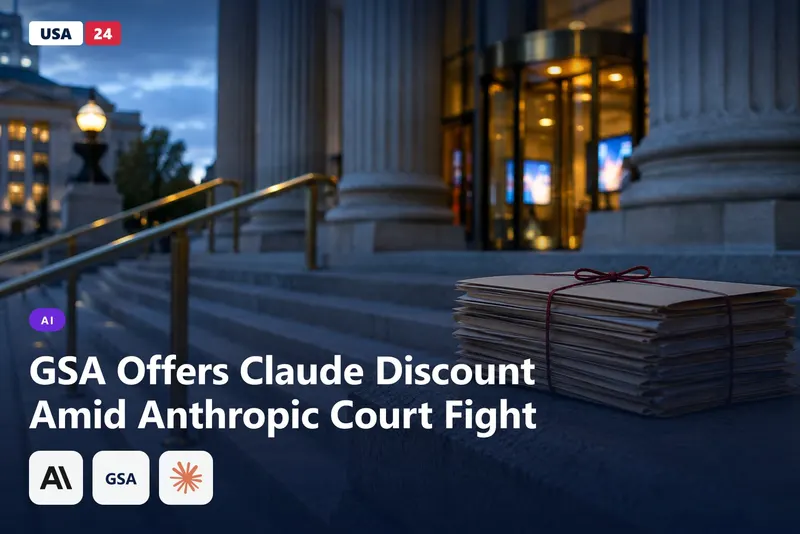
The Anthropic GSA deal gives federal agencies a 40% discount on Claude, and it arrived in the same week the Justice Department asked to reinstate a nationwide injunction against the company that makes the model. The General Services Administration expanded its OneGov agreement with Anthropic, putting Claude back at the center of federal AI buying after a turbulent year in Washington.
According to FedScoop, GSA announced the expanded agreement on Tuesday, October 27. Coverage disagrees on the date of the Justice Department's appeal. A flash report citing Odaily says the appeal was filed October 26 and that the GSA announcement came the same day, so the sources conflict on when GSA acted.
What the GSA OneGov Anthropic deal includes
The discount applies to token-based usage across Claude models, and pricing runs on consumption with no minimum purchase, according to FedScoop. BusinessToday adds more detail. The core terms, as reported, look like this:
- Discount: 40% off token-based usage across Claude models
- Pricing: consumption-based, with no minimum purchase or spending commitment
- Eligible buyers: federal agencies in the executive, legislative and judicial branches, plus state, local, tribal and territorial governments
- Channels: direct from Anthropic and through resellers, with major cloud platforms to follow
The offer also sits on top of an existing route. GSA's schedule has offered Claude since August 2025, when Anthropic said federal departments could buy through it with pre-negotiated pricing, as described in the company's August 2025 announcement. The OneGov expansion adds a 40% discount on top of that setup.
How Claude for Government pricing differs from the discount
Before this deal, Anthropic offered Claude for Enterprise and Claude for Government to all three branches of government for $1 per user, according to its announcement on expanded access. BusinessToday says the GSA agreement builds on that earlier offer for eligible agencies. Coverage also says the discounted government deal ends in October, which gives agencies deciding now a clock to watch.
Claude for Government works on a different billing model. ExecutiveBiz reports that it reached general availability with FedRAMP High authorization. DigitalToday describes it as built for sensitive but unclassified work, with prepaid usage and spending caps instead of per-seat fees.
That difference matters for budgeting. A per-seat plan charges for people, while a prepaid usage plan charges for work and stops at the cap. The reporting does not say whether the 40% discount applies to Claude for Government, and that is the first question a procurement officer should put to Anthropic or GSA.
Where the DOJ appeal on the Anthropic ban stands
The Justice Department filed an appeal on October 26 seeking to reinstate a nationwide injunction against Anthropic, according to a flash report citing Odaily. That report is the main public source for the filing, and no primary court document or major outlet has confirmed it in the reporting reviewed for this story. Readers should treat the appeal as reported, not verified.
The same report ties the appeal to a cryptocurrency ban and terrorism-financing concerns. That claim is unverified too. The reporting does not confirm which case the appeal belongs to or how it connects to the Pentagon dispute that FedScoop describes as ongoing.
The background is clearer. In February, GSA backed the administration's ban on Anthropic and removed Claude from the federal procurement list. In April, a court ruled the broad ban unlawful, and Anthropic regained procurement eligibility, according to the TechFlow Post and the KuCoin flash report.
The Pentagon fight is what complicates the picture. FedScoop describes Anthropic as in an ongoing legal battle with the Pentagon, while its relationship with other federal officials appears solid. BusinessToday's headline calls the company's position a Pentagon blacklist, which underlines the split. A company can litigate against one part of the government and sell to another, and this week's GSA news shows civilian buying moving forward during that fight.
What the $1 billion savings claim means
Anthropic estimates the deal could save the US government $1 billion. That figure comes from the company, and the reporting does not show how it was calculated. Treat it as a projection, not an audited result.
The usage figures call for the same caution. BusinessToday reports that about 500 federal, state and local government organizations now use Claude, that federal civilian agency usage is up roughly 20-fold over the past year, and that weekly active users of Claude for Government are up about eightfold since February 2026. Those numbers show momentum, but they do not isolate the effect of the discount, which was announced only two days ago.
Smaller agencies and state governments may find a no-minimum model easier to try than a large fixed commitment. Agencies that adopt Claude while the appeal is pending take on vendor and legal uncertainty. Rival vendors face a sharper benchmark. OpenAI, Google and others will have to answer if federal buyers start comparing prices per token. USA 24 recently reported that OpenAI cut API prices in half for computer-use agents with its GPT-6.1 Terra model, a sign that price is becoming a central competitive lever.
What agency buyers and vendors should check
If you run procurement or IT for an agency or a state, start with the route to purchase. Buyers can go direct to Anthropic, through a reseller, or later through a major cloud platform, and the channel can change billing, support and terms. Then confirm the spending caps, because prepaid usage with caps is how Claude for Government is designed to work.
A practical checklist:
- Confirm eligibility under the executive, legislative, judicial, state, local, tribal or territorial categories.
- Ask in writing whether the 40% discount applies to Claude for Government.
- Find out what pricing looks like after the October end date for the earlier $1 per user offer, and budget for it now.
- Write contract language that covers a court-ordered change, since the appeal is pending.
Vendors selling AI tools into government should review their procurement terms and track the appeal closely. A reinstated injunction could affect contractors that build products on Claude, so those firms should plan for that scenario before it arrives.
What to watch next
The appeal is the biggest variable. A primary court filing that names the case and the grounds would settle the questions the flash report leaves open. If GSA or Anthropic publishes the deal terms directly, buyers can verify what press coverage reports. Watch whether the 40% discount reaches Claude for Government, and what pricing looks like once the October promotion ends.
Anthropic's own disclosures will matter as well. USA 24 has covered how the company's IPO filing describes models that reached real systems, and its descriptions of the government fight will be worth comparing with what the courts decide. The next few weeks should show whether this deal becomes a durable foothold or a bet placed in the middle of a legal fight.