What Trump said about the tax on AI data centers overseas
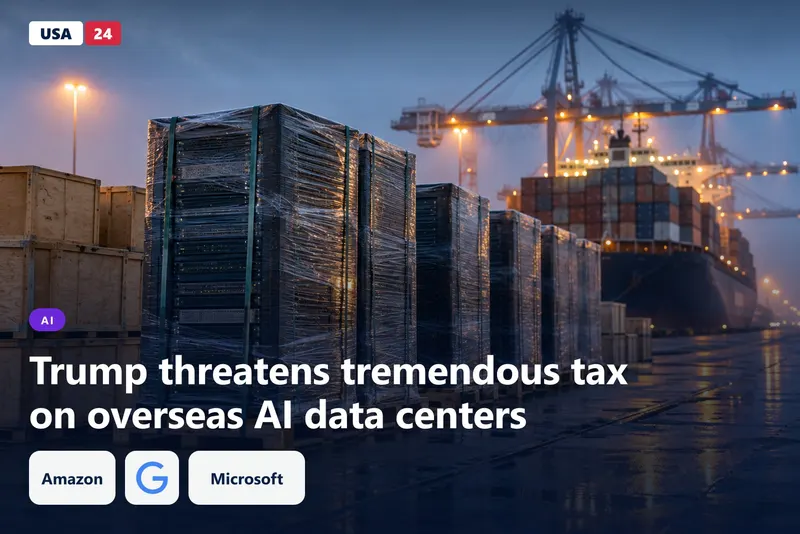
A Trump tax on AI data centers overseas is, for now, a threat without a rule behind it. On Friday, November 20, 2026, President Donald Trump told a White House press conference that US companies building AI data centers in other countries would face a “tremendous tax.” He gave no rate, no legal mechanism and no start date.
CNBC reported the remarks under a headline that reads like a ban, saying Trump vowed to stop U.S. companies from building data centers abroad. The spoken version was more hedged. In one line carried by Benzinga, Trump said: “They can, but we’re going to put a tremendous tax on them.”
The same press conference produced a second line that CNBC and Benzinga both reported: “We’re going to fight very hard for the data centers.” Read together, the two remarks suggest an administration that wants AI capacity built on US soil, but one that has not settled whether to forbid overseas projects or simply make them expensive.
IBTimes reported that the threat came after Trump’s trip to Asia and was framed as an argument about competition with China. Trump said that if US firms built the data centers abroad, China would take them.
Ban, tax or both? The wording problem
The gap between a ban and a tax changes everything for a company’s planning. A ban stops projects outright. A tax leaves room to build abroad and absorb the cost, which is what the “can” remark implies.
Several basic questions remain open:
- Scope: IBTimes reported it is unclear whether the tax would cover all new overseas facilities or only those serving China or advanced AI work.
- Legal basis: No executive order, bill or Treasury guidance backing the threat had surfaced in the reporting reviewed for this story.
- Rate and timing: Trump did not specify a tax rate or an effective date.
- Preparation: CNBC reported that the announcement apparently surprised Trump’s own staff, which makes follow-up clarifications more likely.
That last point carries weight. When a policy is announced from a podium before staff have drafted it, the first clarifications often narrow or widen the original remark in ways that matter to businesses.
Which companies and countries could feel it first
Benzinga framed the message as aimed at big technology firms, naming Amazon, Google and Microsoft. Those three operate the largest cloud platforms, so any new cost would hit their overseas expansion plans first. BigGo’s summary of the story said the threat injects new uncertainty into where companies spend on AI capacity.
The dollar stakes are large. AP reported that UBS economists project the largest high-tech firms could spend as much as $1.8 trillion next year on AI, mostly on data centers. Capital is still flowing, though not always at the pace companies want, as shown by OpenAI’s $11 billion raise at a $1.25 trillion valuation, which fell short of a $30 billion goal. Even a small tax on a slice of that spending would be a large number, but without a rate, no one can calculate the exposure.
Microsoft is a useful test case. Quartz noted that Microsoft has said it will no longer seek tax breaks in the places it builds. It is unclear how that commitment would interact with a tax on overseas builds, and the policy’s details will decide that.
Allies are in the path too. ABC News Australia reported that US tech giants recently committed billions of dollars to data centers in Australia. Unless the scope excludes allied markets, that spending would fall under the threat, and how Canberra and Australian operators respond is an open question.
Investors face the same fog. USA 24 has already reported on a Nasdaq correction that arrived as Nvidia sank, and BigGo’s summary argued that the overseas tax threat adds another source of uncertainty for anyone holding US tech stocks.
Why data centers became a midterm issue
AP reported that the threat came less than three weeks after voter concerns about data centers contributed to a Republican midterm loss. That timing explains why a local zoning fight has become a White House talking point.
Trump had already signaled a different tactic. In October he urged data-center companies to pay local communities a “dividend” to win support for new facilities, according to Quartz. A tax on overseas builds is a second lever, aimed at where capacity is located rather than at what host towns receive.
Opposition is the context that matters most. Quartz reported that a University of Pennsylvania Annenberg survey in August found 61% of Americans were somewhat or strongly opposed to new data centers where they live, up from 49% about four months earlier. A policy that keeps data centers in the United States does not answer the local complaints that made them a major midterm issue.
Americans in communities where new projects are proposed are affected indirectly. The administration frames the threat as keeping the AI buildout at home, but residents who object to a facility down the road will not see that objection disappear because it is built domestically.
Tariffs and chip rules add to existing cost pressure
Trump’s administration has pushed AI infrastructure build-out since his second term began. Fortune reported in March 2025 that tariffs on imported data-center equipment were raising costs, and that pressure has been known since then. The new threat lands on top of that cost base rather than replacing it.
Reuters-attributed reporting, as summarized by BigGo, says Washington has also been tightening rules on remote access to advanced US chips in the same period. Companies could therefore face costs and rules that touch hardware, access and physical location at once, which makes budgeting harder even before any tax takes effect.
What business owners and IT buyers should do now
No direct consumer action is required yet. Business owners and IT buyers with overseas cloud regions should take a few concrete steps before changing any plans:
- List every workload that depends on an overseas cloud region, along with the contract terms that govern it.
- Ask your cloud provider in writing how it would handle a new tax or tariff on overseas builds, and whether any cost would pass through to customers.
- Watch for formal text from the Commerce Department, the Treasury or the White House. A written rate, a defined scope and an effective date would each be worth acting on.
- Hold off on moving regional plans until that text exists, but document your current assumptions so you can compare them with whatever is published.
What to watch next
The next signals will show whether a threat becomes a policy. Watch for a written rate, a defined scope and a named mechanism, whether that is a tax code change, an executive order or agency guidance. A scope limited to China-linked or advanced-AI facilities would leave most allied projects untouched, while a broad scope would reach Australia and other markets where US firms have announced spending.
Watch also what Amazon, Google and Microsoft do with projects already on the books. Pauses, relabeled investments or shifts toward domestic sites would show that the threat is changing behavior, even without a formal rule. If no written text appears in the coming weeks, the most likely reading is that the tax is a bargaining chip, and the companies named in the warning will spend that time lobbying for the details that matter most to them.