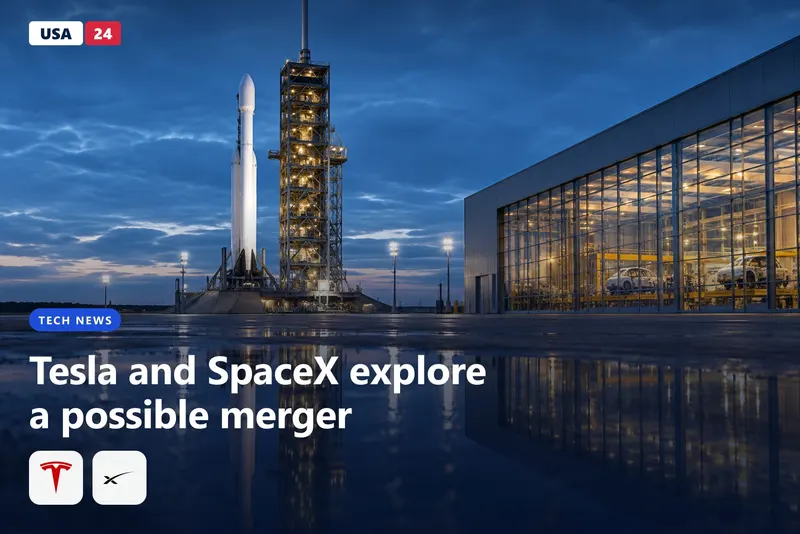
Elon Musk confirmed on SpaceX’s October 20 earnings call that Tesla and SpaceX have each formed a special committee of independent directors to explore a possible merger. The admission turned months of speculation into a formal, early-stage process. Neither company has disclosed deal terms, and Musk said the committees “have not reached agreement on the terms of any transaction.”
The speculation has a basis. Tesla and SpaceX have been collaborating on chips and AI projects, according to Axios, and that overlap is why a Tesla SpaceX merger has been floated for months. In January, Tesla announced it was investing about $2 billion to acquire shares in an AI startup that is a SpaceX subsidiary, per NBC News.
What Musk said about the committees
On the call, Musk said both boards formed their committees “at the request of shareholders,” according to Yahoo Finance. He said he is a conflicted party under securities rules, so he is not on either committee and is not part of the talks. He did not name the committee members.
His comments on the deal itself were hedged. “I think it would be a good idea, but it’s really up to the special committees of both companies,” he said, as Fox Business reported. He also said shareholders “have to be supportive of this,” per Business Standard.
Musk also made the case for a combination. He cited possible gains from cooperation in AI, chip design, robotics, orbital launch and connectivity, which are largely the areas where the two companies already work together. He attached heavy caveats, saying there is “no guarantee that they will” reach a deal. He also described the process as an “odd kabuki dance,” according to Yahoo Finance.
Who sits on the Tesla SpaceX merger committees and what is unknown
Special committees of independent directors are a standard way for a board to negotiate when a controlling executive sits on both sides of a potential deal. The structure matters here because Musk runs both companies. A summary of the public record puts his voting power at SpaceX at 82% to 85% after the IPO, according to Wikipedia. That concentration gives him heavy influence even though he has stepped out of the formal talks.
Several basics remain undisclosed. Committee members have not been named. No exchange ratio, valuation or timeline has been disclosed. None of the coverage reviewed for this story reports whether a deal would trigger US regulatory review or related-party litigation. Each gap will shape how quickly anything could move.
SpaceX’s first quarter as a public company
SpaceX shares reacted fast. CNN reported that the stock surged after Musk’s remarks, and shares rose about 8% in after-hours trading. The same evening, SpaceX posted its first quarterly results as a public company.
According to CNBC, third-quarter revenue reached $14.58 billion, up 161% from a year earlier, and net income reached $4.4 billion compared with a loss a year earlier. MarketBeat said revenue beat the roughly $12.72 billion analysts expected. The AI segment generated about $7.56 billion, and Starlink subscribers reached 13.6 million, per MarketBeat.
Per-share earnings are messier. MarketBeat put adjusted earnings at $0.35 a share against a $0.10 consensus, while CNBC reported 45 cents adjusted against 13 cents expected. The two outlets use different earnings bases, so treat those figures as unreconciled.
Guidance points to heavy spending. SpaceX guided first-quarter 2027 revenue to $33 billion to $37 billion and fourth-quarter capital expenditures to $35 billion to $40 billion, according to TradingView. Capex has already moved the stock once. The company’s first report in August showed $18.4 billion in capital expenditures, which spooked investors and sent shares lower, per CNBC.
The share price has swung widely. SpaceX closed at $147.79 on October 20 and opened at $160.55 on October 21, according to MarketBeat. Google Finance shows a $159.31 close on October 21, up 7.79%. The stock listed on Nasdaq on June 12, 2026, under the ticker SPCX at $135 per share, and its IPO closed June 15 with net proceeds of about $85.7 billion, according to Wikipedia. It fell to a low of $104.83 on August 3, before a lockup expiration, per CNBC. For another AI-linked listing, see Anthropic’s reported Q3 revenue before its IPO.
Tesla’s Q3 report shows a weaker car business
Tesla reported third-quarter revenue of $28.05 billion and adjusted earnings of 48 cents per share, both above LSEG consensus, according to CNBC. The headline beat sits on top of a softer core. Automotive revenue fell 3% to $20.56 billion, free cash flow dropped 62% to $1.53 billion, and energy revenue fell 16% to $2.88 billion.
Shares slid more than 3% in extended trading after the report, and Tesla is down 14% so far this year, CNBC noted. Tesla’s report landed a day after Musk’s comments, so investors are pricing the two companies together. A combination would fold a shrinking car business into one share count alongside a much faster-growing SpaceX.
Why the 50% vote threshold could decide a Tesla merger
Musk said a Tesla merger would need the support of 50% of all outstanding shares, not just a majority of votes cast, according to Yahoo Finance. That distinction changes the math. A majority of votes cast counts only the ballots that arrive, so low turnout can still produce a result. Under a threshold based on all outstanding shares, every share that goes unvoted works against the deal.
Tesla has a large retail shareholder base, and many retail holders skip proxy ballots. That makes turnout a potentially decisive factor. Musk also said Tesla holders would own less than half of any combined company, according to a summary of his remarks. Put those points together and a deal could turn on how many ordinary investors bother to return a ballot.
SpaceX holders face a different setup. Its share price already reflects merger speculation, according to CNN and Business Standard, which means investors who buy on rumors face a high-volatility setup.
The sector backdrop adds pressure. Technology investors are worried about growth as earnings season begins, and the sector had its biggest weekly drop since April 2025, per TradeStation. Analysts expect third-quarter profits for the Magnificent Seven to rise about 20.9% on 22.8% higher revenue, according to a Zacks earnings preview on Yahoo Finance. For context on the chip-stock pullback, see USA 24’s coverage of the selloff as Fed’s Goolsbee warned of AI overheating.
How to track a Tesla SpaceX merger without chasing rumors
The steps below are general information, not investment advice.
- Watch for formal filings. An 8-K, proxy materials or a definitive merger agreement will carry far more weight than a comment on a call or on social media.
- Check your brokerage account for Tesla or SpaceX positions, and read any corporate-action notices your broker sends.
- When a vote is scheduled, read the proxy materials closely. Abstentions and non-votes may count against approval, so the voting rules can matter as much as the result.
The next concrete signals will come from the committees. Watch for a filing that names committee members, sets out an exchange ratio or valuation, or gives a timeline. Tesla’s share reaction on October 22, which is not yet known, will show how investors weigh a combination against the company’s weaker car numbers.