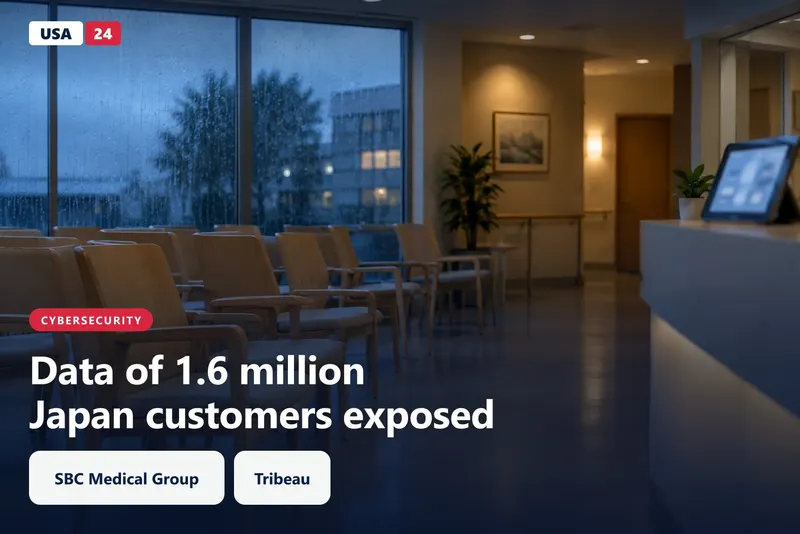
The SBC Medical Group data breach exposed personal information for about 1.6 million customers in Japan and roughly 20,000 employees, according to a Form 8-K the Nasdaq-listed company filed with the SEC on November 18. Most of the people affected live in Japan, and SBC has a limited US presence. The story reached American readers because the disclosure sits in a US securities filing from a company listed on Nasdaq under the ticker SBC.
SBC said it discovered two linked intrusions on November 16, 2026. The first involved databases in a website system run by its Japanese subsidiary. The second involved clinic administrator accounts on Tribeau, a third-party reservation platform used by 56 clinics, according to BleepingComputer.
The company’s filing states: “The Company confirmed that an unauthorized third party accessed and extracted customer information.” SBC has not explained how the attacker got in, and it says the full scope is still under investigation. It has isolated the affected server and blocked the unauthorized access, according to a StockTitan summary of the 8-K.
What the SBC Medical Group data breach exposed
The database incident is the larger of the two. SBC reported that basic personal information for 1,624,000 people was involved, and the data types vary from person to person. They include names, contact details, dates of birth, patient card numbers, member IDs, passwords and survey responses. The StockTitan summary says the affected records date from 2010 to 2023.
| Incident | People or records affected | Data types reported |
|---|---|---|
| Database in website system run by Japanese subsidiary | 1,624,000 people | Names, contact details, dates of birth, patient card numbers, member IDs, passwords, survey responses |
| Tribeau reservation platform, clinic administrator accounts | 56 clinics served; 12,641 people with reservation-only data; 6,804 treatment records; 3 message exchanges | Reservation details, treatment records and message exchanges, per the 8-K summary |
Employee data is a separate category. About 20,000 employee records were involved, and the records for 459 staff include bank information and tax or pension details, according to BleepingComputer and the StockTitan summary.
The medical record question needs care. SBC said electronic medical records were not accessed in the database intrusion, as SC World reported. The Tribeau incident is different: the 8-K summary lists 6,804 treatment records tied to it. The summaries do not say what those records contain, so the database statement should not be read as a blanket assurance about the reservation platform.
Why the affected count is 1.6 million or about 2 million
The headline number is not a settled count. SecurityWeek reported that the total runs past 2 million, citing 255,416 reservation-request records and 217,769 web-inquiry records on top of the 1.6 million figure. Adding those to 1.6 million gives about 2.1 million. That sum is my arithmetic, not a figure in the filings, and the sources do not say whether the groups overlap.
For now, the company's reported figure for the database incident is 1.6 million. Anything higher is an estimate until SBC files a fuller account. Readers should be cautious with headlines that present 2 million as an official total, because the gap matters for anyone trying to judge their own exposure. A person who booked through Tribeau may appear in the reservation count without appearing in the database count, and the reverse may also be true.
Medical records, passwords and ID numbers remain open
- Social Security and government ID numbers: Mallory says the data “potentially included” these identifiers. The company filing summaries and the main trade reports do not list them, so treat that claim as unconfirmed.
- Password storage: GBlock reports “unencrypted passwords.” The SEC summaries say only that passwords were affected. Whether passwords were stored in plain text is unconfirmed.
- Attribution: No threat group has claimed the intrusions in the sources reviewed, and the intrusion method remains unknown.
- Misuse: As of November 18, SBC said it had seen no evidence of misuse of the exposed data. Whether the investigation finds misuse is still open.
These gaps change the risk profile. Names, dates of birth and contact details are enough to support targeted phishing. Patient card numbers, member IDs and passwords could enable account takeover or fraud, which is why the practical advice below focuses on accounts and payments.
Japan regulators, lawyers and investor questions
SBC notified Japan’s Personal Information Protection Commission on November 16 and suspended advertising, Panabee reported. No regulatory penalty has been confirmed in the sources reviewed.
A class-action investigation firm has opened an inquiry into the breach, according to ClaimDepot. An inquiry is a step before any filing, and none of the sources reviewed confirm a filed lawsuit.
The company has not estimated the financial impact, per TipRanks. Investors should treat the 8-K as the primary source for SBC's own statements on scope and costs, and check secondary summaries against it.
The pattern is not unique to SBC. Earlier in 2026, Brown Health Medical Group's breach involved a legacy file server, according to an SQ Magazine report. Health-care breaches often trace back to older or third-party systems, though SBC has not said how its intrusions happened.
Company profile: a Nasdaq listing with mostly Japanese patients
SBC Medical Group Holdings is based in California and trades on Nasdaq under SBC. Its clinics are mainly in Japan, its US presence is limited, and it holds a minority stake in the medical spa chain OrangeTwist, according to SecurityWeek and BleepingComputer.
The company provides management services to medical corporations and clinics in aesthetic medicine, dermatology, dental and fertility care, among other fields. It runs operations and medical-tourism initiatives in the US and Asia, per TipRanks. Its clinics receive about 7 million patient visits a year, a flow that helps explain why the affected count is so large.
What to do if you used SBC clinics or Tribeau
The steps below are general guidance for anyone who booked through an SBC-affiliated clinic or Tribeau. They are not instructions from the company.
- Change any password you reused on a clinic portal, booking account or other site. Use a unique password for each service and turn on multifactor authentication where it is offered.
- Treat messages that mention appointments, treatment details or medical bills as suspicious until you verify them. Call the clinic using a number from its official website or your own records, not a number in the message.
- Do not send passwords, full card numbers or ID numbers in response to unsolicited calls, texts or emails.
- Review card statements for charges you do not recognize, and contact your card issuer if you find any.
- If you are a US patient who used an SBC-affiliated clinic abroad, ask the clinic whether your booking data was held on Tribeau.
What comes next for the SBC investigation
The next answers should come from SBC's own filings. Watch for an updated 8-K that explains the intrusion method, confirms whether Social Security numbers or medical records were involved, and reconciles 1.6 million with the higher figures in circulation. A threat group claim, a Japanese regulatory response or a filed lawsuit would each change the picture. For US readers, the case shows how a Nasdaq listing can place a breach of a mostly Japanese patient base into American securities disclosure, and that filing is where the scope first became public.