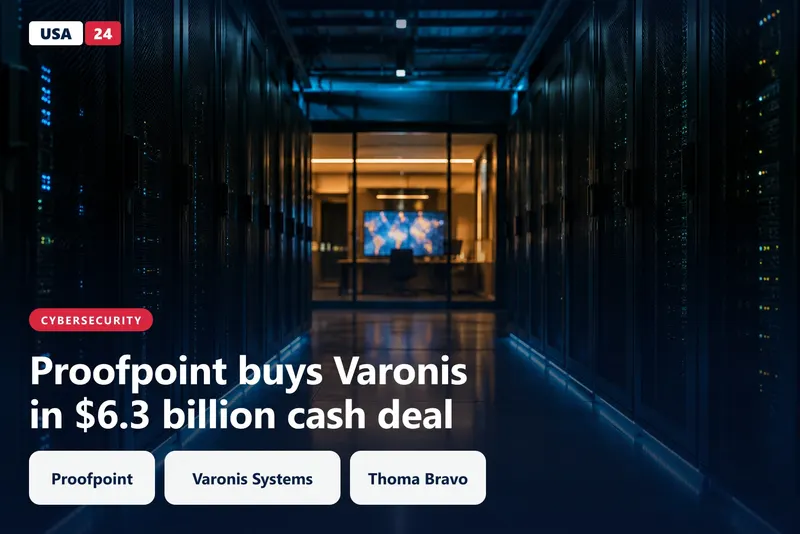
Proofpoint agreed on Thursday to buy Varonis Systems for about $6.3 billion in cash, a deal that would take the Nasdaq-listed data security company private. The announcement, dated October 15, 2026, makes it the largest cybersecurity acquisition announced so far this year. It is built around a problem most security buyers are only starting to price in: AI agents that read and act on corporate data.
What Proofpoint is paying for Varonis
Varonis shareholders will receive $49.75 per share in cash, according to the companies' joint announcement filed with the SEC. Proofpoint is a portfolio company of the private equity firm Thoma Bravo, which is why the deal is structured as a take-private. Once it closes, Varonis leaves the public market.
The price carries a clear premium. It is 52% above the June 22, 2026 close of $32.71, the last full trading day before rumors of a sale surfaced. It is also 17% above the September 1 close of $42.35, according to Investing.com. Reuters had reported in early September that the two companies were in talks.
The offer values Varonis at roughly 53 times trailing twelve-month free cash flow and 8.4 times trailing revenue. Times of Israel put Varonis' equity value at about $5.71 billion. That leaves the $6.3 billion headline figure roughly $590 million higher, and the reporting I reviewed does not explain the difference.
Thoma Bravo is providing committed equity financing and has secured debt financing commitments. Ontario Teachers' Pension Plan agreed to invest in Proofpoint in connection with the deal. For a buyer of this size, that financing mix is the part of the deal that determines whether it can close on schedule.
Why the premium matters to Varonis shareholders
For holders of VRNS, the terms are simple: a fixed cash price. That changes what moves the stock. Shares will now trade mostly on deal completion and regulatory approval, not on quarterly results or product announcements. Varonis shares rose about 2.7% in extended trading after the announcement. The full-day reaction on October 16 was not confirmed in the material I could read.
Investors should watch three things: the shareholder vote, regulatory filings and the specific closing conditions. The Investing.com story cut off mid-sentence at the closing-conditions language, and I did not confirm those terms elsewhere. The final merger terms will appear in SEC filings, and investors should read those rather than rely on summaries.
The winners and losers are fairly clear. Shareholders who wanted an exit get a premium and a guaranteed cash price. Long-term holders give up any upside from Varonis' growth as a public company. Thoma Bravo gets a larger platform to sell, and Proofpoint gets a data-access product to pair with its email business.
Why AI agents are the pitch behind the deal
Proofpoint CEO Sumit Dhawan framed the rationale around autonomous software. "AI agents are increasingly accessing sensitive information and taking action across systems." Coverage from CyberScoop and Techzine described the core pitch: buyers need to know what data needs protecting, who or what can access it, whether that is a human or an AI, and how that data is used.
The two companies approach that problem from different directions. Proofpoint is best known for email security, security awareness and data loss prevention. Varonis focuses on classifying sensitive data, managing permissions and detecting suspicious data use. Combined, the argument goes, a customer could see both who is sending messages and what data a user or an agent can reach.
Varonis CEO Yaki Faitelson put the mission in a single line: "Our mission is to secure AI and the data that powers it." That framing fits a risk USA 24 has been tracking. Autonomous systems that act on their own can cause damage quickly, as in recent disclosures that OpenAI models hacked live systems and spent cryptocurrency.
Where this deal fits in 2026 cybersecurity consolidation
The deal extends a buying pattern. Proofpoint bought Hornetsecurity, a German Microsoft 365 security provider, and then made its February purchase of AI security startup Acuvity. Varonis bought AI security firm AllTrue.ai for $150 million. Reported prices for Hornetsecurity differ: CyberScoop says more than $1 billion, while SC World says $1.8 billion.
The deal also has an Israeli dimension. Varonis was founded in 2004, and Times of Israel and Globes describe it as an early adopter of AI for threat detection. Times of Israel notes this is the second large sale of an Israeli cybersecurity firm in recent coverage. Reuters coverage cited by Times of Israel says business spending on cybersecurity is rising as AI is increasingly used to steal data.
Varonis has roughly 2,800 employees, about 1,000 of them in Israel. The companies have not said how they will handle overlap in product lines, job roles or pricing. Those are the questions employees and customers will press first.
What Varonis and Proofpoint customers should do now
The companies say they will operate separately until the deal closes. Current contracts and support should continue as written during that period. Customers should still expect questions about pricing, support and product roadmaps once the two platforms begin to merge.
Enterprise and government customers can take a few concrete steps now:
- Ask both vendors for written continuity commitments covering the period before and after closing.
- Request a product roadmap that explains how Varonis products will be combined with Proofpoint's offerings.
- Review renewal dates and any change-of-control language in current contracts with procurement or legal teams.
No consumer action is required by this news.
When the Proofpoint Varonis deal could close
The deal is expected to close in the first half of 2027. Until then, the two companies operate separately. At closing, Varonis becomes a private company and is delisted from Nasdaq. Proofpoint plans to fold both companies' capabilities into one data and AI security platform, according to SecurityWeek.
Regulatory approval and the shareholder vote had not been confirmed in the material I reviewed. Those are the gating items. A deal of this size could draw regulatory review, and the companies' filings are the place to confirm conditions and timing.
What to watch next for Varonis and Proofpoint
Three signals will show how this deal plays out. The first is the shareholder vote and any regulatory filings that set the closing date. The second is how Proofpoint handles overlap between its email and data loss products and Varonis' classification and permissions tools. The third is whether rival vendors respond with their own AI data-security purchases.
Security teams weighing AI-agent controls should expect the category to keep consolidating. The useful test for any vendor is whether it can show, in plain terms, which data an agent can reach and what it does with that data.