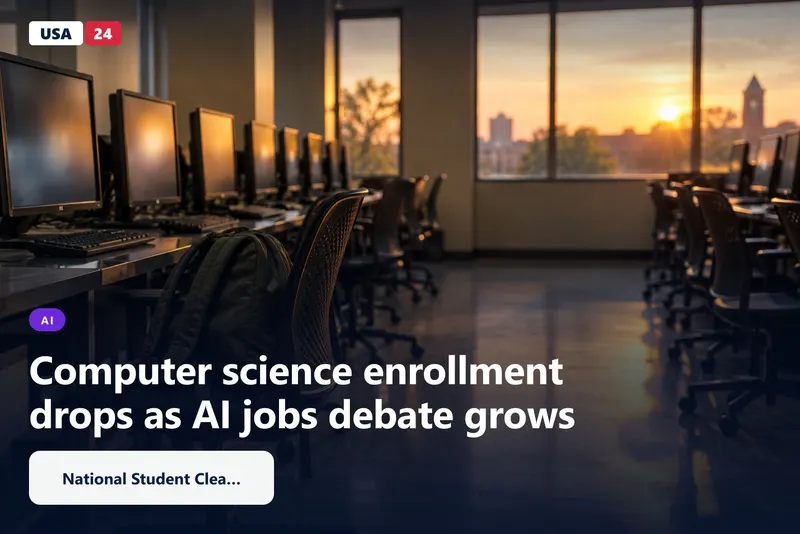
Computer science enrollment fell by double digits at every level of US higher education this fall. Preliminary data from the National Student Clearinghouse, released Thursday, show four-year undergraduate enrollment in computer and information science down 12.4% from a year earlier. Graduate enrollment fell 10.4%, and two-year colleges dropped 12.3%.
Bloomberg's headline on the story puts the cause plainly: Computer Science Programs Lose Students as AI Replaces Jobs. The enrollment counts alone cannot prove that. They do show a field shrinking quickly while the rest of technical education holds up better, and that gap is the detail most worth reading closely.
How big the computer science enrollment drop is at each level
The table below sets the Clearinghouse's preliminary fall 2026 figures against the one comparison in the release that is growing.
| Program level | Change from a year earlier |
|---|---|
| Four-year undergraduate, computer and information science | -12.4% |
| Two-year colleges | -12.3% |
| Graduate programs | -10.4% |
| Four-year engineering | +6.1% |
The losses build on a smaller decline last year. A Cornford and Cross analysis puts four-year undergraduate computer science enrollment at about 499,000 in fall 2020 and about 660,000 in fall 2024, then roughly 606,000 in fall 2025 after an 8.1% drop. Over two years, undergraduate programs have lost 18.4% of their students and graduate programs have lost 27.1%, according to The Star.
Two-year losses at both the undergraduate and graduate levels look more like a sustained shift in demand than a weak incoming class. A single bad year can come from one cohort. Two years of declines is harder to explain away.
Why engineering growth matters more than the headline number
The release's most useful detail may be what did not fall. At four-year colleges, engineering enrollment rose 6.1% from fall 2025, according to 1023 Jack's report on the data. That gap suggests students have not turned away from technical study as a whole. The movement appears to be within technical study rather than out of it.
The decline is also not a one-off. The Next Web reported in July that undergraduate computer science enrollment at four-year colleges fell 8.1% in autumn 2025, which it described as the first drop in roughly two decades. Fortune reported an 8.4% decline in spring 2026 for undergraduate computer and information sciences at four-year institutions. The two reports use different measures and periods, but both point the same direction.
Is AI really the reason students are leaving
The AI argument rests on labor-market reasoning, not on enrollment data. The Star reports that AI's rise has made it harder for computer science graduates to find jobs as companies cut many entry-level coding roles. That explanation is plausible. The Star also cites an August Bureau of Labor Statistics report that found computer and mathematics jobs would feel the most impact from AI, which gives the argument a federal data point, though not a direct link to enrollment.
Enrollment counts cannot show motive. Cornford and Cross note that the data does not explain why students enter, leave or avoid computer science, and it cannot show that AI caused the decline. The Next Web described one economist's view that the pattern is a warning sign rather than proof that AI is behind it.
Matthew Holsapple, the Clearinghouse's senior director of research, described the declines in remarks The Star reported. "Those are just remarkable declines," he said. The quote conveys the scale of the drop, but it stops short of naming a cause.
Other forces appear in the reporting too. The Next Web cites analysts who point to weaker math preparation, immigration-linked demographic shifts and the rise of data science. Any of these could pull students away from computer science, and the preliminary numbers cannot rank them. Pinning the decline on AI alone runs ahead of the evidence, while dismissing AI entirely ignores the labor data.
What the preliminary numbers can and cannot tell you
These are preliminary figures. According to Higher Ed Dive, via Yahoo News, the sample draws on responses from 46% of institutions that report to the Clearinghouse and includes 7.9 million student enrollments. Final fall 2026 data is expected in January 2027.
Several figures in the coverage do not line up:
- Total enrollment: Higher Ed Dive reports undergraduate enrollment up 0.6%, The Star reports a 1.2% gain, and 1023 Jack reports total college enrollment up 0.2% in early data. The measures may differ, but the coverage does not reconcile them.
- Fall 2025 decline: Fortune put the drop at 3.6%, while The Next Web and Cornford and Cross used 8.1%.
- Source base: the Clearinghouse's enrollment insights page covers only fall 2026 preliminary data, so the fall 2025 comparisons rely on secondary reporting.
What the drop means for colleges, students and employers
For students and parents, the signal is a shrinking computer science pipeline at every level, set against growth in engineering. Anyone choosing a major has reason to wait for the January numbers before drawing firm conclusions from a preliminary sample.
Colleges face budget and staffing questions. Enrollment drives program budgets and faculty decisions, so a second straight year of losses can force hard choices about hiring and course offerings. Some schools are responding by teaching AI outside their computer science departments. Fortune cites Colby College, a small liberal arts university in Waterville, Maine, as one example.
For employers, a smaller pipeline of new computer science graduates could matter for software hiring down the road. The data does not show that yet.
Practical steps for students and early-career workers
- Wait for the final Clearinghouse release in January 2027 before treating preliminary numbers as settled.
- If you are weighing a computer science degree, ask programs for recent graduates' job placement and internship data, and compare those results with engineering and data science programs.
- If you are an early-career tech worker, track entry-level job postings in your field alongside enrollment figures, so you can see whether hiring follows the same downward path.
What to watch before the January 2027 data
Three things will show whether this is a sharp dip or a lasting shift. The first is whether final numbers hold near the preliminary declines, since the early sample covers less than half of reporting institutions. The second is whether the engineering gap persists. The third is entry-level hiring. If software job postings rebound, the AI explanation weakens. If they keep shrinking, it becomes harder to dismiss.
AI job anxiety is also spilling into campaigns. USA 24 has reported on how voter backlash has put AI regulation at the center of the midterms, and enrollment figures like these are likely to give candidates fresh material. Expect the debate over AI and first jobs to move from college advising offices into election season.